Latest Stories
Most recently published stories in Futurism.
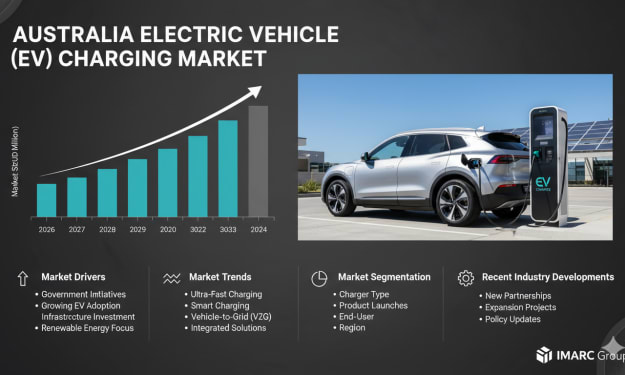
Australia Electric Vehicle (EV) Charging Market: Fast-Charging Infrastructure Expansion, Smart Charging Technologies & Public-Private Investments. AI-Generated.
According to IMARC Group, the Australia electric vehicle (EV) charging market reached a value of USD 304.4 Million in 2025 and is projected to reach USD 1,692.2 Million by 2034, growing at a compound annual growth rate (CAGR) of 21.00% during 2026–2034. The market is expanding rapidly as Australia accelerates the adoption of electric mobility and transitions toward a low-carbon transportation ecosystem. Electric vehicle charging infrastructure plays a critical role in supporting EV adoption by ensuring convenient and reliable access to charging services across cities, highways and regional areas. Governments and private sector stakeholders are investing heavily in public charging networks, fast-charging corridors and residential charging solutions. Technological advancements such as smart charging platforms, vehicle-to-grid (V2G) systems and integrated energy management solutions are also transforming the EV charging ecosystem. As electric vehicle ownership continues increasing and policy support strengthens nationwide charging infrastructure development, Australia’s EV charging market is becoming a cornerstone of the country’s sustainable mobility strategy.
By Kevin Cooper10 minutes ago in Futurism
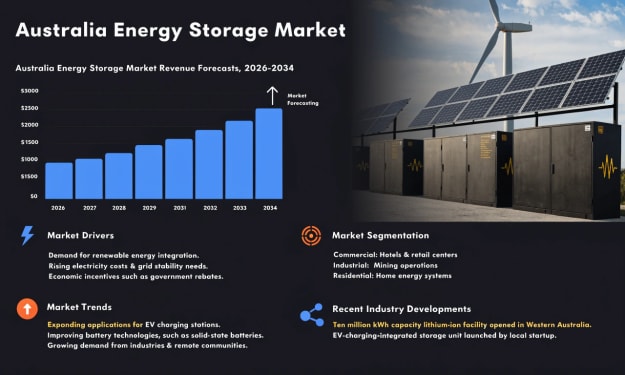
Australia Energy Storage Market: Utility-Scale Battery Deployment, Renewable Energy Integration & Grid Stability Solutions. AI-Generated.
According to IMARC Group, the Australia energy storage market reached a capacity of 4.72 GW in 2025 and is projected to reach 19.81 GW by 2034, growing at a compound annual growth rate (CAGR) of 17.28% during 2026–2034. The market is expanding rapidly as Australia accelerates its transition toward renewable energy and modern electricity infrastructure. Energy storage systems play a critical role in balancing power supply and demand by storing excess electricity generated from renewable sources such as solar and wind. These systems release stored energy during periods of high demand or low renewable generation, helping maintain grid stability. Increasing investments in utility-scale battery projects, advancements in battery technologies and growing government support for clean energy initiatives are driving the development of large-scale energy storage infrastructure. As renewable energy penetration increases across Australia, energy storage solutions are becoming essential components of a resilient and flexible electricity grid.
By Kevin Cooper21 minutes ago in Futurism
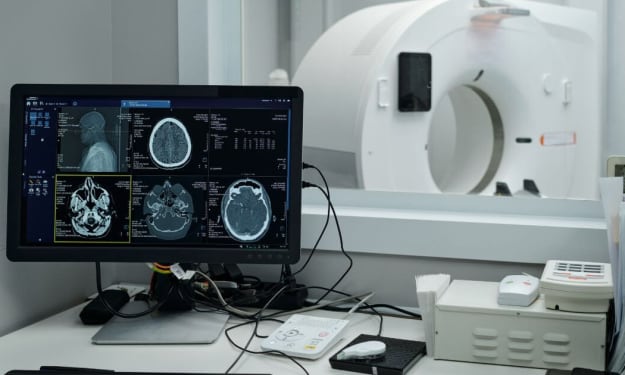
Computed Tomography Market Outlook: Advanced Diagnostic Imaging and Healthcare Expansion Opportunities. AI-Generated.
According to IMARC Group's latest research publication, The global computed tomography market size was valued at USD 4.93 Billion in 2024. The market is projected to reach USD 7.83 Billion by 2033, exhibiting a CAGR of 5.01% from 2025-2033.
By James Whitmanabout an hour ago in Futurism
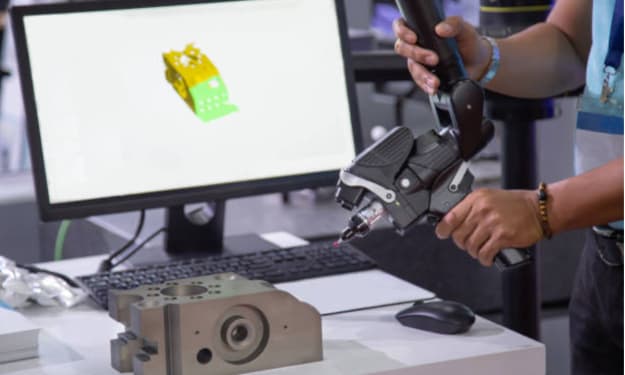
3D Metrology Market Outlook: Precision Measurement Technologies and Industrial Automation Growth Opportunities. AI-Generated.
According to IMARC Group's latest research publication, The global 3D metrology market size reached USD 11.0 Billion in 2024. Looking forward, IMARC Group expects the market to reach USD 21.1 Billion by 2033, exhibiting a growth rate (CAGR) of 7.5% during 2025-2033.
By James Whitmanabout 2 hours ago in Futurism
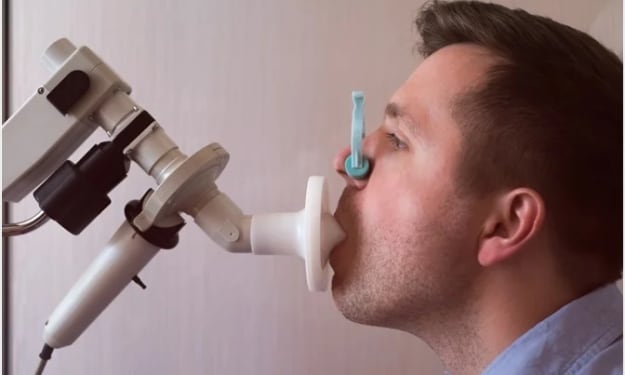
Spirometer Market Outlook: Respiratory Diagnostics Demand and Healthcare Innovation Opportunities. AI-Generated.
According to IMARC Group's latest research publication, The global spirometer market size reached USD 1,227.0 Million in 2024. Looking forward, IMARC Group expects the market to reach USD 2,468.2 Million by 2033, exhibiting a growth rate (CAGR) of 7.67% during 2025-2033.
By James Whitmanabout 2 hours ago in Futurism
Vacuum Gas Oil Market Outlook: Refinery Processing Demand and Petrochemical Feedstock Growth Opportunities. AI-Generated.
According to IMARC Group's latest research publication, The global vacuum gas oil market size reached USD 454.2 Billion in 2024. Looking forward, IMARC Group expects the market to reach USD 695.9 Billion by 2033, exhibiting a growth rate (CAGR) of 4.36% during 2025-2033.
By James Whitmanabout 2 hours ago in Futurism
Unanimous vote in key risk assessment has moon mission crew barreling toward a new launch date". AI-Generated.
A unanimous vote in a key safety and risk assessment review has moved the crew of NASA’s next lunar mission one step closer to a new launch date, signaling growing confidence within the agency that the ambitious program is ready to proceed.
By Fiaz Ahmed about 2 hours ago in Futurism
Artemis II: Nasa targets early April for Moon mission. AI-Generated.
The mission represents a crucial milestone in NASA’s broader Artemis program, which aims to return humans to the lunar surface and establish a long-term presence on the Moon. If successful, Artemis II will pave the way for future missions that could eventually support lunar bases and deeper exploration into the solar system. Artemis II will be the first crewed flight of the powerful Orion spacecraft launched aboard the massive Space Launch System rocket. The spacecraft will carry four astronauts on a journey that will take them thousands of kilometers beyond the Moon before returning safely to Earth. The mission follows the success of Artemis I, which flew in late 2022 and successfully tested the Orion spacecraft in deep space without astronauts on board. That mission orbited the Moon and returned valuable data about the spacecraft’s performance, heat shield durability, and onboard systems. According to NASA officials, Artemis II will take astronauts on a roughly 10-day journey. During the mission, the Orion spacecraft will perform a flyby of the Moon, traveling farther from Earth than any human mission has gone before. The astronauts will also test key navigation systems, life-support technology, and communication equipment needed for long-duration space travel. The crew selected for the historic mission includes commander Reid Wiseman, pilot Victor Glover, mission specialist Christina Koch, and Canadian astronaut Jeremy Hansen. Together, they will represent a new era of international cooperation in space exploration. Christina Koch’s participation is particularly significant, as she will become the first woman to travel to the Moon. Meanwhile, Jeremy Hansen will be the first Canadian astronaut to take part in a lunar mission, highlighting the role of international partnerships in NASA’s long-term exploration strategy. The Artemis program itself is part of a broader effort to establish sustainable human exploration beyond Earth. Unlike the earlier Apollo missions, which focused on short lunar visits, the Artemis program aims to build infrastructure that will support repeated missions and long-term scientific research. Future plans include the construction of the Lunar Gateway, a small space station that will orbit the Moon and serve as a staging point for missions to the lunar surface. From there, astronauts could travel down to the Moon using specialized landers designed for repeated use. NASA officials say the Artemis program will also help prepare astronauts for future missions to Mars. By testing deep-space systems near the Moon, engineers and scientists can learn valuable lessons about life-support systems, radiation protection, and long-duration spaceflight. Despite the excitement surrounding Artemis II, the mission has faced multiple delays as engineers worked to ensure the safety of both the spacecraft and the launch system. Issues related to hardware testing, battery components, and environmental control systems required additional time for inspection and redesign. NASA administrators have emphasized that safety remains the agency’s top priority. Crewed missions beyond low Earth orbit carry significant risks, and officials have insisted that all systems must be thoroughly tested before astronauts are launched into deep space. The early April target represents a tentative launch window rather than a fixed date. Weather conditions, final technical checks, and launch readiness reviews will ultimately determine the exact day when the rocket lifts off from Kennedy Space Center. If the mission proceeds as planned, Artemis II will become the first crewed lunar flyby mission since Apollo 17 in 1972. That historic mission marked the end of the Apollo era, after which human exploration of the Moon paused for decades. Now, with Artemis II approaching launch, NASA is preparing to usher in a new chapter of lunar exploration. The mission is expected to capture global attention as astronauts once again venture into deep space, retracing a path last traveled by the Apollo generation. For space enthusiasts, scientists, and engineers around the world, the upcoming mission represents more than just a technological achievement. It symbolizes humanity’s renewed determination to explore beyond Earth and expand our understanding of the universe. If Artemis II succeeds, it will not only demonstrate the readiness of NASA’s next-generation spacecraft but also bring humanity one step closer to returning astronauts to the lunar surface for the first time in the 21st century.
By Fiaz Ahmed about 4 hours ago in Futurism
Stanford Just Killed Prompt Engineering With 8 Words (And I Can’t Believe It Worked)
Artificial intelligence tools like ChatGPT, Claude, and Gemini have made one thing clear: the way you ask a question often matters more than the question itself. Over the last few years, an entire skill set called prompt engineering has emerged. People spend hours learning how to write detailed prompts in order to get better answers from AI. But what if most of that effort isn’t actually necessary? Researchers studying large language models discovered something surprisingly simple. Instead of writing long and complicated prompts, adding a short instruction of just eight words can dramatically improve the quality of AI responses. Those eight words are simple: “Think step by step and explain your reasoning.” At first, this sounds almost too basic to be powerful. But in practice, this small instruction can completely change how an AI system approaches a question.
By Shahid Zamanabout 9 hours ago in Futurism