
Artemis II: Nasa targets early April for Moon mission
NASA sets early April launch window for historic Artemis II mission carrying astronauts around the Moon

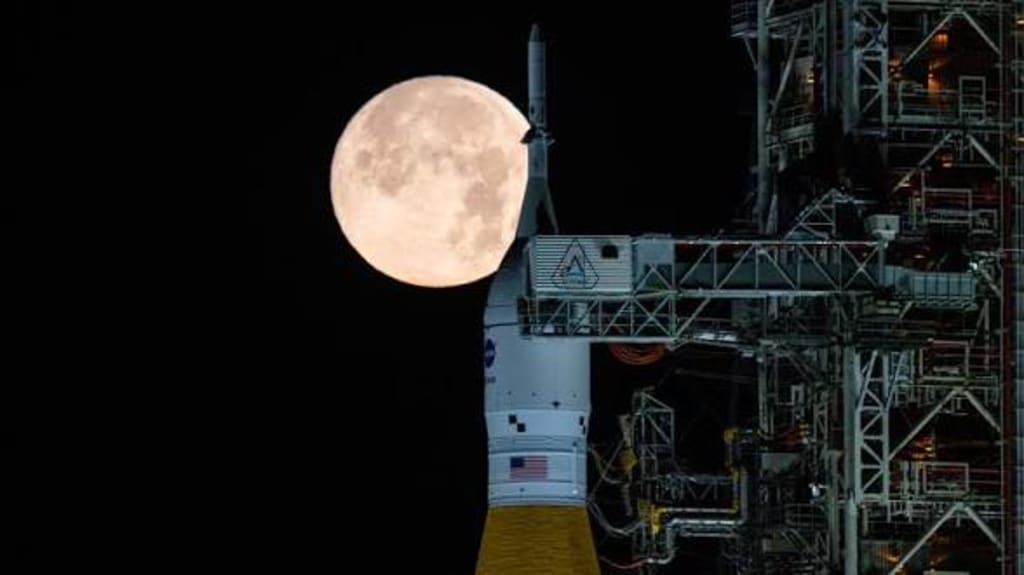
The mission represents a crucial milestone in NASA’s broader Artemis program, which aims to return humans to the lunar surface and establish a long-term presence on the Moon. If successful, Artemis II will pave the way for future missions that could eventually support lunar bases and deeper exploration into the solar system.
Artemis II will be the first crewed flight of the powerful Orion spacecraft launched aboard the massive Space Launch System rocket. The spacecraft will carry four astronauts on a journey that will take them thousands of kilometers beyond the Moon before returning safely to Earth.
The mission follows the success of Artemis I, which flew in late 2022 and successfully tested the Orion spacecraft in deep space without astronauts on board. That mission orbited the Moon and returned valuable data about the spacecraft’s performance, heat shield durability, and onboard systems.
According to NASA officials, Artemis II will take astronauts on a roughly 10-day journey. During the mission, the Orion spacecraft will perform a flyby of the Moon, traveling farther from Earth than any human mission has gone before. The astronauts will also test key navigation systems, life-support technology, and communication equipment needed for long-duration space travel.
The crew selected for the historic mission includes commander Reid Wiseman, pilot Victor Glover, mission specialist Christina Koch, and Canadian astronaut Jeremy Hansen. Together, they will represent a new era of international cooperation in space exploration.
Christina Koch’s participation is particularly significant, as she will become the first woman to travel to the Moon. Meanwhile, Jeremy Hansen will be the first Canadian astronaut to take part in a lunar mission, highlighting the role of international partnerships in NASA’s long-term exploration strategy.
The Artemis program itself is part of a broader effort to establish sustainable human exploration beyond Earth. Unlike the earlier Apollo missions, which focused on short lunar visits, the Artemis program aims to build infrastructure that will support repeated missions and long-term scientific research.
Future plans include the construction of the Lunar Gateway, a small space station that will orbit the Moon and serve as a staging point for missions to the lunar surface. From there, astronauts could travel down to the Moon using specialized landers designed for repeated use.
NASA officials say the Artemis program will also help prepare astronauts for future missions to Mars. By testing deep-space systems near the Moon, engineers and scientists can learn valuable lessons about life-support systems, radiation protection, and long-duration spaceflight.
Despite the excitement surrounding Artemis II, the mission has faced multiple delays as engineers worked to ensure the safety of both the spacecraft and the launch system. Issues related to hardware testing, battery components, and environmental control systems required additional time for inspection and redesign.
NASA administrators have emphasized that safety remains the agency’s top priority. Crewed missions beyond low Earth orbit carry significant risks, and officials have insisted that all systems must be thoroughly tested before astronauts are launched into deep space.
The early April target represents a tentative launch window rather than a fixed date. Weather conditions, final technical checks, and launch readiness reviews will ultimately determine the exact day when the rocket lifts off from Kennedy Space Center.
If the mission proceeds as planned, Artemis II will become the first crewed lunar flyby mission since Apollo 17 in 1972. That historic mission marked the end of the Apollo era, after which human exploration of the Moon paused for decades.
Now, with Artemis II approaching launch, NASA is preparing to usher in a new chapter of lunar exploration. The mission is expected to capture global attention as astronauts once again venture into deep space, retracing a path last traveled by the Apollo generation.
For space enthusiasts, scientists, and engineers around the world, the upcoming mission represents more than just a technological achievement. It symbolizes humanity’s renewed determination to explore beyond Earth and expand our understanding of the universe.
If Artemis II succeeds, it will not only demonstrate the readiness of NASA’s next-generation spacecraft but also bring humanity one step closer to returning astronauts to the lunar surface for the first time in the 21st century.
About the Creator
Fiaz Ahmed
I am Fiaz Ahmed. I am a passionate writer. I love covering trending topics and breaking news. With a sharp eye for what’s happening around the world, and crafts timely and engaging stories that keep readers informed and updated.
Keep reading
More stories from Fiaz Ahmed and writers in Futurism and other communities.
Air France Evacuation Flight Turns Back Because of Missile Fire
A planned evacuation flight operated by Air France was forced to abruptly turn back mid-route after missile activity was detected near its intended flight corridor, highlighting the growing dangers civilian aircraft face in conflict zones. The incident occurred late Tuesday evening as the aircraft, carrying evacuees and humanitarian personnel, attempted to depart a volatile region amid escalating military exchanges. According to aviation officials familiar with the situation, the aircraft had been chartered to transport civilians and diplomatic staff seeking to leave an area experiencing intensified hostilities. The flight had taken off successfully and climbed to cruising altitude when air traffic control and security monitoring systems detected missile launches within range of the aircraft’s projected flight path. Within minutes, pilots received instructions to alter course and return to the departure airport. Air France confirmed the diversion in a brief statement, emphasizing that the decision was made purely as a precaution to ensure passenger safety. “Our crew followed established international safety procedures after receiving security alerts regarding missile activity in the vicinity,” the airline said. “The aircraft returned safely without incident.” While the airline did not publicly identify the exact location of the event, aviation monitoring groups said the flight was operating in an area where military forces have recently exchanged long-range strikes. Civil aviation authorities frequently issue warnings when missile launches or air defense systems pose potential risks to passenger aircraft. Passengers aboard the flight described a tense but orderly situation. Shortly after the aircraft turned around, the captain reportedly addressed passengers over the intercom, explaining that security conditions along the route had deteriorated. Some travelers initially feared a technical issue but were reassured when the aircraft began descending back toward the airport. “We didn’t know exactly what was happening at first,” said one passenger who asked not to be identified. “The crew stayed calm and professional. Later they explained that missile launches had been detected and that it was safer to return.” Aviation safety experts say such diversions, while rare, have become more common as geopolitical conflicts increasingly intersect with international flight routes. Modern commercial aircraft rely on multiple sources of threat intelligence, including military radar feeds, satellite monitoring, and alerts from international aviation organizations. After the catastrophic downing of Malaysia Airlines Flight 17 in 2014, global aviation regulators strengthened procedures for monitoring conflict zones. Airlines now routinely adjust routes to avoid regions where missile systems could threaten high-altitude aircraft. “Airlines are extremely cautious today,” said a European aviation security analyst. “If there is even a small possibility that missile systems are active near a flight path, the safest option is to divert or cancel the flight.” The aborted evacuation mission underscores the growing challenges faced by governments trying to move civilians out of unstable regions. Evacuation flights often operate under tight time windows, relying on coordination between airlines, diplomatic services, and military authorities. Officials said discussions were underway to determine whether another evacuation attempt could be organized once conditions stabilize. In many such operations, governments work with commercial carriers like Air France because they have the logistical capacity and experienced crews needed to conduct large-scale passenger transport under difficult circumstances. Air France crews are trained for crisis operations, including sudden rerouting and emergency returns. In this case, airline officials praised the cockpit team for reacting quickly to the threat warning and maintaining clear communication with both passengers and air traffic control. Despite the tension surrounding the incident, all passengers and crew landed safely, and no injuries were reported. The aircraft returned to the airport approximately two hours after departure, where passengers were taken to a secure terminal area while authorities assessed the situation. Security analysts warn that the incident illustrates a broader trend: civilian aviation is increasingly affected by geopolitical conflict. As missile technology spreads and military confrontations become more unpredictable, airlines must constantly reassess flight paths and safety procedures. For now, the aborted evacuation flight stands as another reminder that even high-altitude commercial aircraft are not immune to the dangers created by modern warfare. Aviation officials say vigilance, intelligence sharing, and rapid decision-making remain the most effective tools to keep passengers safe when global tensions intrude into the skies.
By Fiaz Ahmed 7 days ago in Futurism
Silicon Supremacy: Why the iPhone 18 Pro is the Architectural Shift We’ve Been Waiting For
1. Introduction: The Evolution of Pro Every year, the tech zeitgeist asks the same recurring question: "Is this the year to upgrade, or should I hold out for the next leap?" While the silhouettes of the iPhone 18 Pro and Pro Max—slated for their traditional September debut—may feel familiar, our intelligence regarding Apple’s silicon and hardware roadmap suggests we are standing on the precipice of a massive architectural shift. This isn't just another "S" year; it is a calculated pivot where internal engineering triumphs over external gimmicks, signaling a new era of professional-grade mobile computing.
By Tech Horizons2 days ago in Futurism
Facility Management Market to Hit USD 1,903.7 Billion by 2033
Facility Management Market Overview The global Facility Management Market is projected to reach approximately USD 1,903.7 Billion by 2033, increasing from USD 849.0 Billion in 2023, reflecting a CAGR of 8.41% during the forecast period from 2024 to 2033. Facility management refers to the integrated management of physical assets, infrastructure, and support services within buildings and workplaces. These services include maintenance, security, cleaning, energy management, space planning, and workplace services that help organizations maintain efficient operations. The industry has expanded steadily as businesses seek structured methods to maintain assets, improve employee productivity, and optimize operational costs.
By Roberto Crum7 days ago in Futurism
Top tipple tricks
Been thinking a lot about drinking, lately. Not least because of a recent episode of over-indulgence and the inevitable after effects. Some readers may recall the earlier articles I wrote about beating the booze. Here I set out an experiment in techniques for cutting down on my alcohol intake. The experiment was successful, the techniques worked, and I have armed myself with an arsenal of weapons in the war against the demon drink. I have yet to fire the first round however. It's all a question of timing (perhaps procrastination).
By Raymond G. Taylor4 days ago in Psyche




Comments
There are no comments for this story
Be the first to respond and start the conversation.