
Online Education Market Forecast 2026–2034: Digital Learning Set to Surpass US$ 1 Trillion by 2034
Rapid internet expansion, mobile learning adoption, and AI-powered platforms are transforming the global education ecosystem

Introduction
The global education landscape is undergoing a profound transformation as digital technology reshapes how people learn, teach, and acquire new skills. The rise of online education has opened unprecedented opportunities for students, professionals, and organizations seeking flexible, accessible, and cost-effective learning solutions.
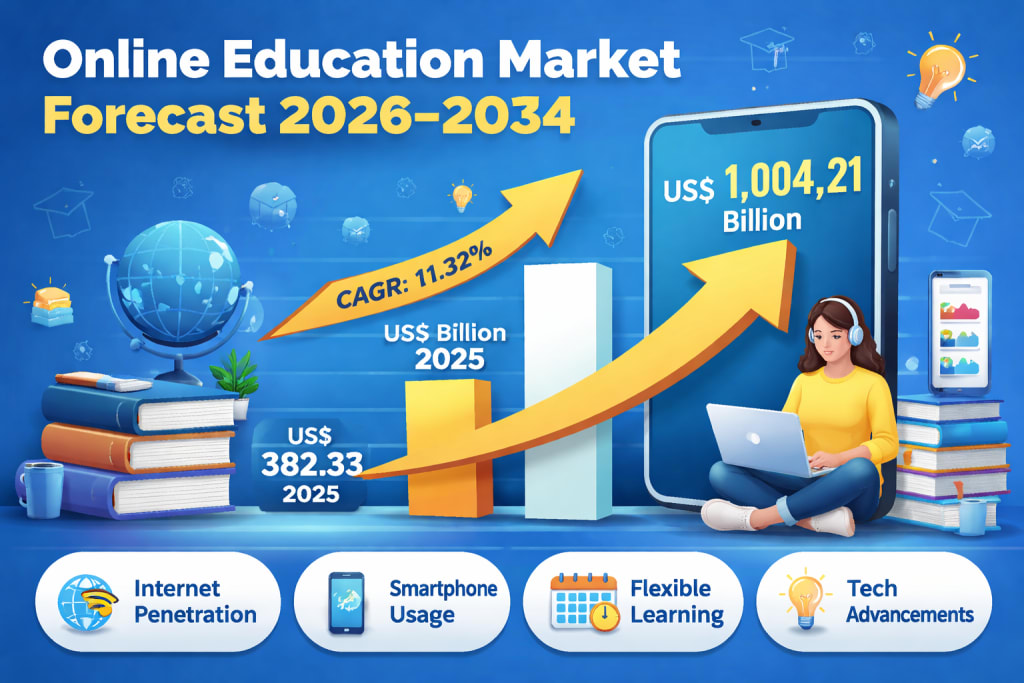
According to Renub Research, the Online Education Market is projected to grow from US$ 382.53 Billion in 2025 to approximately US$ 1,004.21 Billion by 2034, expanding at a compound annual growth rate (CAGR) of 11.32% during 2026–2034. The rapid expansion of internet connectivity, growing smartphone usage, and rising demand for flexible learning are key factors driving this growth.
Online education has become a central component of modern learning systems worldwide. It enables students to access lectures, assignments, and training modules from anywhere in the world using digital devices such as smartphones, tablets, and computers. As technology continues to evolve, the adoption of online learning platforms is accelerating across academic institutions, corporate organizations, and government training programs.
Online Education Market Overview
Online education refers to learning conducted through digital platforms over the internet. It includes virtual classes, recorded lectures, digital learning modules, certification courses, and online examinations that allow learners to study remotely without attending physical classrooms.
This form of education offers significant advantages compared to traditional learning models. Learners benefit from flexibility, affordability, and the ability to study at their own pace. In addition, online education platforms often provide access to a wide variety of courses across disciplines such as technology, business, healthcare, finance, and digital marketing.
The popularity of online education has surged dramatically in recent years due to technological advancements and increasing digital adoption. During global disruptions that limited access to physical classrooms, many educational institutions adopted online learning models to ensure continuity in education.
Today, online education is widely used not only by students but also by working professionals seeking to enhance their skills. Organizations are increasingly leveraging digital learning platforms to train employees and improve workforce productivity. As a result, online education has evolved into a critical pillar of the global education ecosystem.
Key Growth Drivers of the Online Education Market
Increasing Internet Penetration and Smartphone Usage
One of the most significant factors fueling the growth of the online education market is the rapid expansion of internet connectivity worldwide.
By 2025, approximately 74% of the global population—around 6 billion people—have access to the internet, compared with 71% in 2024. This widespread connectivity has enabled millions of learners to participate in online education programs from virtually any location.
The proliferation of smartphones has also played a crucial role in expanding digital learning. Currently, there are approximately 7.4 billion smartphones in use globally, accounting for around 87% of mobile phone connections worldwide. Smartphones have made learning more accessible by enabling students to watch lectures, complete assignments, and participate in interactive classes through mobile apps.
Additionally, the rollout of 4G and 5G networks has significantly improved internet speeds and video streaming quality, allowing students to engage in real-time virtual classrooms and interactive learning sessions. Governments and telecom companies are also investing heavily in digital infrastructure to expand internet accessibility, further supporting the growth of online education.
Rising Demand for Flexible and Skill-Based Learning
Modern learners increasingly prioritize flexibility and practical skill development when choosing educational programs. Online education platforms offer a convenient solution for individuals who want to balance education with work or personal commitments.
Students and professionals can access courses anytime and learn at their own pace, making online education particularly attractive for working individuals seeking career advancement. Many learners enroll in online programs to gain new technical and professional skills that help them stay competitive in evolving job markets.
Industries such as information technology, healthcare, finance, and digital marketing are experiencing rapid innovation, creating a strong demand for skilled professionals. Online education platforms provide specialized training programs that help individuals develop these in-demand competencies.
Organizations are also investing heavily in digital training programs to upskill their workforce. In February 2026, Echo360, a leader in AI-powered education technology, announced a partnership with Exxat, a provider of experiential education technology. The collaboration aims to strengthen skills-based education and better prepare students for workforce demands.
Such partnerships highlight the growing role of online education in bridging the gap between academic learning and professional skills.
Technological Advancements in E-Learning Platforms
Technological innovation is revolutionizing the online learning experience and making digital education more interactive and effective.
Modern e-learning platforms incorporate advanced technologies such as artificial intelligence (AI), virtual reality (VR), cloud computing, and gamification to enhance the learning process.
AI-driven systems can analyze students’ learning patterns and provide personalized recommendations, enabling adaptive learning experiences tailored to individual needs. Virtual reality technology is also enabling immersive educational experiences, particularly in fields such as medicine, engineering, and science.
Video conferencing tools allow real-time interaction between students and instructors, replicating traditional classroom environments in digital spaces. Cloud-based learning platforms ensure secure storage and easy access to learning materials, allowing students to access content anytime.
Gamification techniques—such as quizzes, rewards, and interactive challenges—are also being used to increase engagement and motivation among learners.
For example, in March 2025, the European Labour Authority (ELA) launched a new e-learning platform designed to help users understand European Union legislation related to labor mobility and social security coordination. The platform demonstrates how digital technologies are being used to deliver specialized training and educational resources.
These technological advancements are making online education more engaging, interactive, and effective than ever before.
Challenges in the Online Education Market
Limited Digital Infrastructure in Some Regions
Despite its rapid growth, the online education market still faces several challenges, particularly in regions with limited digital infrastructure.
In many rural and developing areas, reliable high-speed internet connectivity remains unavailable. Students in these regions often struggle to access online classes or learning materials due to slow internet speeds or unstable connections.
Furthermore, not all learners have access to devices such as laptops, tablets, or smartphones that are necessary for participating in online education. This lack of technological resources contributes to a digital divide, creating disparities in educational opportunities.
Governments and organizations worldwide are working to expand internet infrastructure and provide affordable connectivity. However, addressing these infrastructure gaps remains a critical challenge for the global online education market.
Student Engagement and Practical Learning Limitations
Another challenge associated with online education is maintaining student engagement and providing practical learning experiences.
Unlike traditional classrooms, online learning environments often lack face-to-face interaction between students and teachers. This can reduce motivation and engagement levels among learners.
Some subjects—particularly those that require hands-on training—are also difficult to teach effectively through online platforms. Fields such as medical training, engineering, and laboratory sciences require practical experience that cannot always be replicated digitally.
Additionally, online learners must develop strong self-discipline and time management skills to successfully complete courses. Many students struggle with maintaining consistent study schedules, leading to lower course completion rates.
To address these challenges, online education providers are integrating interactive features such as virtual simulations, live discussions, and collaborative learning tools. However, improving engagement remains an ongoing priority for the industry.
Online Higher Education Market
Online higher education represents one of the fastest-growing segments within the online education industry. Universities and colleges are increasingly offering undergraduate, postgraduate, and professional degree programs through digital platforms.
These programs provide students with the flexibility to pursue higher education without relocating or attending physical classes. This model is particularly beneficial for working professionals and international students seeking advanced qualifications.
Online degree programs are now widely recognized and accepted by employers, as many universities ensure that digital courses maintain the same academic standards as traditional programs.
As demand for higher education continues to rise globally, online platforms are playing a vital role in expanding access to quality education.
Large Enterprises Online Education Market
Large enterprises are increasingly adopting online education platforms for employee training and professional development.
Digital training programs allow organizations to deliver consistent learning experiences to employees across multiple locations while significantly reducing training costs.
Companies use online learning systems to provide training in areas such as leadership development, technical skills, compliance education, and digital transformation.
Cloud-based learning management systems (LMS) enable organizations to track employee progress, monitor learning outcomes, and customize training programs according to business needs.
As industries continue to evolve, organizations recognize the importance of continuous learning to maintain competitiveness. Online education platforms are therefore becoming essential tools for workforce development.
Online Education Services Market
The online education services segment includes various support services that help institutions and organizations implement digital learning programs effectively.
These services include content development, platform integration, technical support, consulting, and training solutions. Service providers create engaging learning materials, maintain online platforms, and help organizations design customized educational programs.
With the growing adoption of digital learning technologies, demand for professional online education services is increasing rapidly. These services also help institutions integrate advanced technologies such as artificial intelligence and cloud computing into their learning systems.
Mobile E-Learning Market
Mobile e-learning is emerging as one of the most influential trends in digital education. It involves delivering educational content through smartphones and tablets, enabling learners to study anytime and anywhere.
Mobile learning platforms offer features such as video lessons, quizzes, and microlearning modules that are optimized for smaller screens. These platforms are particularly popular among young learners and working professionals.
The rapid growth of smartphone usage and mobile internet connectivity is accelerating the adoption of mobile e-learning solutions. Educational institutions and organizations are increasingly integrating mobile learning into their training programs to enhance accessibility and convenience.
Regional Insights
United States
The United States remains one of the largest and most advanced markets for online education. The presence of leading EdTech companies and strong digital infrastructure continues to support market growth.
Innovations such as artificial intelligence, virtual classrooms, and immersive technologies are transforming online learning experiences across schools, universities, and corporate training programs.
United Kingdom
The United Kingdom is experiencing steady growth in online education adoption. Universities, training institutions, and organizations are increasingly integrating digital learning into their educational models.
Government initiatives supporting digital skills development are also driving market expansion. In January 2024, the UK government announced an investment of £100 million under the National Skills Fund to support digital training initiatives.
India
India is witnessing rapid expansion in its online education market due to increasing smartphone penetration, affordable internet access, and growing demand for cost-effective learning solutions.
The country’s large student population and expanding digital infrastructure are creating significant opportunities for online education providers. In September 2024, Indian ed-tech company Vedantu secured INR 19.25 crore ($2.4 million) in funding to strengthen its platform and address industry challenges.
Saudi Arabia
Saudi Arabia is also emerging as a promising market for online education. The government’s focus on digital transformation and workforce development is accelerating the adoption of e-learning platforms.
In January 2026, the country’s National eLearning Center launched the “Multiversity” initiative, aimed at enhancing collaboration between universities and private sector organizations to strengthen digital education.
Final Thoughts
The global online education market is entering a new era of expansion as technology reshapes how knowledge is delivered and consumed. With increasing internet penetration, mobile learning adoption, and advancements in AI-powered educational platforms, digital learning is becoming a fundamental component of modern education systems.
As the market moves toward surpassing US$ 1 trillion by 2034, online education will play a critical role in democratizing access to knowledge and enabling lifelong learning opportunities worldwide.
While challenges such as digital infrastructure gaps and engagement issues remain, continued technological innovation and global investment in digital education will likely overcome these barriers.
In the coming decade, online education is expected to evolve into an even more immersive, personalized, and globally accessible learning ecosystem—transforming the future of education for generations to come.
About the Creator
Keep reading
More stories from shibansh kumar and writers in Trader and other communities.
Anti-Venom Market Size & Forecast 2025–2033
Global Anti-Venom Market Outlook The global anti-venom market continues to gain momentum as governments, pharmaceutical companies, and public health organizations intensify efforts to address the growing threat of venomous animal bites. According to market estimates, the global anti-venom market was valued at approximately US$ 1.18 billion in 2024 and is projected to expand at a compound annual growth rate (CAGR) of 6.51% between 2025 and 2033, reaching around US$ 2.07 billion by 2033.
By shibansh kumarabout 7 hours ago in Trader



Comments
There are no comments for this story
Be the first to respond and start the conversation.