
Global Printer Market Set for Steady Growth as Businesses and Homes Embrace Advanced Printing Technologies
Rising Demand for Multifunction Devices, Sustainable Printing Solutions, and Expanding E-Commerce Packaging Drives Market Expansion

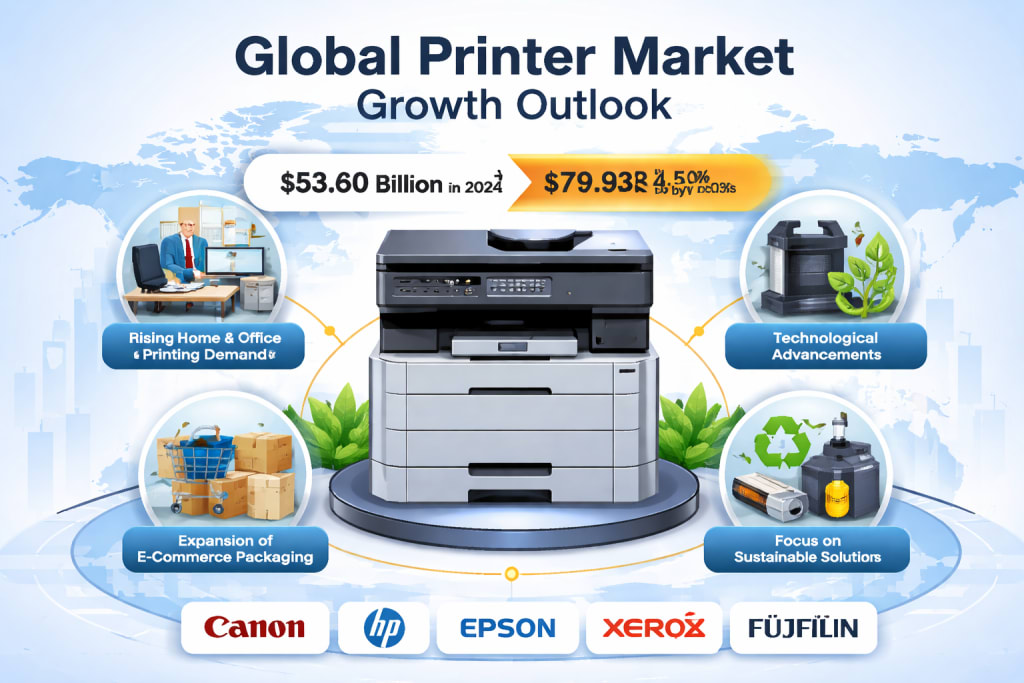
The global printer industry continues to evolve as businesses, educational institutions, and households increasingly rely on efficient printing technologies to bridge the gap between digital and physical documentation. From office paperwork to customized packaging and advanced manufacturing applications, printers remain an essential component of modern workflows.
According to Renub Research, the Global Printer Market is expected to grow from US$ 53.60 billion in 2024 to US$ 79.93 billion by 2033, expanding at a compound annual growth rate (CAGR) of 4.54% between 2025 and 2033. This steady expansion is being driven by advancements in printing technology, the growing adoption of multifunction printers, and increasing demand for eco-friendly printing solutions.
As organizations continue to digitize operations and streamline document management, the printer market is evolving to deliver smarter, faster, and more sustainable solutions for users worldwide.
Understanding the Role of Printers in the Modern Digital Economy
A printer is an electronic device designed to convert digital data into physical output such as text, graphics, and images on paper or other materials. Connected to computers, laptops, and smart devices, printers play a critical role in transforming digital documents into tangible forms.
Printers come in various formats, each designed to meet specific printing needs. Inkjet printers are widely used for high-quality photo and image printing, while laser printers are preferred in offices for fast and cost-efficient document printing. Other technologies such as dot matrix, flexographic, offset, and 3D printing support specialized industrial, packaging, and manufacturing applications.
Across homes, schools, offices, and industrial environments, printers facilitate communication, documentation, and creative production. Whether it is printing business reports, school assignments, marketing materials, labels, or prototypes, printers remain a cornerstone of modern productivity.
Key Growth Drivers in the Global Printer Market
Increasing Demand for Home and Office Printing
The growing trend of remote work, digital education, and hybrid office environments has significantly boosted demand for printers in both residential and corporate settings.
Businesses rely on printers for producing essential documents such as invoices, presentations, marketing materials, and administrative paperwork. Meanwhile, households increasingly use printers for school assignments, personal documentation, and photo printing.
The rising need for versatile printing solutions has also led to the growing popularity of multifunction printers, which combine printing, scanning, copying, and faxing into a single device. These solutions help users save space, reduce costs, and increase operational efficiency.
Manufacturers are actively launching new products to meet this demand. For example, in January 2025, Canon India introduced ten new printers in its PIXMA MegaTank and imageCLASS series, targeting small businesses, home offices, and enterprises with improved print quality and productivity features.
Rapid Technological Advancements
Technological innovation is one of the most significant factors shaping the future of the printer market. Modern printers now incorporate features such as wireless connectivity, cloud printing, mobile integration, and smart device compatibility.
Wireless printing allows users to send documents directly from smartphones, tablets, and laptops without the need for physical connections. Cloud printing solutions further enhance accessibility by enabling remote document management and printing.
Additionally, 3D printing technology is revolutionizing manufacturing and product design. Industries such as healthcare, automotive, aerospace, and consumer goods are increasingly using 3D printers to produce prototypes, custom components, and complex structures with high precision.
Another important technological trend is the development of eco-friendly printing technologies, including energy-efficient devices, recyclable cartridges, and reduced ink consumption. These innovations not only lower operating costs but also support global sustainability initiatives.
At CES, the Italian startup 3dnextech showcased a new technology that converts 3D printed items into consumer-ready products, demonstrating how printing technologies are expanding beyond traditional applications.
Growth of E-Commerce and Packaging Printing
The rapid expansion of e-commerce is creating new opportunities for the printing industry, particularly in packaging and labeling solutions.
Online retailers rely heavily on printed labels, shipping documents, and customized packaging to manage logistics and enhance brand identity. As e-commerce volumes increase, businesses are adopting advanced printing technologies to produce high-quality packaging materials quickly and efficiently.
Innovative solutions are also emerging to support personalized packaging. In November 2024, Sealed Air launched AutoPrint, an on-demand printing system designed to enable last-minute customization for protective packaging. This technology allows logistics and fulfillment companies to respond quickly to customer requests for branded packaging and messaging.
Such developments highlight the growing importance of printing technologies within the global supply chain and logistics ecosystem.
Challenges Facing the Printer Industry
Despite its steady growth, the printer market faces several challenges that manufacturers must address to maintain long-term competitiveness.
High Maintenance and Operating Costs
One of the most common concerns among printer users is the cost of consumables such as ink cartridges and toner replacements. Frequent maintenance requirements can increase operating expenses, particularly for small businesses and individual users.
These costs sometimes discourage customers from investing in printers, prompting manufacturers to focus on cost-efficient solutions such as refillable ink tanks and high-yield cartridges.
Environmental Concerns and Sustainability Pressures
Environmental sustainability has become a major challenge for the printing industry. Traditional printers contribute to electronic waste, energy consumption, and cartridge disposal issues.
As consumers and organizations become more environmentally conscious, printer manufacturers are under increasing pressure to develop greener products.
Companies are responding by introducing recyclable materials, energy-efficient printing technologies, and eco-friendly inks. Sustainable innovation is likely to become a major competitive factor in the printer market over the coming decade.
3D Printer Market Expanding Across Industries
Among the various printer technologies, 3D printing is experiencing particularly rapid growth due to its ability to produce complex structures and customized components.
Industries such as healthcare, automotive, aerospace, and manufacturing are increasingly adopting 3D printers for rapid prototyping and production. These printers can create objects from materials such as plastics, metals, and ceramics, enabling innovative manufacturing processes.
The technology allows companies to reduce production lead times, minimize waste, and customize products according to specific requirements.
However, the 3D printing sector also faces challenges such as high equipment costs and limited material compatibility. Despite these obstacles, continued technological improvements are expected to accelerate adoption across multiple industries.
For instance, Bambu Lab has announced plans to launch its next generation of high-end 3D printers in early 2025, highlighting the ongoing innovation within this rapidly evolving segment.
Laser Printer Market Maintaining Strong Demand
Laser printers remain one of the most widely used printing technologies in business environments due to their speed, efficiency, and reliability.
Unlike inkjet printers, laser printers are designed for high-volume document printing, making them ideal for corporate offices, government agencies, and educational institutions. They offer lower per-page printing costs and faster output speeds, which are crucial for organizations handling large volumes of paperwork.
Recent innovations in laser printers include wireless connectivity, cloud integration, and energy-efficient operation. These features provide greater convenience and flexibility for users while reducing operational costs.
As businesses continue to prioritize efficiency and productivity, the demand for laser printers is expected to remain strong in the coming years.
Flexographic Printing Driving Packaging Innovation
Flexographic printing is widely used in the packaging industry due to its ability to print on a variety of materials such as plastic, paper, and metallic films.
This technology uses flexible relief plates to transfer ink onto packaging surfaces, making it ideal for applications in the food and beverage, pharmaceutical, and consumer goods industries.
Advancements in eco-friendly inks and digital integration have further improved the efficiency and sustainability of flexographic printing systems. However, the high initial setup costs and competition from digital printing technologies remain key challenges for this segment.
Despite these obstacles, growing demand for packaged goods and branded packaging is expected to support long-term growth in the flexographic printer market.
Expanding Role of Commercial and Industrial Printers
Commercial printers play a crucial role in producing marketing materials, signage, packaging, and publishing products. With businesses increasingly focusing on brand visibility and customer engagement, high-quality commercial printing solutions remain in strong demand.
Meanwhile, industrial printers are gaining traction across sectors such as textiles, electronics, automotive manufacturing, and packaging. These printers enable high-speed, large-scale production of labels, designs, and product markings.
Automation and advanced printing technologies are transforming industrial printing processes, allowing companies to improve accuracy, speed, and cost efficiency.
Regional Market Insights
United States
The United States remains one of the most significant markets for printing technologies. Continuous innovation and widespread adoption of advanced printing solutions have contributed to strong market demand across business and personal segments.
Major technology companies continue to invest in sustainable printing initiatives. For example, HP aims to incorporate 30% post-consumer recycled plastic in its print and personal systems by 2025, demonstrating the industry's commitment to environmental responsibility.
India
India is emerging as a rapidly growing printer market due to increasing digital transformation across businesses, educational institutions, and government sectors.
Demand for multifunction printers and cost-efficient printing technologies is rising as organizations seek solutions that enhance productivity while minimizing operational expenses.
In January 2024, HP launched new OfficeJet Pro printers in India, targeting small and medium-sized businesses with advanced features and affordable pricing.
France, Brazil, and the UAE
Other regions are also experiencing steady growth in printer adoption.
In France, increasing demand for multifunction printers and digital document management systems is driving market expansion.
In Brazil, the printer market is growing as businesses invest in document management and marketing materials.
Meanwhile, the UAE is witnessing strong demand for advanced printing technologies, particularly in sectors such as logistics, retail, and hospitality.
Competitive Landscape and Key Industry Players
The global printer market is highly competitive, with several major technology companies dominating the industry.
Leading players include:
Canon Inc.
FUJIFILM Corporation
Fujitsu Limited
Hitachi Ltd.
Honeywell International Inc.
HP Inc.
Panasonic Corporation
Seiko Epson Corporation
Toshiba Corporation
Xerox Corporation
These companies continue to focus on product innovation, sustainability initiatives, and strategic partnerships to strengthen their market positions.
Final Thoughts
The global printer market is undergoing a transformation as technological innovation, sustainability initiatives, and evolving consumer needs reshape the industry landscape.
From multifunction office printers to industrial printing systems and advanced 3D manufacturing technologies, printers are becoming smarter, faster, and more environmentally friendly.
With increasing demand across sectors such as e-commerce, education, healthcare, and manufacturing, the industry is well positioned for steady growth over the next decade.
According to Renub Research, the market’s projected rise to US$ 79.93 billion by 2033 reflects the continuing importance of printing technologies in an increasingly digital world. As businesses and consumers seek efficient and sustainable solutions, the printer market will remain a vital component of global technological infrastructure.
About the Creator
Online Education Market Forecast 2026–2034: Digital Learning Set to Surpass US$ 1 Trillion by 2034
Introduction The global education landscape is undergoing a profound transformation as digital technology reshapes how people learn, teach, and acquire new skills. The rise of online education has opened unprecedented opportunities for students, professionals, and organizations seeking flexible, accessible, and cost-effective learning solutions.
By shibansh kumarabout 10 hours ago in Trader
Vegetable Seeds Market Size and Forecast 2026–2034
The global agricultural ecosystem is undergoing a transformative shift as food security, sustainability, and nutritional awareness take center stage. At the heart of this transformation lies the vegetable seeds market — a crucial yet often overlooked segment that forms the foundation of vegetable production worldwide.
By Sakshi Sharma4 days ago in Trader
Early March 2026: 4 Goals Accomplished
It's early March and I've now accomplished my 4th writing goal for the year of 2026. Before diving into the behind-the-scenes of it... why not tell you up front what that accomplishment was? I was published in a 2nd publication for this year. Published in Helix Literary Magazine out of Central Connecticut State University. You can read it for free right now!
By Stephen Kramer Avitabile7 days ago in Writers



Comments
There are no comments for this story
Be the first to respond and start the conversation.