
Corn Starch Market Size & Forecast 2026–2034: Rising Demand for Sustainable Ingredients and Processed Foods Driving Global Growth
Expanding food processing, biodegradable materials, and pharmaceutical applications position corn starch as a key industrial ingredient worldwide

Corn Starch Market Outlook
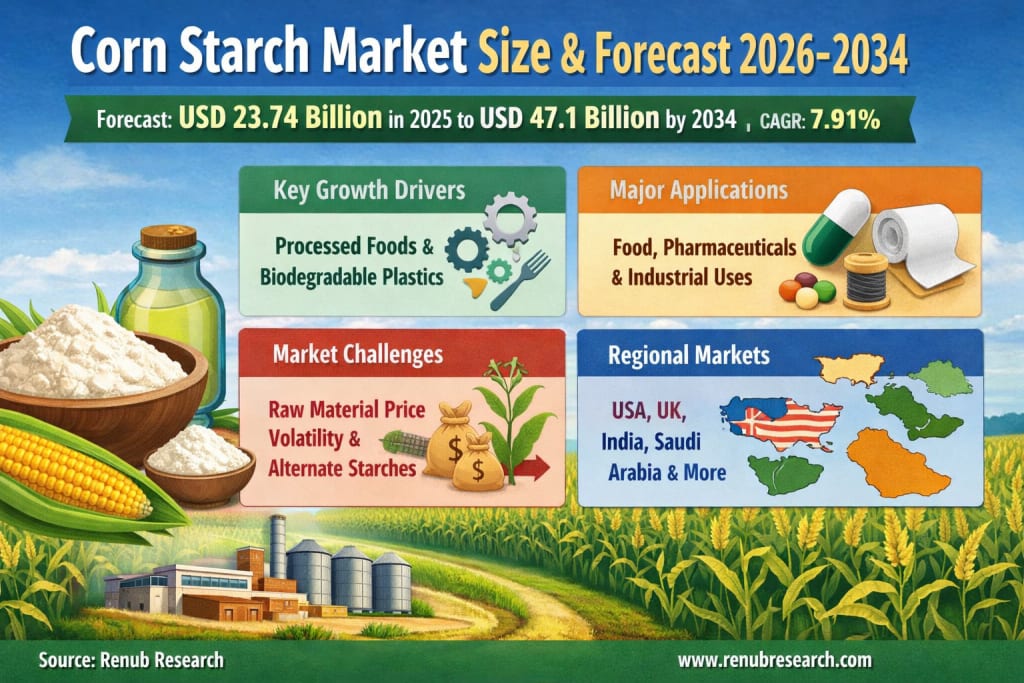
The global Corn Starch Market is witnessing significant expansion as industries increasingly rely on plant-based ingredients for food processing, pharmaceuticals, and industrial applications. According to Renub Research, the market is projected to grow from US$ 23.74 Billion in 2025 to US$ 47.1 Billion by 2034, registering a compound annual growth rate (CAGR) of 7.91% from 2026 to 2034.
Corn starch, derived from the endosperm of corn kernels through a wet milling process, is widely valued for its thickening, stabilizing, and binding properties. Its versatility allows it to be used across multiple industries including food and beverages, pharmaceuticals, textiles, paper manufacturing, adhesives, and biodegradable plastics.
As global industries shift toward sustainable and plant-based materials, corn starch has become increasingly popular due to its affordability, natural origin, and adaptability. Rapid urbanization, rising processed food consumption, and industrial expansion are also strengthening market demand across North America, Europe, Asia-Pacific, and emerging economies.
Corn Starch Market Overview
Corn starch appears as a fine white powder and plays an essential role in the global ingredient ecosystem. In the food industry, it functions as a thickener in soups, sauces, gravies, puddings, and pie fillings. It is also widely used in bakery products, confectionery, and snack manufacturing.
Beyond food production, corn starch serves several industrial purposes. Pharmaceutical manufacturers use it as a tablet binder and disintegrant, while cosmetic companies use it as an absorbent agent in powders and skincare products. In industrial sectors such as textiles and paper manufacturing, corn starch enhances fabric strength, improves paper texture, and acts as an adhesive component.
The growing demand for biodegradable packaging materials and starch derivatives is further boosting global adoption. As governments and corporations focus on sustainability and reducing plastic waste, corn starch-based materials are emerging as a key alternative to petroleum-based plastics.
Growth Drivers of the Corn Starch Market
Expanding Processed and Convenience Food Industry
One of the strongest drivers of the corn starch market is the rapid expansion of the global processed and convenience food industry. Modern consumers increasingly prefer ready-to-eat and easy-to-prepare foods due to busy lifestyles and urbanization.
Corn starch is a crucial ingredient in processed foods because it improves texture, stability, and shelf life. It is commonly used in soups, sauces, dairy products, confectionery items, bakery products, and meat preparations.
Additionally, the expansion of quick-service restaurants (QSRs) and frozen food consumption is boosting demand for corn starch in food formulations. Global food manufacturers rely on starch-based ingredients to maintain consistent product quality while enhancing taste and texture.
In February 2024, Ingredion Incorporated introduced NOVATION Indulge 2940 starch, a clean-label innovation designed to deliver superior gelling and texturizing properties for dairy and alternative dairy desserts. The launch highlights the growing demand for functional native corn starch in food innovation.
Rising Demand for Biodegradable and Sustainable Products
Sustainability concerns and environmental regulations are creating new growth opportunities for the corn starch market. With increasing pressure to reduce plastic waste, industries are seeking renewable and biodegradable materials for packaging and manufacturing.
Corn starch is widely used in the production of bioplastics, which can decompose naturally and reduce environmental impact. These materials are increasingly used in packaging, disposable products, and agricultural films.
In January 2025, Corn Next introduced a biodegradable material derived from renewable corn starch using a patented fermentation-based process. The product reportedly decomposes within 30 days in natural environments, while still maintaining mechanical strength suitable for industrial applications.
Such innovations demonstrate how corn starch can play a crucial role in the transition toward a circular economy and environmentally responsible manufacturing.
Increasing Applications in Pharmaceutical and Industrial Sectors
Corn starch is also gaining prominence in pharmaceutical and industrial manufacturing. In the pharmaceutical industry, it serves as a binder, filler, and disintegrant in tablet formulations. Its safety profile and compatibility with active pharmaceutical ingredients make it a preferred excipient.
The growing global healthcare industry and increasing production of generic medicines are boosting demand for pharmaceutical-grade starch.
Industrial applications further strengthen market growth. Corn starch is used extensively in:
Paper manufacturing
Textile finishing
Adhesives and corrugation
Biodegradable packaging materials
Emerging economies in Asia-Pacific and Latin America are experiencing rapid industrialization, which is increasing demand for starch-based industrial ingredients.
In January 2022, DFE Pharma introduced three starch-based excipients—Nutroféli ST100, Nutroféli ST200, and Nutroféli ST300—to expand nutraceutical formulation options.
Challenges of the Corn Starch Market
Volatility in Raw Material Prices
Despite its strong growth potential, the corn starch market faces several challenges. One of the most significant issues is fluctuating corn prices.
Corn production is highly dependent on agricultural conditions such as weather patterns, climate change, crop diseases, and water availability. Droughts, floods, and unpredictable seasonal conditions can significantly impact crop yields.
Furthermore, corn is widely used in animal feed and biofuel production, creating competition for raw material supply. Government policies on ethanol production and agricultural subsidies can also influence corn pricing.
These fluctuations directly affect starch manufacturers by increasing production costs and reducing profit margins, particularly for small and medium-sized producers.
Competition from Alternative Starches
Another challenge facing the corn starch industry is competition from alternative starch sources, including potato, wheat, tapioca, and rice starch.
These substitutes often provide similar functional properties and may offer advantages in certain applications. For example, tapioca starch is widely used in gluten-free foods due to its neutral flavor and excellent texture.
Additionally, increasing consumer demand for organic and non-GMO products is encouraging some manufacturers to explore alternative starch sources.
To remain competitive, corn starch manufacturers are investing heavily in modified starch technologies that enhance performance in specialized applications.
Native Corn Starch Market
The native corn starch segment continues to grow steadily due to increasing demand for clean-label ingredients.
Native starch is extracted directly from corn without chemical modification, making it attractive to food manufacturers seeking minimally processed ingredients.
It is commonly used in:
Soups and sauces
Bakery products
Confectionery
Dairy products
Native corn starch is also widely applied in textile and paper industries where modification is not necessary.
Although native starch has limitations in extreme processing conditions such as high heat or acidity, its natural perception and affordability continue to drive demand globally.
Modified Corn Starch Market
The modified corn starch segment is experiencing rapid growth due to its enhanced functional properties.
Modified starch undergoes chemical, physical, or enzymatic treatment to improve characteristics such as:
Heat resistance
Acid stability
Texture improvement
Shear tolerance
These improvements make modified starch highly suitable for frozen foods, ready-to-eat meals, and industrial applications.
Manufacturers increasingly develop specialty starch formulations tailored to specific industrial needs, further accelerating the expansion of this segment.
Food and Beverage Corn Starch Market
The food and beverage industry represents the largest consumer of corn starch worldwide.
Corn starch is widely used as a thickening and stabilizing agent in:
Soups and sauces
Desserts and puddings
Bakery products
Confectionery
Beverage formulations
Because it does not alter flavor while providing smooth texture, corn starch is an ideal ingredient for enhancing food consistency.
The rising popularity of gluten-free diets has also increased corn starch usage as a wheat substitute in baked goods.
Additionally, the expansion of quick-service restaurants, ready meals, and packaged foods continues to strengthen demand for corn starch in the food sector.
Animal Feed Corn Starch Market
Corn starch is also a valuable ingredient in the animal feed industry, where it acts as an energy-rich carbohydrate source.
Livestock, poultry, and aquaculture feed manufacturers use starch to enhance digestibility and energy content in feed formulations.
Global demand for meat, dairy, and poultry products continues to rise, driving increased feed production. As commercial farming expands across developing regions, corn starch consumption in feed applications is expected to grow.
However, fluctuations in raw corn prices may affect feed production costs in the future.
Paper and Board Corn Starch Market
The paper and board industry represents another major consumer of corn starch.
In paper manufacturing, corn starch is used for surface sizing and fiber bonding, improving paper strength, durability, and surface finish.
The rapid growth of e-commerce and packaging industries has significantly increased demand for paperboard products. As companies shift toward environmentally friendly packaging materials, corn starch is becoming an important component in sustainable paper production.
Regional Insights
United States Corn Starch Market
The United States holds a strong position in the global corn starch industry due to its abundant corn production and advanced processing infrastructure.
The country’s large food processing sector, along with pharmaceutical, textile, and adhesive industries, creates substantial demand for corn starch. Additionally, increasing interest in bio-based packaging materials is driving new applications for corn starch derivatives.
The launch of innovative starch products by companies such as Ingredion further supports market expansion in the region.
United Kingdom Corn Starch Market
In the United Kingdom, demand for corn starch is largely driven by the food processing sector and rising consumer interest in convenience foods.
Native corn starch is increasingly used in clean-label product formulations. The country’s well-established retail and private-label markets also create demand for cost-effective ingredient solutions.
In September 2024, Cargill strengthened its European starch capabilities by acquiring StarchTech Solutions, a British starch innovator.
India Corn Starch Market
India’s corn starch market is expanding rapidly due to urbanization, industrialization, and growing packaged food consumption.
Corn starch is widely used in snacks, dairy products, confectionery items, and traditional sweets. The textile and paper industries also contribute significantly to domestic demand.
In March 2025, Cargill inaugurated a new corn milling plant in Gwalior, Madhya Pradesh, to meet growing demand from India’s confectionery, infant formula, and dairy sectors.
Saudi Arabia Corn Starch Market
Saudi Arabia’s corn starch market is experiencing steady growth as food processing activities expand and the country diversifies its economy.
The rising demand for packaged foods, sauces, desserts, and baked goods is increasing starch consumption. Additionally, sustainability initiatives and the development of domestic manufacturing capabilities are creating opportunities for corn starch-based materials in packaging and industrial applications.
Key Companies in the Corn Starch Market
Major players shaping the global corn starch industry include:
Cargill Inc.
Ingredion Inc.
Archer Daniels Midland Company
Tate & Lyle
Associated British Foods plc
Tereos Group
Sudzucker AG
Global Bio-Chem Technology Group Company Ltd.
These companies are focusing on innovation, clean-label ingredients, and sustainable starch solutions to strengthen their global market positions.
Final Thoughts
The global corn starch market is entering a strong growth phase, supported by expanding processed food consumption, increasing industrial applications, and rising demand for biodegradable materials.
With sustainability becoming a central priority for governments and businesses worldwide, corn starch-based solutions are gaining significant attention as renewable alternatives to synthetic materials.
Continuous technological innovation in modified starch products, bio-based plastics, and clean-label food ingredients will likely further accelerate market growth.
As industries continue to adopt plant-based and environmentally friendly ingredients, corn starch is poised to remain a crucial component of the global food and industrial supply chain through 2034 and beyond.
About the Creator
Keep reading
More stories from shibansh kumar and writers in Trader and other communities.
Online Education Market Forecast 2026–2034: Digital Learning Set to Surpass US$ 1 Trillion by 2034
Introduction The global education landscape is undergoing a profound transformation as digital technology reshapes how people learn, teach, and acquire new skills. The rise of online education has opened unprecedented opportunities for students, professionals, and organizations seeking flexible, accessible, and cost-effective learning solutions.
By shibansh kumarabout 5 hours ago in Trader
App Analytics Market Size and Forecast 2026–2034
The App Analytics Market is entering a period of strong expansion as organizations increasingly rely on data-driven insights to optimize digital experiences. According to industry estimates, the market is projected to grow from US$ 7.43 Billion in 2025 to US$ 31.29 Billion by 2034, registering a compound annual growth rate (CAGR) of 17.32% from 2026 to 2034.
By Sakshi Sharma2 days ago in Trader
Australia Smart Home Market Size and Forecast 2026–2034
Introduction The Australia Smart Home Market is experiencing remarkable growth as households increasingly adopt connected technologies designed to improve convenience, safety, and energy efficiency. Smart devices are transforming traditional homes into digitally connected living spaces where lighting, climate control, entertainment systems, and security devices can be managed through mobile applications, voice commands, or automated schedules.
By Sakshi Sharmaa day ago in Trader




Comments
There are no comments for this story
Be the first to respond and start the conversation.