
China Ultrasound Devices Market Size and Forecast 2026–2034
Rising Healthcare Investments and Diagnostic Imaging Demand Drive Growth Across China

Introduction
China’s healthcare industry has been undergoing rapid modernization over the past decade. One of the key areas benefiting from this transformation is the ultrasound devices market, which has become a crucial component of diagnostic imaging across hospitals, clinics, and diagnostic centers.
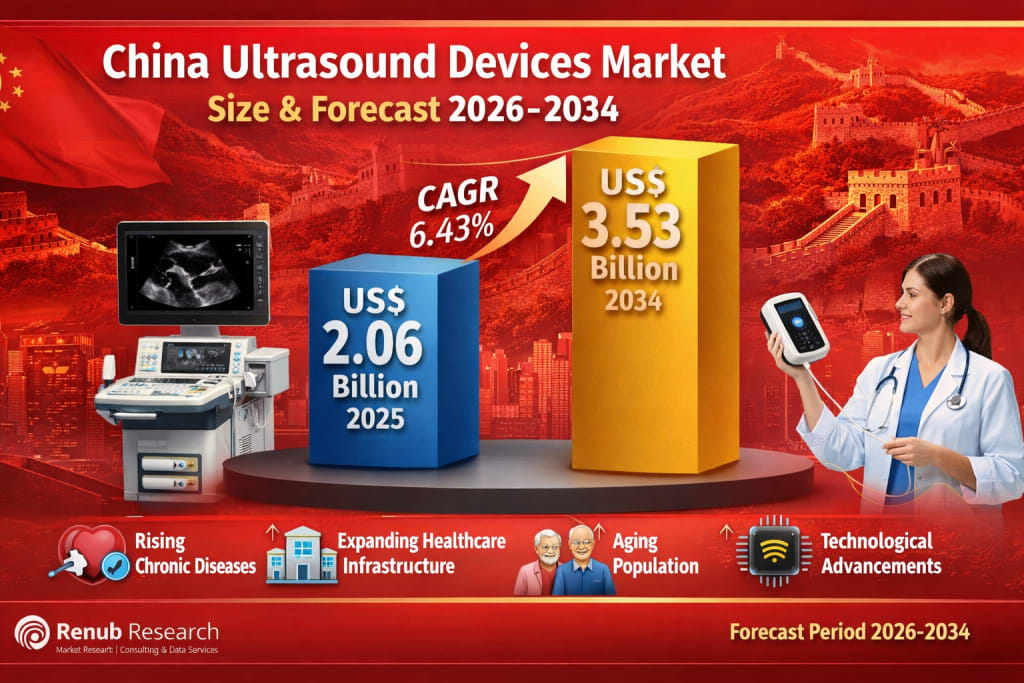
According to Renub Research, the China Ultrasound Devices Market is expected to grow from US$ 2.06 Billion in 2025 to US$ 3.53 Billion in 2034, expanding at a compound annual growth rate (CAGR) of 6.43% between 2026 and 2034. The growth of this market is primarily fueled by the increasing demand for diagnostic imaging, rising prevalence of chronic diseases, expanding healthcare infrastructure, and continuous technological advancements in ultrasound equipment.
Ultrasound technology has become indispensable in modern healthcare because of its non-invasive nature, affordability, and ability to provide real-time imaging without radiation exposure. As China continues to improve its healthcare accessibility and quality of medical services, ultrasound devices are becoming increasingly important for early disease detection, maternal care, and cardiovascular monitoring.
Understanding Ultrasound Technology in Modern Healthcare
Ultrasound machines are medical imaging systems that use high-frequency sound waves to generate images of organs, tissues, and blood flow within the body. These devices typically consist of a transducer probe, which emits sound waves and captures echoes that are processed into visual images displayed on a monitor.
Because ultrasound imaging does not use ionizing radiation, it is considered one of the safest diagnostic imaging techniques. It is widely used for applications such as:
Pregnancy monitoring and fetal development assessment
Abdominal organ imaging
Cardiac function evaluation
Tumor detection and monitoring
Blood flow analysis
In China, ultrasound machines are widely adopted due to their cost-effectiveness and accessibility, especially in regions where advanced imaging technologies such as MRI or CT scanners may not be readily available.
The large population of China and the growing demand for affordable medical diagnostics have significantly increased the adoption of ultrasound devices across both urban and rural healthcare facilities.
Expanding Healthcare Infrastructure Boosts Market Growth
One of the most important drivers of the China ultrasound devices market is the rapid expansion of healthcare infrastructure.
The Chinese government has been making significant investments to improve healthcare accessibility, particularly in rural and underserved regions. These investments include the establishment of new hospitals, diagnostic centers, and rural healthcare facilities.
Ultrasound systems are highly favored in such healthcare environments because they are portable, affordable, and capable of delivering fast diagnostic results.
Government initiatives aimed at strengthening healthcare services have further accelerated the adoption of advanced medical devices. In March 2025, China’s State Council introduced comprehensive reforms designed to modernize the regulatory framework for drugs and medical devices. These reforms aim to enhance the approval process for innovative technologies and strengthen research and development activities.
Such initiatives are expected to encourage manufacturers to introduce more advanced ultrasound systems while making diagnostic technologies more accessible across the country.
Rising Chronic Diseases and Aging Population
Another major factor driving the demand for ultrasound devices in China is the increasing prevalence of chronic diseases and the rapidly aging population.
Conditions such as cardiovascular disease, kidney disorders, liver diseases, and cancer require frequent imaging tests for early detection and ongoing monitoring. Ultrasound imaging plays a critical role in these diagnostic procedures due to its ability to provide real-time images without exposing patients to radiation.
China’s aging demographic is particularly significant. By 2050, the country is expected to have approximately 400 million people aged 65 years or older, creating a large patient population that requires continuous medical monitoring.
Older individuals are more vulnerable to chronic illnesses, which increases the demand for diagnostic imaging technologies including ultrasound systems.
In addition, the growing awareness of preventive healthcare among the population is encouraging more people to undergo regular health check-ups. This trend has significantly boosted the demand for imaging services in hospitals and diagnostic centers.
Healthcare professionals are increasingly relying on ultrasound technology because it provides fast, reliable, and cost-effective diagnostic results, making it suitable for large-scale healthcare systems.
Technological Advancements Transforming Ultrasound Devices
Technological innovation has been a key factor shaping the development of ultrasound devices in China.
Modern ultrasound systems now feature:
High-resolution imaging capabilities
Artificial intelligence integration
3D and 4D imaging technology
Wireless connectivity
Portable and handheld device formats
Portable ultrasound systems have gained particular popularity because they allow healthcare providers to conduct imaging tests in emergency rooms, ambulances, rural clinics, and bedside hospital settings.
These devices provide flexibility and convenience while maintaining high diagnostic accuracy.
AI-powered ultrasound technology is also transforming the healthcare landscape. Artificial intelligence algorithms can assist healthcare professionals in identifying abnormalities, improving diagnostic precision and reducing scanning time.
In October 2024, GE Healthcare signed a strategic cooperation agreement to establish its Greater China Ultrasound Headquarters in Wuxi New District. The facility includes an innovation center, customer experience center, and service hub designed to enhance ultrasound technology research and development in the region.
Such initiatives highlight the growing focus on innovation within China’s medical imaging sector.
Market Challenges: Cost and Skill Shortages
Despite the strong growth potential, the China ultrasound devices market faces several challenges.
High Cost of Advanced Ultrasound Systems
Advanced ultrasound machines equipped with AI capabilities, high-resolution imaging, and portable designs can be expensive. Smaller hospitals and rural healthcare facilities may struggle to afford these sophisticated systems due to budget limitations.
In addition to the initial purchase cost, maintenance, software upgrades, and training expenses can further increase the financial burden on healthcare providers.
Manufacturers must therefore focus on developing cost-effective solutions that make advanced ultrasound technology accessible to a broader range of healthcare institutions.
Shortage of Skilled Healthcare Professionals
Operating ultrasound equipment requires trained technicians and radiologists who understand imaging techniques and interpretation.
However, many rural areas in China face shortages of qualified medical professionals. Without proper training, the benefits of advanced ultrasound technologies cannot be fully utilized.
Continuous education programs and specialized training initiatives are essential to ensure healthcare professionals remain updated on the latest diagnostic techniques and technologies.
Trolley/Cart-Based Ultrasound Devices
Trolley or cart-based ultrasound systems remain widely used across Chinese hospitals and diagnostic centers.
These systems are known for their advanced imaging capabilities, powerful processing units, and comprehensive software functionality. Compared to handheld devices, trolley ultrasound systems provide superior diagnostic performance, making them suitable for complex medical procedures.
They are commonly used in fields such as:
Cardiology
Radiology
Gynecology
Abdominal imaging
The mobility of trolley-based systems allows them to be easily transported between patient rooms and hospital departments. Their compatibility with advanced imaging features such as Doppler imaging and 3D/4D scanning further enhances diagnostic accuracy.
As hospital infrastructure continues to expand across China, the demand for these sophisticated imaging systems is expected to grow steadily.
Cardiology Ultrasound Devices Market
Cardiology ultrasound devices, also known as echocardiography systems, play a vital role in diagnosing and monitoring heart-related diseases.
China has experienced a significant increase in cardiovascular conditions due to lifestyle changes, urbanization, and aging demographics.
Echocardiography enables doctors to observe the heart’s structure, blood flow, and functional performance in real time, making it a critical tool in cardiac diagnostics.
Hospitals and specialized cardiac care centers are increasingly investing in advanced ultrasound systems to improve patient outcomes and provide early detection of heart disease.
Portable cardiac ultrasound devices are also becoming more common, allowing physicians to conduct quick heart examinations in emergency situations or remote locations.
Gynecology Ultrasound Devices Market
Ultrasound imaging is an essential tool in women’s healthcare, particularly for pregnancy monitoring and reproductive health assessments.
In China, gynecology ultrasound systems are widely used for:
Prenatal screening
Fetal development monitoring
Detection of ovarian cysts
Diagnosis of uterine abnormalities
Government initiatives aimed at improving maternal and child healthcare services have significantly increased the demand for ultrasound technology in maternity hospitals and diagnostic clinics.
Advancements such as 3D and 4D ultrasound imaging provide clearer and more detailed images, helping doctors monitor pregnancies more accurately and detect potential complications early.
With rising awareness about maternal health and prenatal care, the gynecology ultrasound market in China is expected to continue growing.
Role of Diagnostic Centers in Market Expansion
Diagnostic centers represent a major end-user segment in the China ultrasound devices market.
These specialized facilities offer imaging services such as abdominal scans, cardiac ultrasounds, and prenatal imaging.
Compared to hospitals, diagnostic centers often provide faster and more convenient services, making them attractive to patients seeking routine health check-ups or early disease detection.
The rapid expansion of private diagnostic centers and imaging clinics across China has significantly improved access to ultrasound services.
As preventive healthcare becomes more popular, diagnostic centers will remain an important contributor to the growth of the ultrasound devices market.
Hospitals Remain the Largest End-User Segment
Hospitals continue to hold the largest share of the ultrasound devices market in China.
They perform a wide range of diagnostic procedures using ultrasound imaging, including emergency care assessments, obstetrics examinations, and cardiac evaluations.
The increasing number of hospitals and healthcare facilities across China has led to rising demand for advanced diagnostic technologies.
Hospitals are increasingly investing in high-performance ultrasound systems equipped with multifunctional imaging capabilities and high-resolution displays to enhance diagnostic efficiency.
As China continues to expand and modernize its healthcare infrastructure, hospitals are expected to remain the primary adopters of ultrasound devices.
Regional Market Insights
Major Chinese cities such as Beijing, Shanghai, Tianjin, and Guangdong are experiencing significant growth in ultrasound device adoption due to their advanced healthcare infrastructure and high healthcare expenditure.
Beijing and Shanghai host numerous top-tier hospitals, research institutions, and diagnostic centers that require cutting-edge medical imaging technologies.
Meanwhile, rapidly developing regions such as Tianjin and Guangdong are investing heavily in healthcare facilities to improve medical services and meet the growing demand for diagnostic imaging.
The expansion of healthcare services in both urban and rural areas is expected to create new growth opportunities for ultrasound device manufacturers.
Key Companies in the China Ultrasound Devices Market
Several leading medical technology companies are actively competing in China’s ultrasound devices market. These companies focus on innovation, strategic partnerships, and technological advancements to strengthen their market presence.
Major companies include:
Canon Medical Systems Corporation
Koninklijke Philips NV
Siemens AG
Samsung Electronics Co., Ltd.
Hologic, Inc.
Fujifilm Holdings Corporation
GE Healthcare
Shenzhen Mindray Bio-Medical Electronics Co., Ltd.
These companies are continuously investing in research and development to introduce advanced ultrasound systems that improve diagnostic accuracy and patient care.
Final Thoughts
China’s ultrasound devices market is poised for steady expansion over the next decade. The combination of government healthcare reforms, rising chronic diseases, technological innovation, and expanding healthcare infrastructure is creating strong demand for diagnostic imaging solutions.
With the market projected to reach US$ 3.53 Billion by 2034, ultrasound technology will continue to play a crucial role in improving healthcare accessibility and disease diagnosis across China.
As healthcare providers increasingly adopt portable, AI-powered, and high-resolution imaging systems, the ultrasound devices market will remain a vital component of China’s rapidly evolving healthcare ecosystem.
About the Creator
Europe Cardiac Surgical Device Market Size & Forecast 2025–2033
Cardiovascular diseases remain one of the leading causes of death worldwide, and Europe is no exception. As healthcare systems continue to evolve and populations age, the demand for advanced cardiac treatment solutions is increasing. Among the most important tools supporting modern heart care are cardiac surgical devices—highly specialized instruments used in procedures that diagnose, repair, or treat heart-related conditions.
By Sakshi Sharmaabout 5 hours ago in Trader
Vaccine Contract Manufacturing Market: Expanding Global Capacity for Life-Saving Immunization
Vaccine Contract Manufacturing Market: Supporting Global Vaccine Production The vaccine contract manufacturing market has become an essential component of the global pharmaceutical and biotechnology industries. Vaccine production involves highly complex processes that require advanced facilities, strict regulatory compliance, and specialized expertise. Many pharmaceutical companies choose to collaborate with contract manufacturing organizations (CMOs) to handle various stages of vaccine production.
By James Smith2 days ago in Trader
Why Didn't Anyone Tell Us
Men, move along. This is not for you. This is for the women. I was forty-five when I began menopause. It is pretty young for that to be going on in a woman’s life, but I had undiagnosed PCOS, my entire life. Thank you to all the gynecologists I had seen my entire life. That in itself should encourage women to keep seeking second opinions, especially when you are not getting correct answers or any at all.
By Alexandra Grant3 days ago in Humans


Comments
There are no comments for this story
Be the first to respond and start the conversation.