
Point of Care Diagnostics Market Size and Forecast 2026–2034
Rapid Testing Revolution: Point of Care Diagnostics Market Expected to Reach US$100.94 Billion by 2034

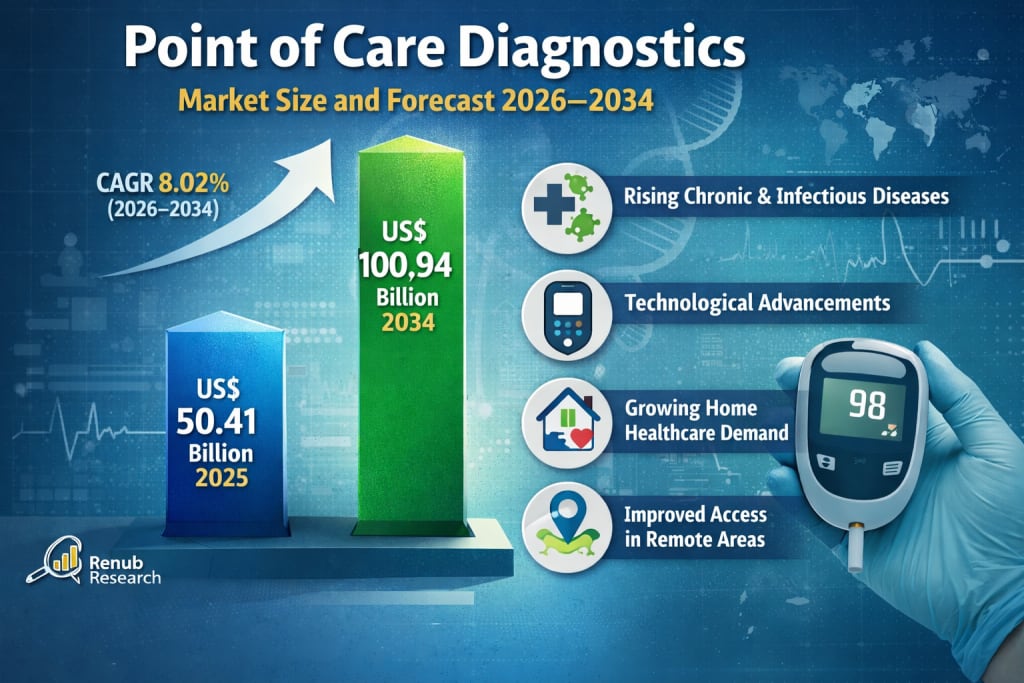
The global Point of Care Diagnostics Market is experiencing remarkable growth as healthcare systems increasingly shift toward faster, more accessible diagnostic solutions. According to Renub Research, the market is expected to expand from US$ 50.41 Billion in 2025 to US$ 100.94 Billion by 2034, growing at a Compound Annual Growth Rate (CAGR) of 8.02% from 2026 to 2034.
This rapid expansion is fueled by several factors including the rising prevalence of infectious and chronic diseases, increasing demand for rapid diagnostic solutions, and the growing adoption of home healthcare technologies. Technological advancements in portable diagnostic devices and improved healthcare accessibility in remote and rural areas are also contributing significantly to the growth of the Point of Care (POC) diagnostics industry.
Point of Care Diagnostics Industry Overview
Point of Care Diagnostics refers to medical tests performed at or near the patient’s location, eliminating the need to send samples to centralized laboratories. These tests can be conducted in hospitals, clinics, ambulances, doctor's offices, pharmacies, or even within patients’ homes.
Unlike traditional laboratory testing—where results may take hours or days—POC diagnostics deliver rapid results within minutes, enabling healthcare professionals to make immediate clinical decisions.
Common examples of POC diagnostic tests include:
Blood glucose monitoring
Pregnancy tests
Rapid COVID-19 antigen tests
Cardiac marker testing
Infectious disease screening
These tests utilize portable and easy-to-operate diagnostic devices designed to detect a wide range of medical conditions such as infections, metabolic disorders, and chronic diseases.
The growing adoption of POC diagnostics worldwide is largely attributed to its speed, convenience, and clinical efficiency. Faster test results enable quicker treatment decisions, which improves patient outcomes while reducing healthcare system burden.
In addition, point-of-care diagnostics significantly enhance patient convenience by reducing hospital visits and waiting times. These diagnostic solutions are particularly valuable in emergency settings, remote areas, and developing countries where access to centralized laboratory infrastructure is limited.
As healthcare systems increasingly prioritize early detection, preventive care, and decentralized healthcare models, POC diagnostics are becoming an integral part of modern medical practice.
Growth Drivers of the Point of Care Diagnostics Market
Rising Prevalence of Chronic and Infectious Diseases
One of the primary factors driving the growth of the Point of Care Diagnostics Market is the increasing global burden of chronic and infectious diseases.
According to the Centers for Disease Control and Prevention (CDC), congenital heart defects represent the most common birth defects in the United States, affecting approximately 1% of births annually. Early detection through diagnostic testing allows for improved treatment planning and disease management.
Similarly, lifestyle changes, environmental factors, and aging populations have contributed to a surge in diseases such as:
Diabetes
Cardiovascular diseases
Respiratory disorders
Cancer
For instance, the Breast Cancer Research Foundation estimates that around 300,590 individuals were expected to be diagnosed with breast cancer in the United States in 2023.
Chronic diseases often require continuous monitoring and timely diagnosis to prevent complications. Point of care diagnostic devices provide rapid testing and instant results, allowing healthcare providers to make faster treatment decisions.
In addition, infectious diseases such as influenza, COVID-19, and various bacterial infections have increased demand for rapid diagnostic testing solutions. POC testing plays a vital role in identifying infections quickly, preventing transmission, and enabling early treatment.
The growing global geriatric population further increases the need for regular health monitoring, which strengthens the demand for portable and convenient diagnostic technologies.
Technological Advancements and Portable Diagnostic Devices
Technological innovation has dramatically improved the accuracy, efficiency, and usability of point-of-care diagnostic devices.
Modern POC diagnostic tools are now:
Highly portable
User-friendly
Capable of delivering highly accurate results within minutes
Advancements in biosensors, microfluidics, and digital health technologies have expanded the capabilities of POC devices. Some advanced diagnostic platforms can now detect multiple biomarkers simultaneously, enabling comprehensive disease diagnosis using a single device.
Integration with smartphones and cloud-based healthcare systems has further enhanced the value of these devices by enabling:
Real-time data sharing
Remote patient monitoring
Digital medical record integration
Portable and wearable diagnostic devices are also gaining popularity, allowing continuous monitoring of health conditions.
A notable industry development occurred in February 2024, when Roche introduced three new coagulation assays designed for oral Factor Xa inhibitors including rivaroxaban, apixaban, and edoxaban. These assays assist clinicians in making more accurate treatment decisions for patients receiving anticoagulant therapies for stroke prevention and thromboembolism management.
These innovations make POC diagnostics more reliable, accessible, and affordable—contributing significantly to global market expansion.
Growing Demand for Home Healthcare and Decentralized Testing
Another major factor driving the market is the rising demand for home healthcare services and decentralized medical testing.
Patients increasingly prefer diagnostic solutions that can be performed at home or in nearby healthcare facilities without visiting centralized laboratories.
Home-based point-of-care devices allow individuals to monitor conditions such as:
Diabetes
Pregnancy
Infections
Cardiovascular health
This trend is particularly beneficial for elderly individuals, patients with mobility limitations, and people living in rural regions.
Healthcare systems are also encouraging decentralized testing to reduce pressure on hospitals and improve operational efficiency.
The COVID-19 pandemic significantly accelerated the adoption of home-based diagnostic testing, reinforcing the importance of rapid and accessible healthcare solutions.
In June 2025, Amazon India entered the diagnostics sector by launching a new at-home diagnostics service through its mobile application. The service enables users to book laboratory tests, manage appointments, and access digital reports conveniently.
Furthermore, the integration of telemedicine with POC diagnostic devices allows physicians to monitor patients remotely, supporting the shift toward patient-centric healthcare models.
Challenges in the Point of Care Diagnostics Market
Accuracy and Reliability Concerns
Despite its advantages, the POC diagnostics market faces several challenges—one of the most significant being concerns regarding accuracy and reliability compared with traditional laboratory testing.
Although many POC tests deliver rapid results, some may lack the sensitivity or specificity of centralized laboratory methods. This can sometimes result in:
False positive results
False negative results
Such inaccuracies may affect clinical decision-making and patient safety.
Additionally, device performance may vary depending on environmental conditions, device handling, and operator experience. In some cases, confirmatory testing in centralized laboratories may still be required.
To address these issues, manufacturers are investing heavily in research and development to improve diagnostic accuracy and device validation.
Regulatory Challenges and Skilled Workforce Limitations
The point of care diagnostics industry is also influenced by strict regulatory frameworks designed to ensure safety, accuracy, and clinical effectiveness.
Manufacturers must comply with complex regulatory approval processes before launching diagnostic devices in different countries. These requirements may delay product commercialization and increase development costs.
Regulatory standards also vary significantly across regions, making global market expansion more complicated.
Another challenge involves the lack of trained healthcare professionals capable of operating diagnostic devices correctly. While many POC devices are designed to be simple and user-friendly, proper training is still required to ensure reliable results and effective patient care.
Improving training programs and expanding awareness about POC technologies will be essential for broader adoption.
Segment Insights in the Point of Care Diagnostics Market
Point of Care Infectious Diseases Kits Market
Point of care infectious disease testing kits are designed to rapidly detect viruses, bacteria, and parasites directly at the patient’s location.
These diagnostic kits are widely used for detecting infections such as:
Influenza
COVID-19
HIV
Malaria
Dengue fever
Rapid detection enables healthcare providers to initiate treatment immediately and prevent disease outbreaks.
These kits are particularly valuable in emergency care settings, rural regions, and resource-limited healthcare systems where laboratory infrastructure may be unavailable.
With increasing global focus on disease surveillance and outbreak preparedness, the demand for infectious disease testing kits is expected to grow substantially.
Lateral Flow Point of Care Diagnostics Market
Lateral flow diagnostic devices are among the most widely used point-of-care testing technologies due to their simplicity, affordability, and rapid results.
These tests typically require small samples of blood, urine, or saliva and provide visual results within minutes.
Common examples include:
Pregnancy tests
COVID-19 rapid antigen tests
Infectious disease test strips
Lateral flow devices do not require complex laboratory equipment, making them ideal for home use, small clinics, and developing regions.
Technological advancements have improved the sensitivity and accuracy of these devices, expanding their applications across multiple healthcare settings.
Prescription-Based Point of Care Devices Market
Prescription-based point-of-care diagnostic devices are advanced tools used under the supervision of healthcare professionals.
These devices are commonly used for diagnosing and managing serious medical conditions including:
Cardiovascular diseases
Diabetes
Infectious diseases
Hospitals and healthcare facilities rely on these devices to support rapid clinical decision-making, improving treatment efficiency and patient outcomes.
Technological improvements have enhanced device portability, connectivity, and integration with digital health platforms.
As healthcare systems increasingly focus on early disease detection and personalized medicine, demand for prescription-based POC diagnostic devices is expected to continue growing.
Regional Insights
United States Point of Care Diagnostics Market
The United States represents one of the most advanced markets for point of care diagnostics due to its highly developed healthcare infrastructure and rapid adoption of innovative medical technologies.
Hospitals, clinics, and home healthcare providers widely utilize POC diagnostic devices to improve diagnostic speed and patient care.
The high prevalence of chronic diseases—including diabetes and cardiovascular disorders—continues to drive demand for rapid diagnostic solutions.
In May 2025, Siemens Healthineers announced an investment of USD 150 million to strengthen manufacturing and supply chain capabilities in the United States, further supporting the expansion of diagnostic technologies.
United Kingdom Point of Care Diagnostics Market
The United Kingdom is witnessing steady growth in POC diagnostics due to the integration of rapid testing solutions within the national healthcare system.
Hospitals, community healthcare providers, and general practitioners increasingly use POC devices to reduce laboratory workloads and enhance diagnostic efficiency.
Government initiatives aimed at modernizing healthcare infrastructure and promoting preventive care are further supporting market growth.
India Point of Care Diagnostics Market
India is emerging as a fast-growing market for point-of-care diagnostics due to rising healthcare awareness and the need for cost-effective diagnostic solutions.
Infectious diseases such as tuberculosis, dengue, and malaria remain significant public health concerns. Additionally, the growing prevalence of chronic conditions such as diabetes has increased demand for frequent diagnostic testing.
POC diagnostic devices are especially valuable in rural areas, where access to centralized laboratories may be limited.
In January 2023, Cipla introduced Cippoint, an immunofluorescence-based quantitative analyzer capable of delivering diagnostic results within 3 to 15 minutes, making it suitable for mobile healthcare units and rural clinics.
Saudi Arabia Point of Care Diagnostics Market
Saudi Arabia’s point of care diagnostics market is expanding due to increasing investments in healthcare modernization and medical technology.
Government initiatives aimed at improving healthcare accessibility and preventive care have encouraged the adoption of rapid diagnostic tools.
In October 2025, Co-Diagnostics partnered with Arabian Eagle Manufacturing to form a joint venture named CoMira Diagnostics. The partnership focuses on developing and commercializing advanced point-of-care PCR diagnostic technologies.
Competitive Landscape
The global Point of Care Diagnostics Market features several major healthcare technology companies driving innovation and market expansion.
Key players include:
Sysmex
Abbott Laboratories
Becton, Dickinson and Company
Danaher Corporation
Quidel Diagnostics
F. Hoffmann-La Roche Ltd
Thermo Fisher Scientific Inc.
Bio-Rad Laboratories Inc.
These companies compete through product innovation, strategic partnerships, technological advancements, and global expansion strategies.
Final Thoughts
The Point of Care Diagnostics Market is undergoing a transformative phase as healthcare systems move toward faster, decentralized, and patient-centered diagnostic solutions.
Rapid technological advancements, increasing chronic disease prevalence, and growing demand for home healthcare are reshaping the global diagnostics landscape.
With the market projected to double in size and reach US$100.94 Billion by 2034, point-of-care diagnostics will play an increasingly critical role in improving healthcare accessibility, accelerating disease detection, and enabling more efficient treatment decisions worldwide.
As healthcare continues to evolve toward digital, decentralized, and preventive models, point-of-care diagnostics will remain at the forefront of modern medical innovation.
About the Creator
Mexico Factory Automation Market Size to Hit USD 7.0 Million in 2034 | Grow CAGR by 7.13%
Mexico Factory Automation Market Overview The Mexico Factory Automation Market is gaining strong momentum as industries increasingly adopt advanced technologies to improve manufacturing efficiency and productivity. Factory automation refers to the use of control systems, robotics, industrial software, and automated machinery to operate manufacturing processes with minimal human intervention.
By Jackson Watsona day ago in Trader
Stanislav Kondrashov Discusses New Directions in the Global Coal Trade
Energy markets evolve constantly, shaped by changing industrial needs, shifting supply routes, and the ongoing development of global logistics. Among these sectors, the coal trade remains one of the most dynamic. Over time, patterns of supply and demand have adapted to new economic realities, creating a more interconnected system than ever before.
By Stanislav Kondrashova day ago in Trader
Worth the Wait: Puerto Viejo, Costa Rica
Beach bumming in a small Caribbean beach town sounded like a perfect way to end our 6-month trip through Mexico and Central America. Or so we thought. The foul, fishy stench of rotten seaweed hit our nostrils as we stepped from the cramped bus and looked out at a rather depressing, empty, and underwhelming black sand beach. It was pouring with rain, and we had to quickly fish out our ponchos. We thought, this couldn’t be it, could it?
By Sh*t Happens - Lost Girl Travel6 days ago in Wander




Comments
There are no comments for this story
Be the first to respond and start the conversation.