
The Vasa: The 17th-Century Warship That Sank After Only 20 Minutes
Built to be the pride of Sweden’s navy, the massive warship Vasa sank on its maiden voyage in 1628, becoming one of history’s most famous maritime disasters.

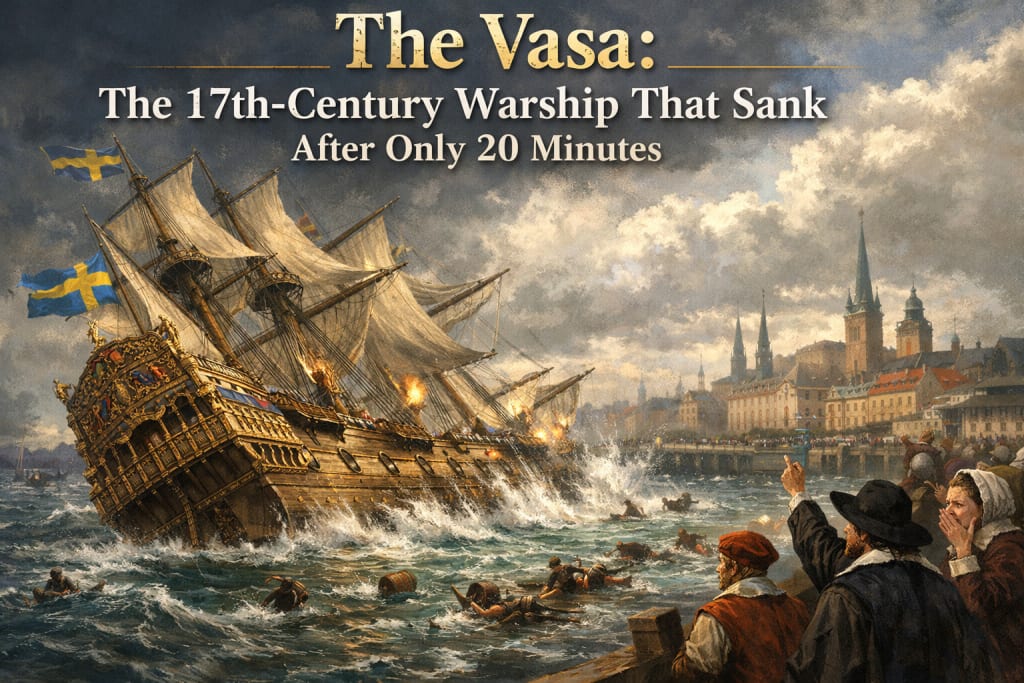
In the early 17th century, European powers were fiercely competing to dominate the seas. Powerful naval fleets were considered symbols of national strength, and kings invested huge sums of money in building impressive warships. Among the most ambitious of these vessels was the Vasa, a magnificent ship built for the Swedish navy. Designed to be one of the most powerful warships of its time, the Vasa instead became famous for sinking after sailing for only about 20 minutes.
The story of the Vasa begins during the reign of Gustavus Adolphus, who ruled Sweden during a period of military expansion. Sweden was involved in several conflicts in Northern Europe and sought to strengthen its naval power in the Baltic Sea. To achieve this goal, the king ordered the construction of a large and heavily armed warship that would intimidate enemies and demonstrate Sweden’s technological and military superiority.
Construction of the ship began in 1626 in the capital city of Stockholm. The shipbuilder responsible for the project was Henrik Hybertsson, an experienced craftsman who had built ships for the Swedish navy before. The Vasa was designed to be enormous for its time, measuring around 69 meters (226 feet) in length and equipped with 64 powerful bronze cannons. This made it one of the most heavily armed warships in the world during the 17th century.
The Vasa was not only powerful but also incredibly ornate. The ship’s exterior was decorated with hundreds of carved wooden sculptures painted in bright colors. These decorations included lions, warriors, mythical creatures, and royal symbols that glorified the Swedish monarchy. The elaborate carvings made the ship look like a floating palace, further emphasizing the king’s authority and Sweden’s ambitions as a naval power.
However, beneath its impressive appearance, the ship had a serious design problem. The Vasa was built with two full gun decks stacked on top of each other, making the vessel tall and top-heavy. Although the ship carried heavy cannons, it lacked enough ballast—heavy stones placed at the bottom of the hull—to stabilize it. As a result, the ship’s center of gravity was dangerously high.
Despite these concerns, pressure from the king to launch the ship quickly meant that construction continued without major redesigns. According to historical records, a stability test was even conducted before the launch. During the test, sailors ran from one side of the ship to the other to see how much it would sway. After only a few runs, the ship rocked so violently that the test was stopped, yet the vessel was still allowed to sail.
On August 10, 1628, the Vasa set off on its maiden voyage from Stockholm harbor. Crowds gathered along the shore to witness the launch of the magnificent warship. The ship sailed proudly out of the harbor with flags flying and cannons ready to salute.
However, the voyage quickly turned into disaster.
Shortly after leaving the harbor, a strong gust of wind hit the ship. The Vasa tilted to one side, and water began pouring through the open gunports. The crew attempted to correct the tilt, but the ship leaned even further. Within minutes, the vessel took on more water and began to sink. To the shock of onlookers, the massive warship disappeared beneath the waves just a short distance from shore.
The entire tragedy unfolded in roughly 20 minutes. Although many crew members managed to escape, between 30 and 50 people are believed to have died in the accident. The sinking was a major embarrassment for the Swedish navy and for King Gustavus Adolphus, who had personally overseen the ship’s construction.
For more than three centuries, the wreck of the Vasa remained at the bottom of Stockholm harbor. Remarkably, the ship was preserved in good condition due to the cold and relatively low-salinity waters of the Baltic Sea, which prevented the wood from being destroyed by marine organisms.
In 1961, after years of searching and preparation, the Vasa was successfully raised from the seabed in one of the most ambitious maritime recovery operations ever attempted. The recovered ship was later placed in the Vasa Museum, where it remains today as one of the world’s best-preserved 17th-century ships.
Today, millions of visitors travel to Stockholm to see the Vasa. The ship has become an extraordinary historical artifact that provides valuable insight into naval engineering, craftsmanship, and life aboard a 17th-century warship.
Ironically, although the Vasa failed in its original mission, it achieved something even greater centuries later. Instead of becoming a weapon of war, it has become one of the most important maritime discoveries in history—reminding the world how ambition, pride, and engineering mistakes can shape history in unexpected ways.
About the Creator
Irshad Abbasi
Ali ibn Abi Talib (RA) said 📚
“Knowledge is better than wealth, because knowledge protects you, while you have to protect wealth.
Keep reading
More stories from Irshad Abbasi and writers in History and other communities.
The Ghost of the Indus: The Rise and Fall of the 'Dera Titanic'
The mighty Indus River has long been the lifeblood of South Asia, a winding giant that has witnessed the rise and fall of empires. Yet, tucked away on its banks in Southern Punjab lies a haunting reminder of a more recent, opulent era: the Indus Queen, often referred to locally as the "Titanic of Dera." Once a symbol of royal prestige and a vital lifeline for thousands, this legendary steamer now sits as a skeletal wreck, slowly being swallowed by the silt of time.
By Irshad Abbasi about 24 hours ago in History
Which War Caused More Destruction: World War I or World War II?
The two largest conflicts in modern history are World War I (1914–1918) and World War II (1939–1945). Both wars changed the course of human history and caused enormous destruction across many countries. Millions of soldiers and civilians lost their lives, cities were destroyed, and economies collapsed. However, historians generally agree that the Second World War caused far greater damage and loss of life than the First World War. By examining the number of deaths, the scale of destruction, and the impact on civilians, it becomes clear why World War II is considered the deadliest conflict in history.
By shaoor afridi6 days ago in History
Worth the Wait: Puerto Viejo, Costa Rica
Beach bumming in a small Caribbean beach town sounded like a perfect way to end our 6-month trip through Mexico and Central America. Or so we thought. The foul, fishy stench of rotten seaweed hit our nostrils as we stepped from the cramped bus and looked out at a rather depressing, empty, and underwhelming black sand beach. It was pouring with rain, and we had to quickly fish out our ponchos. We thought, this couldn’t be it, could it?
By Sh*t Happens - Lost Girl Travel7 days ago in Wander




Comments
There are no comments for this story
Be the first to respond and start the conversation.