
The “Rebel” Who Faced Karachi’s First Military Court in the 19th Century
A little-known chapter from colonial Sindh that tells the story of resistance, justice, and the first recorded military execution in Karachi.

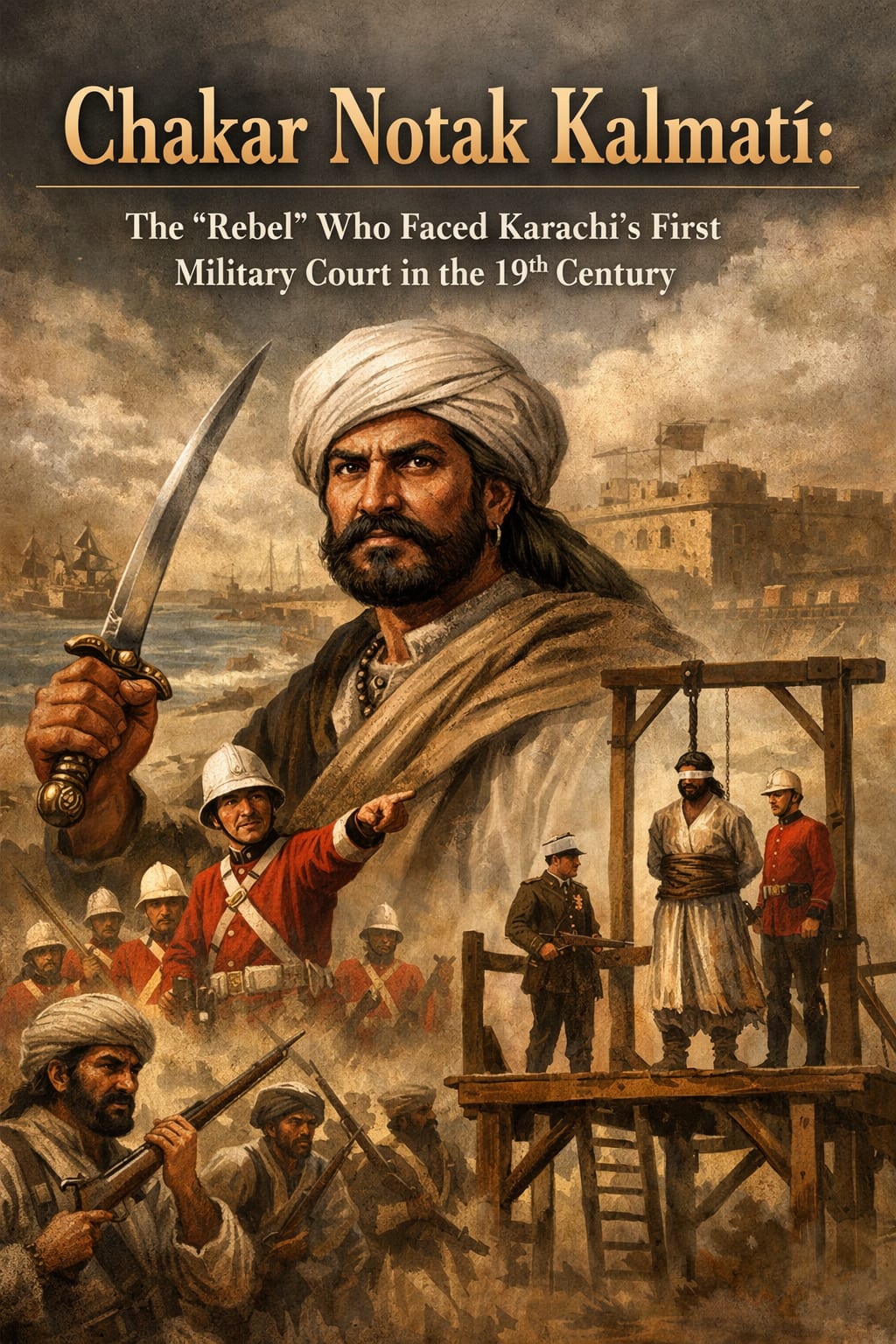
In the early decades of the 19th century, Karachi was far from the bustling megacity it is today. It was a small but strategically important coastal town whose control became crucial after the British East India Company expanded its influence in Sindh. Amid this transformation emerged a dramatic and largely forgotten story—the trial and execution of Chakar Notak Kalmatī, a local tribal figure who became the first person to receive the death penalty from Karachi’s earliest military court.
Chakar Notak Kalmatī belonged to the Kalmatī tribe, a Baloch community historically settled along the coastal belt of Sindh and Balochistan. The tribe had long maintained its own traditions, leadership structures, and sense of autonomy. When British authority began tightening its grip over Sindh in the mid-1800s, many local groups saw the new rulers as outsiders attempting to control their land, resources, and way of life.
During this period, tensions between local tribes and British administrators were common. The British sought to impose new administrative systems, taxation policies, and military control in regions that had previously been governed through tribal alliances and local chiefs. Resistance from indigenous communities often took the form of localized rebellions, raids, or refusal to accept British authority.
Chakar Notak Kalmatī emerged as one of the prominent figures resisting colonial rule in the Karachi coastal region. According to historical accounts and local narratives, he was accused by the British authorities of organizing armed resistance and attacking colonial interests. From the British perspective, such acts were labeled as rebellion and criminal insurrection. For many locals, however, these actions represented resistance against foreign domination.
As British military presence in Karachi increased following the annexation of Sindh in 1843, the colonial administration began establishing formal mechanisms of control, including military courts. These courts were designed to quickly deal with cases involving armed resistance or challenges to British authority.
Chakar Notak Kalmatī was eventually captured by British forces and brought before one of the earliest military courts established in Karachi. The proceedings reflected the colonial justice system of the time—swift, strict, and often heavily biased toward maintaining imperial authority. The court accused him of rebellion against the British government, participation in violent acts against colonial personnel, and inciting unrest among local tribes.
The trial itself was brief by modern standards. Military courts in colonial territories typically prioritized swift decisions over lengthy legal deliberations. Evidence was largely based on testimonies from colonial officers and informants. In such circumstances, defendants had limited opportunities to present their side or mount a meaningful defense.
Ultimately, the military court found Chakar Notak Kalmatī guilty of rebellion and sentenced him to death. This verdict made him the first recorded individual to receive capital punishment through a military court in Karachi during the 19th century. His execution served not only as punishment but also as a powerful message from the British administration.
Public executions during the colonial era were often intended to deter further resistance. By executing a tribal leader accused of rebellion, the British aimed to demonstrate their authority and discourage others from challenging their rule. The event reportedly had a strong impact on local communities, reinforcing the reality that British power had firmly established itself in the region.
Yet, while colonial records portrayed Chakar Notak Kalmatī as a rebel and criminal, local oral traditions remember him differently. In many narratives among Baloch and coastal communities, he is seen as a figure of resistance—someone who stood against foreign control and defended local autonomy.
This contrast between colonial records and local memory highlights an important aspect of history: perspectives often differ depending on who tells the story. For the British Empire, maintaining order in newly conquered territories required decisive action against anyone who opposed them. For indigenous communities, such individuals could symbolize courage and defiance.
Today, the story of Chakar Notak Kalmatī remains relatively unknown in mainstream historical discussions about Karachi. However, it represents an early chapter in the city’s complex colonial past. His trial and execution illustrate how the British administration established authority through military law and harsh punishments in newly annexed regions.
Remembering such figures helps shed light on the broader patterns of resistance that occurred across South Asia during the colonial era. Long before organized political movements for independence emerged, many local leaders and tribal figures resisted imperial expansion in their own ways.
Chakar Notak Kalmatī’s story therefore stands not only as a historical record of Karachi’s first military court execution but also as a reminder of the many lesser-known individuals who shaped the region’s history through acts of resistance and struggle.
About the Creator
Irshad Abbasi
Ali ibn Abi Talib (RA) said 📚
“Knowledge is better than wealth, because knowledge protects you, while you have to protect wealth.
Keep reading
More stories from Irshad Abbasi and writers in History and other communities.
The Munshi Whom Even Kings Admired
Throughout history, the power of knowledge has often stood quietly beside the power of the throne. While kings ruled with authority and armies, there were individuals whose influence came not from swords but from words. Among them were the Munshis—scholarly scribes, advisors, and masters of language—whose intellect and skill earned them admiration even from the most powerful rulers.
By Irshad Abbasi about 9 hours ago in History
The Year 1986 in Review: Fun Facts, Trivia, and Historic Highlights
This quick read is a collection of fun facts, trivia, and historical events from the year 1986. Discover the year’s top news stories, most influential people, sports trivia, grocery prices, and much more.
By Gregory DeVictor3 days ago in History


Comments
There are no comments for this story
Be the first to respond and start the conversation.