
The Mughal Princess Who Became One of the Wealthiest Women in History
Daughter of the Mughal emperor Shah Jahan, Jahanara Begum rose to extraordinary influence, wealth, and power, becoming one of the richest princesses of the Mughal Empire.

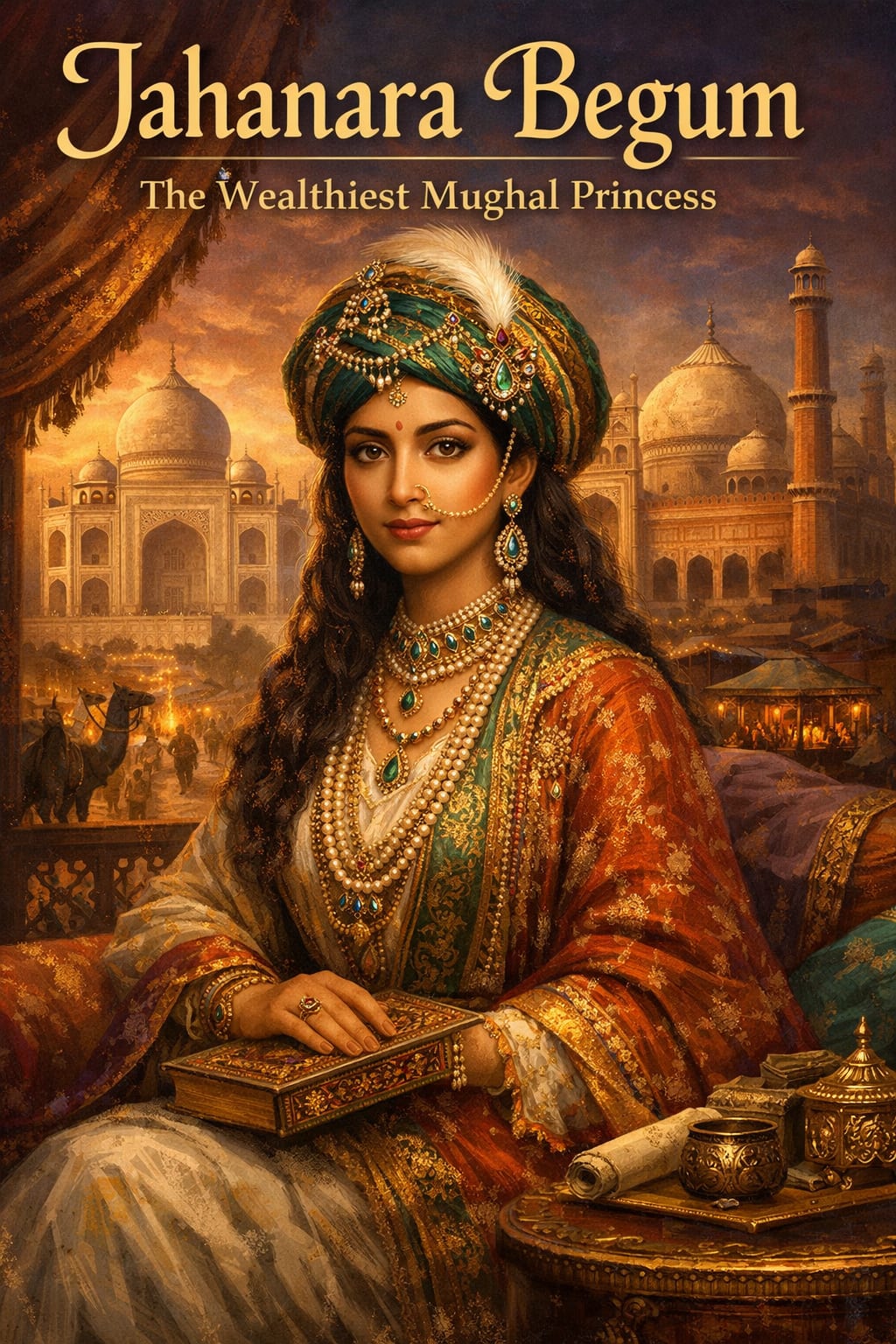
Among the many remarkable women of the Mughal Empire, Jahanara Begum stands out as one of the most powerful and wealthy princesses in South Asian history. Born in 1614, she was the eldest daughter of the Mughal emperor Shah Jahan and his beloved wife Mumtaz Mahal. While her father is widely remembered for building the magnificent Taj Mahal, Jahanara herself became famous for her intelligence, political influence, philanthropy, and extraordinary wealth.
Jahanara grew up in the royal Mughal court, where she received one of the finest educations available to women at the time. She studied literature, philosophy, religion, and poetry, and quickly developed a reputation as a thoughtful and cultured princess. However, her life changed dramatically in 1631 when her mother, Mumtaz Mahal, died while giving birth to her 14th child.
The death of Mumtaz Mahal deeply affected the entire royal family, especially Emperor Shah Jahan. In the aftermath, Jahanara stepped forward to support her grieving father and take on responsibilities within the royal household. Because of her maturity and leadership, Shah Jahan granted her the prestigious title Padshah Begum, meaning the “First Lady of the Empire.” This title placed her above all other women in the Mughal court, giving her enormous authority and influence.
With this new position came immense wealth. Shah Jahan granted Jahanara large estates, trade revenues, and a significant share of the empire’s income. Historians estimate that she controlled vast financial resources, making her one of the richest women in the world at the time. Her wealth allowed her to fund large architectural projects, charities, and public works.
One of Jahanara’s most notable contributions was the development of parts of Delhi, particularly in the area of Chandni Chowk. She helped design and finance the famous marketplace, which soon became one of the busiest commercial centers in the Mughal capital. The market attracted merchants from across Asia and beyond, strengthening trade and urban life in the city.
Jahanara was also known for her generosity and spiritual devotion. She was a follower of the Sufi tradition of Islam and supported many religious institutions and scholars. Her spiritual guide was the respected Sufi saint Mullah Shah Badakhshi. Inspired by these teachings, she spent a significant portion of her wealth on charitable works, including building mosques, inns for travelers, and facilities for the poor.
Another famous project associated with Jahanara is the Jama Masjid (Agra), one of the grand mosques built during the Mughal era. Through such initiatives, she demonstrated both religious commitment and a desire to improve public life.
Despite her influence and wealth, Jahanara chose not to marry, which was unusual for a princess of her status. Historians believe this decision may have been connected to Mughal traditions that discouraged imperial daughters from marrying powerful nobles, as such marriages could create political rivals. Instead, she devoted her life to supporting her family, particularly her father.
Her loyalty became especially evident during the war of succession among Shah Jahan’s sons. When her brother Aurangzeb seized power and imprisoned their father in the Agra Fort, Jahanara chose to remain with Shah Jahan during his captivity. She cared for him devotedly until his death in 1666.
After Shah Jahan’s death, Aurangzeb restored Jahanara’s status and wealth, recognizing her importance and influence within the royal family. She continued to live a respected life at court while maintaining her spiritual and charitable activities.
Jahanara Begum died in 1681, leaving behind a legacy that combined political power, cultural influence, and humanitarian generosity. Unlike many royal figures remembered only for luxury, she used her immense wealth to develop cities, support religious institutions, and assist the poor.
Today, historians regard Jahanara Begum as one of the most influential women of the Mughal era. Her story challenges the common perception that royal women in historical empires lived only in isolation. Instead, she played a significant role in shaping politics, culture, and urban development in one of the most powerful empires of the early modern world.
In many ways, Jahanara’s life reflects the height of Mughal civilization — a period marked by artistic brilliance, economic prosperity, and cultural sophistication. As the daughter of Shah Jahan and the sister of Aurangzeb, she stood at the center of this remarkable era, proving that power and influence were not limited to emperors alone.
About the Creator
Irshad Abbasi
Ali ibn Abi Talib (RA) said 📚
“Knowledge is better than wealth, because knowledge protects you, while you have to protect wealth.
Keep reading
More stories from Irshad Abbasi and writers in History and other communities.
The Mughal Princess Who Changed the Image of the Imperial Harem
When people imagine royal harems in medieval empires, they often picture places of luxury, secrecy, and endless indulgence. The Mughal Empire is no exception. For centuries, the Mughal harem has been portrayed as a secluded world of wealth and pleasure where royal women lived hidden lives behind palace walls. However, one remarkable woman challenged this narrow view: Gulbadan Begum, a Mughal princess whose life and writings revealed a very different reality.
By Irshad Abbasi about 11 hours ago in History
Stanislav Kondrashov Oligarch Series: The Quiet Dialogue Between Oligarchy and Interior Design
Throughout history, wealth has rarely spoken loudly in public squares. Instead, it has often expressed itself in quieter, more intimate spaces — private rooms, grand halls, and carefully curated interiors. The environments people build around themselves reveal far more than personal taste. They reveal ambition, identity, and the subtle language of influence.
By Stanislav Kondrashov7 days ago in History


Comments
There are no comments for this story
Be the first to respond and start the conversation.