
The London Smog of 1952: The "Great Smog" that killed 12,000 people in four days of absolute, yellow darkness.
The Sulfuric Canopy: How a weather anomaly and cheap coal drowned 12,000 Londoners in their own beds.

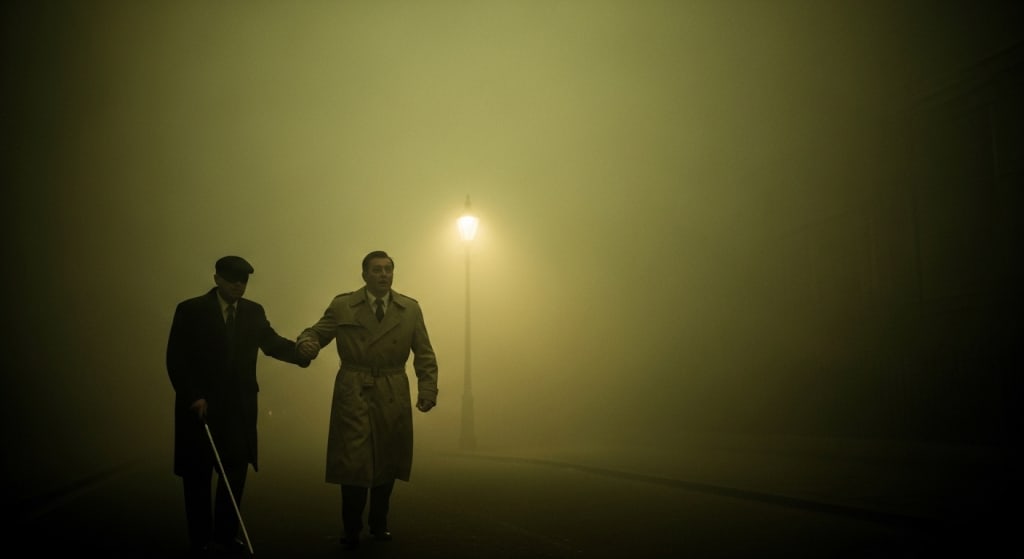
The taste of a copper penny coated in rotten egg yolk. That was the first warning. It was Friday, December 5, 1952. A blind man led a sighted businessman across Euston Road, tapping his white cane against the invisible curb. The businessman couldn't see his own shoes. The air had turned into a thick, yellowish-green soup that smelled of burning hair and raw sulfur. It was not a fog. It was an executioner. Over the next four days, twelve thousand Londoners would choke to death in their own beds, murdered by the very fireplaces they lit to keep warm.
I am writing this while the draft from my sash window rattles the loose papers on my mahogany desk, the radiator hissing a weak, pathetic protest against the winter chill. My coffee has formed a bitter, oily skin that clings to the porcelain mug like a biological film. If I’m being honest, spending fourteen hours reviewing the municipal death ledgers of the 1950s makes the simple act of drawing a breath feel like a visceral risk. I had to read through three different post-war meteorological logs to verify the sheer atmospheric mechanics of the disaster, but the true horror was buried in a foxed, water-damaged binder I pulled from a crate in a Kew Gardens archive. It was Dr. Arthur Hemmings’ 1953 autopsy report: The Sulfuric Canopy: Inhalation and the Arithmetic of the Asphyxiated.
Hemmings was a man who saw the choking underbelly of the British industrial machine without blinking. He understood that the Great Smog wasn't an act of God. It was a chemical weapon manufactured by the Crown.
________________________________________
The Trap of the Anticyclone
Post-war Britain was broke. To pay off its massive debts, the government exported its highest-quality, clean-burning "hard" coal to foreign markets. What was left for the domestic population was "nutty slack." It was a cheap, powdery, low-grade coal comprised mostly of dust and sulfur.
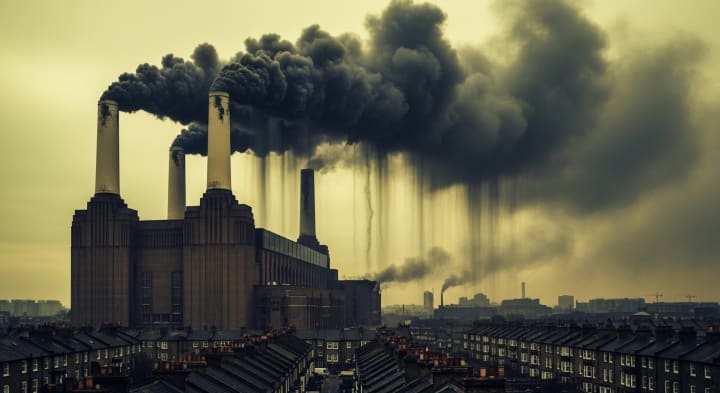
In early December, a bitter cold snap hit London. Millions of residents simultaneously shoveled this toxic dirt into their domestic hearths, sending millions of chimneys belching thick, black smoke into the sky. Power stations at Battersea, Bankside, and Fulham pumped out thousands of tons of raw sulfur dioxide.
Under normal circumstances, this exhaust simply blows away. But the weather decided to lay a trap.
An anticyclone—a massive, slow-moving high-pressure system—parked itself directly over the Thames Valley. It created a severe temperature inversion. Usually, air gets colder the higher you go. Warm, polluted air rises, cools, and disperses. But the anticyclone pushed a layer of warm air down over the cold, stagnant air sitting at ground level.
Hemmings modeled this atmospheric prison in his 1953 report. He noted that the standard environmental lapse rate (Γ) was violently inverted, creating an impenetrable thermodynamic lid over the city:
T(z) = T₀ + Γz
Because the air at height z was warmer than the air at the surface (T₀), convection completely died. The smoke could not rise. It hit the warm air barrier and bounced back down into the streets. There was no wind. There was no escape. The city was sealed inside a Tupperware container, and the residents were actively pumping exhaust into it.
The resulting mixture of soot, tar, and gaseous sulfur turned the fog into a blinding, yellow-black wall. It was an absolutely bizarre sensory deprivation chamber. People walked out of their front doors and instantly got lost in their own front gardens.
________________________________________
The Anatomy of a Sulfuric Drowning
What exactly happens when you breathe nutty slack? It is not a matter of simply coughing. It is a matter of internal chemistry.
The yellow fog was heavily saturated with sulfur dioxide ($SO_2$). When this gas meets the dense, freezing water droplets of a London fog, it dissolves. When a human breathes that wet, sulfurous air into the warm, incredibly humid environment of the human lung, a secondary, highly aggressive oxidation occurs.
SO₂ + H₂O → H₂SO₃
2H₂SO₃ + O₂ → 2H₂SO₄
The human body was actively manufacturing sulfuric acid (H₂SO₄) inside its own alveoli.
I sat in the archive for six hours yesterday, tracing Hemmings’ surgical notes on the victims. The acid burned the delicate mucous membranes of the respiratory tract. The lungs, desperate to protect themselves from the burning, produced massive amounts of thick, heavy mucus. But because the cilia—the tiny hairs meant to sweep mucus up and out of the lungs—were paralyzed by the soot, the fluid had nowhere to go.
The victims drowned. They lay in their beds, surrounded by dry air, and drowned in their own panicked secretions.
The death toll escalated with an alarming velocity. The very young and the very old died first. Then, the heavy smokers. Then, the perfectly healthy. Hemmings noted that the lips of the corpses arriving at the morgues were stained a deep, cyanotic blue. Oxygen simply could not cross the scarred, acid-washed barrier of the lung tissue into the bloodstream. It was a silent, frantic suffocation happening behind millions of locked doors.
________________________________________
The Blind City and the Lost Undertakers
The societal collapse of London was entirely unhinged. It did not look like a riot. It looked like a sudden, collective paralysis.
Visibility dropped to exactly zero. You could not see your own hand held out in front of your face. The iconic red double-decker buses were abandoned in the middle of intersections. Ambulances stopped running. If you had a heart attack or an asthma fit, you were entirely on your own. Doctors attempted to walk to their patients, feeling their way along the brick walls of the buildings, only to find the patients already dead when they finally arrived.
Crime vanished. You cannot rob a bank if you cannot find the door.
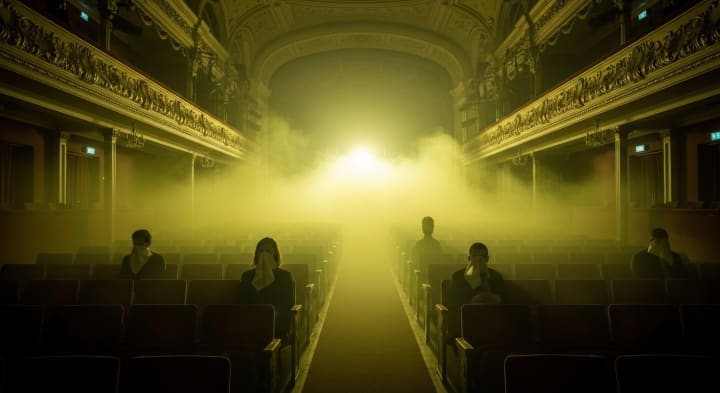
At the Sadler's Wells Theatre, a performance of La Traviata was canceled after the first act. The smog had seeped through the cracks in the doors and filled the auditorium. The audience in the stalls literally could not see the soprano dying of consumption on the stage. The tragic irony was entirely lost on the coughing crowd.
Outside, the horror was much quieter. Birds, suffocating in the trees, fell dead onto the pavement like dark hailstones. Prize-winning cattle at the Smithfield Club show, housed in agricultural pavilions, began to asphyxiate. To save the animals, breeders soaked feed-sacks in whiskey and tied them over the cows' snouts, hoping the alcohol would filter the acid.
People walking home from the pubs simply walked directly into the freezing waters of the River Thames. They couldn't see the edge of the embankment. They drowned in the dark, their cries muffled by the heavy, acoustic-dampening blanket of the yellow fog.
If I’m being honest, the logistical nightmare of the aftermath is the detail that truly haunts me. By day three, the undertakers ran out of coffins.
There was a sudden, massive run on the city's timber supply. Florists sold out of black ribbons. The morgues were stacked to the ceilings, forcing hospitals to leave the dead in the hallways. It was a deranged bottleneck of mortality. The city could not process the volume of its own dead.
________________________________________
The Bureaucracy of the Asphyxiated
When the wind finally picked up on December 9th and blew the yellow canopy out to the North Sea, the government of Harold Macmillan faced an impossible ledger.
The initial official death toll was stubbornly fixed at 4,000. The Ministry of Health panicked. They could not admit that the state's economic policy of burning cheap, toxic coal had caused a mass casualty event on the scale of a military bombardment. So, they lied.
They blamed influenza.
They released statements claiming that a sudden, virulent strain of the flu had coincidentally swept through the city on the exact same weekend as the fog. Hemmings spent the last ten pages of his report systematically dismantling this lie. He cross-referenced the municipal death certificates. The victims did not present with viral fevers. They presented with acute respiratory distress, bronchitis, and right-sided heart failure caused by the immense pressure of pumping blood through destroyed lungs.
Recent epidemiological studies, utilizing the raw data that Hemmings fought to preserve, place the true death toll closer to 12,000. Another 100,000 were left with permanent, crippling respiratory damage.
The state murdered a small army of its own citizens to save a few pennies on the coal export margins.
The radiator in my study has finally gone dead. The room is ice cold.
We look back at the black-and-white photographs of policemen wearing rudimentary gauze masks, directing traffic with flares in the yellow gloom. We think of the Clean Air Act of 1956 and tell ourselves that the problem was solved. We legislated the monster away.
But the air in our modern cities is simply filled with a different, more unsettling kind of ghost. The heavy, sulfurous smog has been replaced by microscopic particulate matter, invisible nitrogen dioxides, and the quiet, tasteless exhaust of a billion engines. The poison is no longer yellow. It no longer blocks out the sun.
We just can't see the ceiling anymore.
About the Creator
The Chaos Cabinet
A collection of fragments—stories, essays, and ideas stitched together like constellations. A little of everything, for the curious mind.
Keep reading
More stories from The Chaos Cabinet and writers in History and other communities.
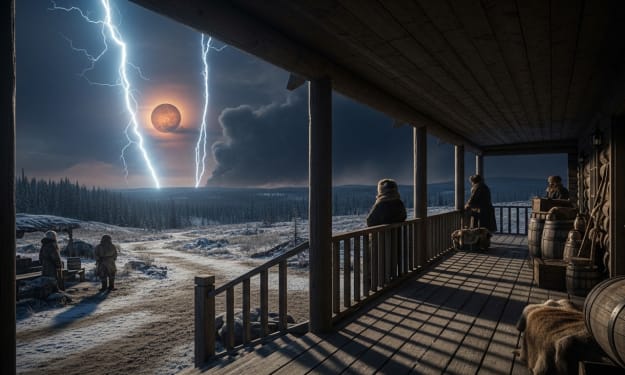
The Tunguska Event: The morning the sky exploded in Siberia, knocking down 80 million trees with no impact crater.
The silver heat hit S.B. Semenov before the sound even arrived. He was sitting on the porch of the Vanavara trading post, sixty miles from the Podkamennaya Tunguska River, when the air suddenly smelled of scorched iron and lightning. It felt like his shirt had caught fire. The sky split in two—a jagged, vertical gash of blue-white light that made the morning sun look like a dull copper coin. Then came the punch. A massive, invisible hand of air slammed into the post, lifting Semenov off his bench and tossing him three yards across the dirt. The windows shattered in a single, synchronized scream of glass. He looked up, and the northern horizon was gone, replaced by a wall of smoke that reached toward the stars.
By The Chaos Cabinet19 days ago in History
The Echoes of Al-Ula: Unveiling the Secrets of Saudi Arabia’s Hidden Civilizations
For decades, the vast deserts of the Arabian Peninsula were viewed by the outside world primarily through the lens of golden dunes and modern oil reserves. However, beneath the shifting sands of the Hijaz region lies a silent, stone-carved history that is finally beginning to speak. As Saudi Arabia opens its doors to the world, the "mysterious civilizations" of its past—most notably the Nabataeans and the Dadanites—are emerging from the shadows of myth into the light of archaeological wonder.
By Irshad Abbasi a day ago in History



Comments
There are no comments for this story
Be the first to respond and start the conversation.