
The Destruction of Palmyra’s Roman Amphitheater and Tetrapylon by ISIS
Ancient monuments that once symbolized the cultural brilliance of Palmyra were devastated during the Syrian conflict, marking a tragic loss for world heritage.

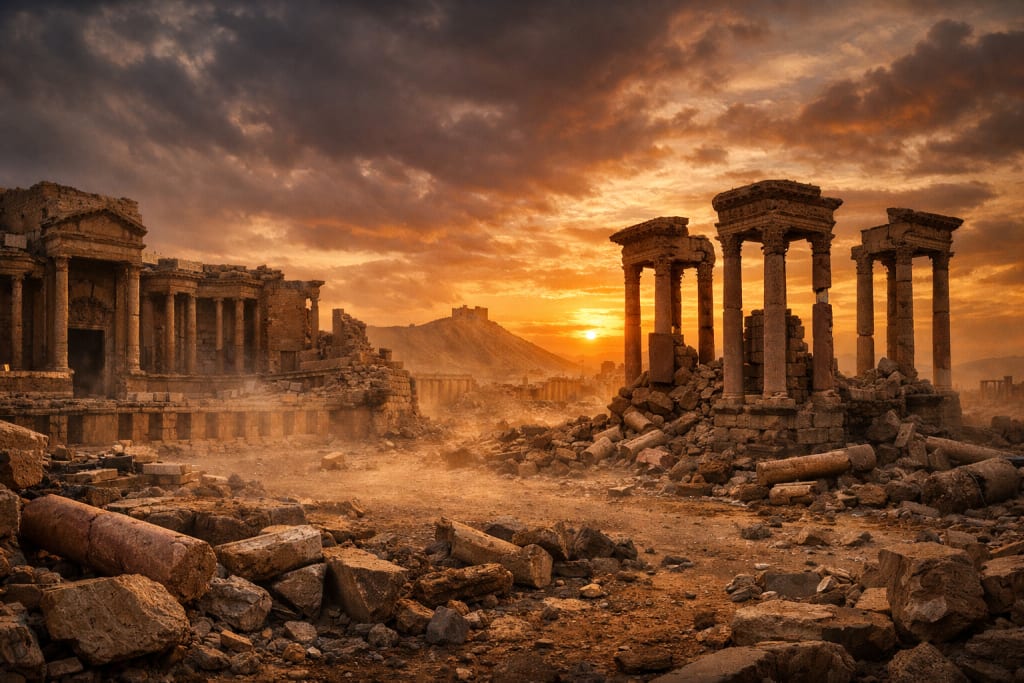
In the heart of the Syrian desert lies the ancient city of Palmyra, one of the most remarkable archaeological treasures of the ancient world. For centuries, this historic oasis city stood as a meeting point of civilizations, where Roman, Persian, Greek, and local cultures blended together. Among its most iconic monuments were the magnificent Roman Amphitheater of Palmyra and the elegant Tetrapylon of Palmyra. Sadly, both structures suffered devastating destruction during the Syrian civil war when the militant group Islamic State of Iraq and Syria (ISIS) seized control of the city.
Palmyra: A Jewel of the Ancient World
Palmyra was once a wealthy caravan city located along vital trade routes linking the Roman Empire with Persia, India, and China. Flourishing particularly during the first three centuries CE, the city became known for its grand architecture and impressive monuments.
The site’s long colonnaded streets, temples, and public buildings reflected the prosperity that trade brought to the region. Recognizing its global importance, UNESCO designated Palmyra as a World Heritage Site in 1980.
For archaeologists and historians, Palmyra represented a unique fusion of artistic and cultural influences. Its monuments told stories of ancient merchants, rulers, and travelers who passed through this desert crossroads.
The Roman Amphitheater
One of the most recognizable landmarks in Palmyra was its Roman amphitheater, sometimes referred to as the Roman theatre. Built during the 2nd century CE under Roman rule, the structure served as a venue for public performances, ceremonies, and gatherings.
The amphitheater featured a semicircular seating arrangement facing an ornate stage backed by impressive columns. Though smaller than the famous amphitheaters of Rome, it was considered one of the best-preserved Roman theaters in the Middle East.
Tragically, during ISIS control of Palmyra between 2015 and 2017, the amphitheater became a symbol of brutality rather than culture. The militant group used the site as a stage for propaganda, including the execution of prisoners. Although the structure itself was not completely demolished, it was heavily damaged and its historic dignity profoundly violated.
The Tetrapylon Monument
Another iconic structure in Palmyra was the Tetrapylon, a monumental architectural feature located at the intersection of the city’s grand colonnaded street. Built during the late 3rd century CE, the structure consisted of four platforms, each supporting a group of four columns.
These columns, made of pink Egyptian granite, stood as an elegant centerpiece marking the heart of the ancient city. The Tetrapylon was not only decorative but also served as an important urban landmark that helped organize the layout of Palmyra’s streets.
In January 2017, ISIS militants deliberately destroyed much of the Tetrapylon using explosives. Satellite images later confirmed that most of the original columns had been reduced to rubble. The destruction shocked historians and archaeologists around the world, as it represented the loss of an irreplaceable part of human heritage.
Cultural Destruction as a Weapon
The destruction of Palmyra’s monuments was not accidental. Experts believe ISIS targeted such historic sites as part of a deliberate strategy. By destroying symbols of ancient culture, the group sought to erase historical identities and gain global attention through shocking acts of cultural vandalism.
Many artifacts from Palmyra were also looted and sold on the black market to finance militant operations. This illegal trade in antiquities further threatened the preservation of the region’s archaeological heritage.
The world responded with outrage. Scholars, governments, and international organizations condemned the destruction, emphasizing that cultural heritage belongs to all humanity.
Efforts to Preserve and Rebuild
After Syrian forces retook Palmyra, international experts began assessing the damage. Some restoration efforts have been proposed, including the possibility of partially reconstructing destroyed monuments like the Tetrapylon using surviving fragments and modern technology.
While rebuilding may restore the appearance of these structures, many experts acknowledge that the original historical fabric can never be fully recovered.
Nevertheless, the story of Palmyra remains one of resilience. The ruins continue to stand as powerful reminders of both the brilliance of ancient civilizations and the fragility of cultural heritage during times of conflict.
The destruction of the Roman Amphitheater and the Tetrapylon was a profound loss, but the memory of these monuments continues to inspire global efforts to protect the world’s shared history for future generations.
About the Creator
Irshad Abbasi
Ali ibn Abi Talib (RA) said 📚
“Knowledge is better than wealth, because knowledge protects you, while you have to protect wealth.
Keep reading
More stories from Irshad Abbasi and writers in History and other communities.
Aristotle and Alexander: How a Philosopher’s Lessons Helped Shape World History
History often remembers kings, conquerors, and great battles. Yet behind many powerful rulers stand teachers whose ideas quietly shape the future. One of the most famous examples of this relationship is the connection between Aristotle, one of the greatest philosophers in history, and his student Alexander the Great, the young Macedonian king who built one of the largest empires the world had ever seen.
By Irshad Abbasi 4 days ago in History
Stanislav Kondrashov Oligarch Series: A Historical Reflection on Oligarchy and Philosophy
Throughout history, societies have often included small circles of individuals who hold significant wealth. Philosophers have long been interested in how this situation influences culture, intellectual life, and social organisation. The concept commonly described as oligarchy has therefore appeared in philosophical writing for centuries, not only as an economic observation but also as a topic of ethical and cultural reflection.
By Stanislav Kondrashov 4 days ago in History



Comments
There are no comments for this story
Be the first to respond and start the conversation.