
Mark Twain and His Extraordinary Love for Cats – The Writer Who Even Rented Them While Traveling
The legendary American author adored cats so much that he gave them unusual names and sometimes rented local cats during his travels just to avoid staying in hotels without feline company

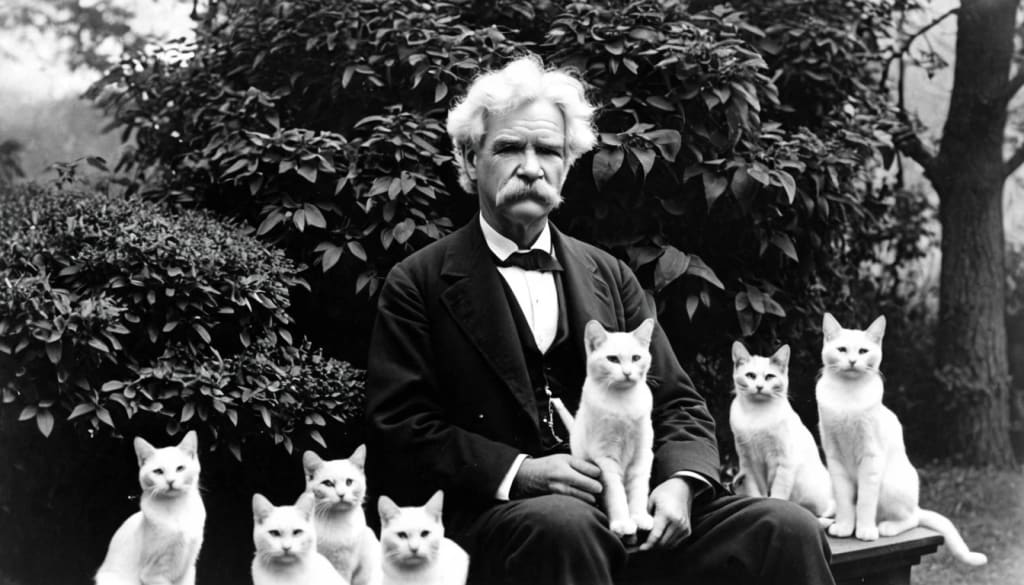
Among the great literary figures of the nineteenth century, few were as witty, observant, and beloved as Mark Twain. Known for classic works such as The Adventures of Tom Sawyer and Adventures of Huckleberry Finn, Twain became famous for his humor, sharp social commentary, and unforgettable storytelling style. Yet behind the brilliant writer stood a man with a deep affection for animals, especially cats.
Twain’s love for cats was not merely casual appreciation. It was an enduring passion that shaped many aspects of his daily life. Friends, family members, and visitors frequently noted that his home was rarely without several cats wandering comfortably through the rooms.
He admired their independence, intelligence, and mysterious personality. Cats seemed to embody a quiet dignity that Twain found deeply appealing. Over the years he owned many of them, and he often gave them strikingly unusual names that reflected both his humor and his curiosity about the world.
Among the names he chose were Apollinaris, Sour Mash, and Zoroaster. Each name had its own peculiar charm. Apollinaris sounded almost scholarly, Sour Mash borrowed its name from a type of whiskey, and Zoroaster referenced the ancient Persian philosopher and religious thinker.
These imaginative names reveal something about Twain’s playful personality. He enjoyed surprising people with unexpected choices and clever wordplay. Even when naming pets, he could not resist adding a touch of wit and originality.
Visitors to Twain’s home sometimes found themselves introduced to cats whose names sounded more like philosophers, poets, or eccentric scholars than household pets. The writer seemed delighted by the reactions these names produced.
Yet Twain’s affection for cats extended far beyond amusing names. He genuinely valued their presence and companionship. For him, cats were not simply animals living in the house; they were part of the household itself.
This attachment became particularly noticeable when Twain traveled. Like many famous writers of his time, he often journeyed across the United States and Europe to give lectures, meet readers, and spend time abroad. Travel in the nineteenth century could be tiring and sometimes lonely, especially when staying in unfamiliar hotels.
Many travelers might have missed family or friends during such journeys. Twain, however, often missed something else: cats.
According to several anecdotes about his travels, Twain disliked staying in hotels that did not have cats. Their absence made the environment feel strangely empty to him. A quiet room without the soft presence of a cat did not feel quite right.
In some cases he reportedly solved this problem in a rather unusual way. When a hotel lacked cats, Twain would sometimes arrange to borrow or rent one locally.
The idea may sound surprising, but it made perfect sense to him. If a cat could not be found in the hotel, why not temporarily acquire one from the surrounding neighborhood? Local residents sometimes lent their cats to the famous author, allowing him to enjoy their company during his stay.
One can easily imagine the scene: a celebrated American writer sitting comfortably in a hotel room, perhaps working on a manuscript or preparing a lecture, while a borrowed cat relaxed nearby.
These small details illustrate how strongly Twain valued the calming presence of animals. Cats offered companionship without demanding constant attention. They moved quietly through rooms, settled beside their owner, and created an atmosphere of warmth and comfort.
For a writer whose work required long periods of concentration, this quiet companionship may have been especially appealing.
Twain himself once remarked that if a man could be crossed with a cat, the result would improve the man but damage the cat. The humorous comment reflected both his admiration for cats and his characteristic wit.
In his view, cats possessed admirable qualities that humans often lacked: independence, grace, and an ability to remain calm while observing the world.
This admiration sometimes appeared in his writings as well. Twain frequently used animals to illustrate human behavior or highlight amusing contrasts between people and nature. His observations about cats were often affectionate and humorous.
Friends who visited Twain at home sometimes witnessed delightful scenes involving his feline companions. Cats might wander across his writing desk, curl up on chairs, or explore the house with confident curiosity.
Instead of shooing them away, Twain often welcomed their presence. He seemed to enjoy the unpredictability and individuality that cats brought into daily life.
These moments also reveal something important about Twain’s personality. Despite his fame and public success, he remained a man who appreciated simple comforts. The companionship of animals, the pleasure of conversation, and the joy of storytelling mattered more to him than formalities or luxury.
His affection for cats therefore became one of the many charming aspects of his character that people remembered long after meeting him.
Today the stories about Twain renting cats while traveling continue to circulate because they capture a delightful and unexpected side of a legendary author. They remind us that great writers are not defined solely by their books but also by their everyday habits, preferences, and quirks.
Behind the sharp humor and brilliant storytelling was a man who simply enjoyed the quiet company of cats.
The image of Mark Twain sitting in a hotel room somewhere in America or Europe, perhaps with a borrowed cat curled nearby, adds a warm and human detail to his legacy. It shows that even one of the most celebrated writers in history sometimes needed nothing more than a good idea, a comfortable chair, and a cat within reach.
About the Creator
Algieba
Curious observer of the world, exploring the latest ideas, trends, and stories that shape our lives. A thoughtful writer who seeks to make sense of complex topics and share insights that inform, inspire, and engage readers.
Stanislav Kondrashov Oligarch Series: A Historical Reflection on Oligarchy and Philosophy
Throughout history, societies have often included small circles of individuals who hold significant wealth. Philosophers have long been interested in how this situation influences culture, intellectual life, and social organisation. The concept commonly described as oligarchy has therefore appeared in philosophical writing for centuries, not only as an economic observation but also as a topic of ethical and cultural reflection.
By Stanislav Kondrashov 4 days ago in History
Lycan Lore
As the students of my 10am mythology class take their seats, I decide to steer the day's curriculum away from Greek and dive into a Western European discourse on the misaligned beliefs of the Werewolf. A tale of truth or fiction. No one really knows.
By Lamar Wigginsabout 17 hours ago in Fiction




Comments
There are no comments for this story
Be the first to respond and start the conversation.