
Israel’s Cave Yields Historical Documents
Discovery of millennia-old manuscripts sheds light on early civilizations and religious practices

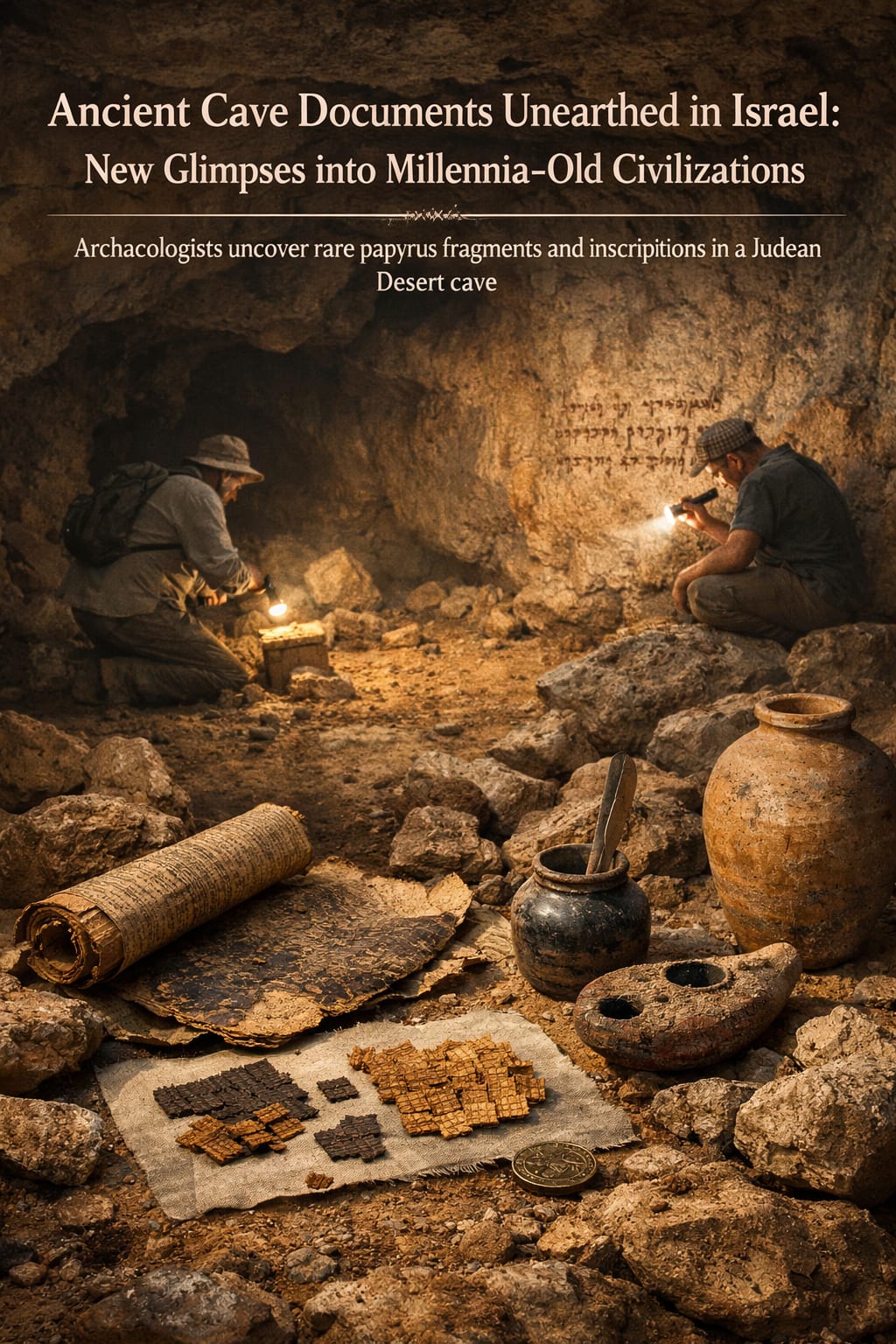
Here’s a detailed article in English based on youIn a remarkable archaeological breakthrough, researchers in Israel have uncovered a cache of ancient documents hidden in a remote cave. The discovery, which experts describe as “extraordinary,” promises to offer fresh insights into the cultural, religious, and social practices of early civilizations in the region.
The cave, located in a rugged and scarcely explored area, was initially surveyed by archaeologists who were conducting routine explorations of Israel’s historical landscape. Inside, the team found a collection of manuscripts, some of which date back thousands of years. Preliminary analysis indicates that these texts were written on fragile materials, possibly animal skins and early forms of parchment, preserved remarkably well due to the cave’s dry and stable environment.
Dr. Eliav Cohen, the lead archaeologist on the project, explained, “These documents are invaluable for understanding the intellectual and spiritual life of communities that lived here centuries ago. Each manuscript provides a window into their beliefs, laws, and daily activities.” Some of the writings appear to contain religious instructions, while others may be administrative or legal in nature, suggesting the cave served as a repository for important communal records.
Similar discoveries in Israel have previously revolutionized our understanding of ancient societies. The most famous of these are the Dead Sea Scrolls, which provided scholars with unprecedented insight into Jewish religious practices during the Second Temple period. This new find, though smaller in scale, could similarly reshape historical narratives by filling gaps in our knowledge of lesser-known communities.
Preservation experts are now working to carefully conserve the manuscripts, employing state-of-the-art techniques to stabilize the fragile texts. Digital imaging and multispectral scanning will allow researchers to read faded or damaged writing without risking further harm. Scholars from multiple disciplines, including historians, linguists, and theologians, have already expressed keen interest in studying the materials.
One of the most intriguing aspects of the discovery is the potential diversity of the texts. Early examinations suggest the documents could have been created by multiple groups over several generations, providing a layered view of societal evolution. Such findings could illuminate the way knowledge, culture, and religious traditions were transmitted in the ancient Near East.
The discovery has also sparked excitement among the public and policymakers. Israel’s Ministry of Culture and Sport has promised to ensure that the site is protected while allowing controlled access for educational purposes. Dr. Cohen emphasized, “We are handling this with the utmost care. It is crucial that the documents are preserved for future generations while also allowing the public to engage with their history.”
Archaeologists are optimistic that further exploration in and around the cave could uncover additional artifacts. Pottery shards, tools, and other everyday objects might provide context for the texts, helping researchers reconstruct the lifestyles of the people who used them. These objects can also offer clues about trade, agriculture, and interactions with neighboring communities.
The discovery serves as a reminder of the enduring human desire to record experiences, beliefs, and knowledge. Even in a time when literacy was rare, communities went to great lengths to preserve vital information, reflecting an early understanding of the importance of memory and legacy.
While it will take months, if not years, for experts to fully analyze the documents, the initial findings have already generated significant academic and public interest. As researchers continue their work, these ancient manuscripts may reveal stories of daily life, spiritual reflection, and governance that have remained hidden for millennia.
In a world increasingly connected by technology and instant communication, these fragile, timeworn documents from Israel’s cave serve as a profound reminder of humanity’s deep-rooted urge to document and preserve knowledge. They are not merely relics of the past but bridges connecting modern society with the wisdom and experiences of ancient civilizations.
About the Creator
Irshad Abbasi
Ali ibn Abi Talib (RA) said 📚
“Knowledge is better than wealth, because knowledge protects you, while you have to protect wealth.
Keep reading
More stories from Irshad Abbasi and writers in History and other communities.
Ancient Secrets Beneath the Thames: 5,000-Year-Old Human Bone Discovered in London
The muddy banks of the River Thames in London have long been known as a treasure trove of history, yielding countless artifacts from different eras. Recently, archaeologists and researchers were astonished by the discovery of a human bone believed to be around 5,000 years old, dating back to prehistoric Britain. This remarkable find sheds new light on the ancient communities that once lived along the river and raises intriguing questions about their rituals, lifestyles, and relationship with the Thames.
By Irshad Abbasi about 21 hours ago in History
Who’s Secretly Behind Israel’s Power?
On 27 September 2024, in New York, during the United Nations General Assembly, when it was the turn of Israeli Prime Minister Benjamin Netanyahu to give his speech, more than half of the diplomats protested by turning their backs on him and walking out of the assembly. The message was very clear: they were protesting Israel’s bombing in Gaza and Lebanon.
By Imran Ali Shah6 days ago in History




Comments
There are no comments for this story
Be the first to respond and start the conversation.