
Father of Millions, Yet Not Always a Father to His Own Sons
The paradox of a conqueror who became the ancestor of millions across Eurasia, while facing doubts, rivalries, and distance within his own family.

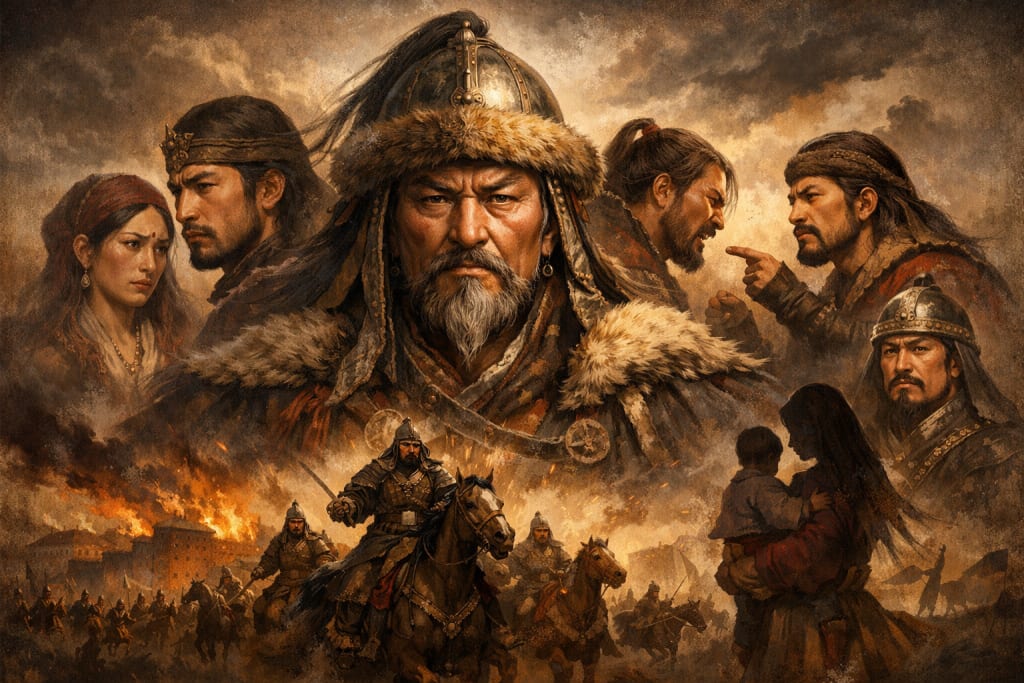
Few figures in world history have left as profound a mark as Genghis Khan. Known for his extraordinary military genius and ruthless campaigns, he forged the largest contiguous empire the world had ever seen—the Mongol Empire. Yet beyond the battlefield and the politics of conquest lies a fascinating paradox: while Genghis Khan is believed to be the ancestor of millions of people today, his relationship with his own sons was complicated, strained, and sometimes filled with uncertainty.
Modern genetic research suggests that a remarkable portion of men across Central Asia share a common Y-chromosome lineage that traces back to the family of Genghis Khan. A famous 2003 genetic study estimated that roughly 16 million men alive today could be descendants of this Mongol ruler. Through his many wives and concubines—common among steppe rulers—his bloodline spread widely across Eurasia. In this sense, Genghis Khan became a symbolic “father of millions.”
However, his role as a father to his own children was far more complex.
Genghis Khan, whose birth name was Temujin, married Börte at a young age. Börte remained his principal wife and the mother of his four most important sons: Jochi, Chagatai Khan, Ögedei Khan, and Tolui. These sons would later inherit and govern vast portions of the Mongol Empire.
But the family’s harmony was disrupted early by a dramatic event. Shortly after her marriage, Börte was kidnapped by a rival tribe known as the Merkits. She was held captive for several months before Temujin rescued her with the help of his allies. Soon after returning, Börte gave birth to her first son, Jochi.
This event cast a long shadow over the family.
Because Börte had been in captivity when Jochi was conceived, rumors spread that Jochi might not be Temujin’s biological son. Although Genghis Khan publicly accepted Jochi as his child, the doubt never fully disappeared. The uncertainty created deep tensions between the brothers, particularly between Jochi and Chagatai.
Historical sources describe frequent arguments between the two. Chagatai openly questioned Jochi’s legitimacy, suggesting that he was not truly the son of Genghis Khan. These disputes became so serious that they threatened the unity of the ruling family.
For Genghis Khan, whose entire empire depended on loyalty and discipline, such family conflict was dangerous. The issue became especially important when the question of succession arose: who would inherit leadership of the vast Mongol Empire?
Because of the tension between Jochi and Chagatai, Genghis Khan avoided choosing either of them as his successor. Instead, he selected his third son, Ögedei, who was seen as more diplomatic and capable of maintaining unity among the Mongol princes.
This decision shaped the future of the empire.
When Genghis Khan died in 1227, Ögedei became the next Great Khan. Under his leadership, the Mongol Empire continued expanding dramatically, eventually stretching from Eastern Europe to China. Meanwhile, Jochi had already died shortly before his father, though his descendants later ruled the western part of the empire known as the Golden Horde.
Despite the doubts surrounding Jochi, his lineage became extremely influential. His descendants ruled large territories for centuries, influencing the history of Russia, Central Asia, and Eastern Europe.
This complicated family history highlights the paradox in Genghis Khan’s life. On one hand, his genetic legacy spread across continents, making him one of the most prolific ancestors in human history. On the other hand, within his own household, questions of legitimacy, rivalry, and power created deep divisions.
Historians often emphasize Genghis Khan’s achievements as a conqueror and empire-builder. Yet his personal life reminds us that even the most powerful rulers faced ordinary human struggles—family disputes, doubts about loyalty, and the challenge of choosing an heir.
In the end, Genghis Khan became the forefather of millions across the world. But the irony remains striking: the man who gave rise to an immense bloodline spent much of his life navigating uncertainty and conflict among his own sons.
It is this contrast—between global legacy and personal complexity—that makes the story of Genghis Khan not only one of conquest, but also of human drama within the greatest empire of the medieval world.
About the Creator
Irshad Abbasi
Ali ibn Abi Talib (RA) said 📚
“Knowledge is better than wealth, because knowledge protects you, while you have to protect wealth.
Keep reading
More stories from Irshad Abbasi and writers in History and other communities.
The Night Polo of Emperor Akbar: When a Glowing Ball Lit Up the Mughal Game
Among the many fascinating innovations associated with the Mughal Empire, one lesser-known yet remarkable story involves the love of sport displayed by the great emperor Akbar. Known for his administrative brilliance, military strength, and cultural openness, Akbar was also passionate about physical games—especially the ancient sport of polo, known in South Asia and Persia as chogan or chaugan. One of the most intriguing legends about him is that he introduced a glowing ball so the game could be played at night.
By Irshad Abbasi about 11 hours ago in History
Echoes of the Empire
Long before modern cities filled the world with noise and light, there stood a powerful civilization known as the Aurorian Empire. Its cities were built from shining white stone, its roads stretched across vast lands, and its people believed their empire would last forever. The story of Auroria began beside a wide river called Lumeris. The river brought life to the dry lands around it, and small villages slowly grew along its banks. Farmers planted wheat and barley in the fertile soil, fishermen filled their nets each morning, and traders carried goods from village to village. Among these early settlers was a wise leader named Arkon. He believed that the scattered villages would be stronger if they united. Arkon spoke to the villagers, saying, “If we build together, protect one another, and share our knowledge, we can create something greater than any single village.” Inspired by his vision, the people joined together and built the first great city of Auroria. As years passed, the small alliance grew into an empire. Massive stone walls surrounded the cities, grand temples rose toward the sky, and marketplaces filled with merchants from distant lands. The Aurorians invented clever irrigation systems that carried river water across their farms, allowing them to grow food even during dry seasons. Scholars studied the stars, artists carved beautiful statues, and engineers built strong bridges and roads that connected the empire from one end to the other. The empire flourished under a line of capable rulers. Each generation expanded the borders further, bringing new cultures, languages, and ideas into Auroria. Soldiers marched proudly beneath golden banners, while caravans carried silk, spices, and precious metals along the empire’s vast trade routes. People from faraway lands admired the strength of Auroria. Travelers would say, “Its cities shine like jewels in the desert, and its people are masters of knowledge and craft.” For centuries, Auroria grew richer and more powerful. But empires, like seasons, cannot remain unchanged forever. After many generations, the empire came under the rule of Emperor Darius II. Unlike the wise leaders before him, Darius cared more for luxury than leadership. He built enormous palaces decorated with gold and rare gems while ignoring the needs of farmers, soldiers, and ordinary citizens. Taxes grew heavier, and many people struggled to survive. The once-great roads fell into disrepair, and corruption spread among officials who cared only about their own wealth. At the same time, the empire’s borders began to weaken. Neighboring kingdoms that had once feared Auroria saw its growing problems. Small raids turned into larger attacks, and the empire’s army—once disciplined and united—began to lose its strength. Within the cities, people argued about how to save their civilization. Some called for reform and wise leadership, while others fought for power. Among the citizens was a young historian named Lyra. Lyra spent her days studying ancient scrolls that told the story of Auroria’s beginnings. She admired the wisdom of Arkon and the early leaders who had built the empire through unity and cooperation. One evening, while standing on the balcony of the grand library, she looked over the city. The buildings were still magnificent, but cracks had begun to appear in the stone walls, and the once-busy streets were quieter than before. Lyra realized something important. Empires were not destroyed in a single day. They slowly weakened when people forgot the values that had made them strong. Determined to preserve the truth, Lyra began writing a detailed history of Auroria. She recorded the achievements of its people—the inventions, the art, the trade, and the wisdom that had shaped their world. But she also wrote about the mistakes: the greed, the neglect, and the division that had slowly torn the empire apart. Years later, the final collapse came. Enemy armies crossed the borders, and the empire’s weakened defenses could not stop them. Cities fell one by one, and the great capital was eventually abandoned. The once-mighty empire disappeared into history. Centuries passed. Wind and sand covered many of Auroria’s ruins, and nature slowly reclaimed the empty cities. Trees grew through broken streets, and birds nested in the crumbling towers. But the story of Auroria did not vanish completely. Travelers exploring the ancient lands sometimes discovered old stone carvings or fragments of buildings that hinted at the empire’s former greatness. And deep within the ruins of the grand library, explorers eventually found Lyra’s carefully preserved writings. Her scrolls told the full story—the rise, the glory, and the fall of the Aurorian Empire. Scholars who read them understood an important lesson. Great civilizations are not remembered only for their power, but for the wisdom they leave behind. The ruins of Auroria became a place of study and reflection. Historians, students, and travelers came to learn from the echoes of the empire. They walked along the broken roads, looked up at the towering remains of ancient temples, and imagined the vibrant world that had once existed there. Though the empire itself was gone, its story continued to teach future generations about ambition, unity, and the fragile nature of power. And in the quiet wind that moved through the ruins, it sometimes seemed as if the past was whispering its lessons to anyone willing to listen—the lasting echoes of a once-great empire. 📜
By Sahir E Shafqat7 days ago in History
Why Didn't Anyone Tell Us
Men, move along. This is not for you. This is for the women. I was forty-five when I began menopause. It is pretty young for that to be going on in a woman’s life, but I had undiagnosed PCOS, my entire life. Thank you to all the gynecologists I had seen my entire life. That in itself should encourage women to keep seeking second opinions, especially when you are not getting correct answers or any at all.
By Alexandra Grant3 days ago in Humans



Comments
There are no comments for this story
Be the first to respond and start the conversation.