
Black Liberty on a Commemorative Coin: Redefining America’s Symbol of Freedom
The historic decision to portray a Black woman as the Goddess of Liberty on a U.S. commemorative coin reflects evolving ideas of identity, representation, and national values.

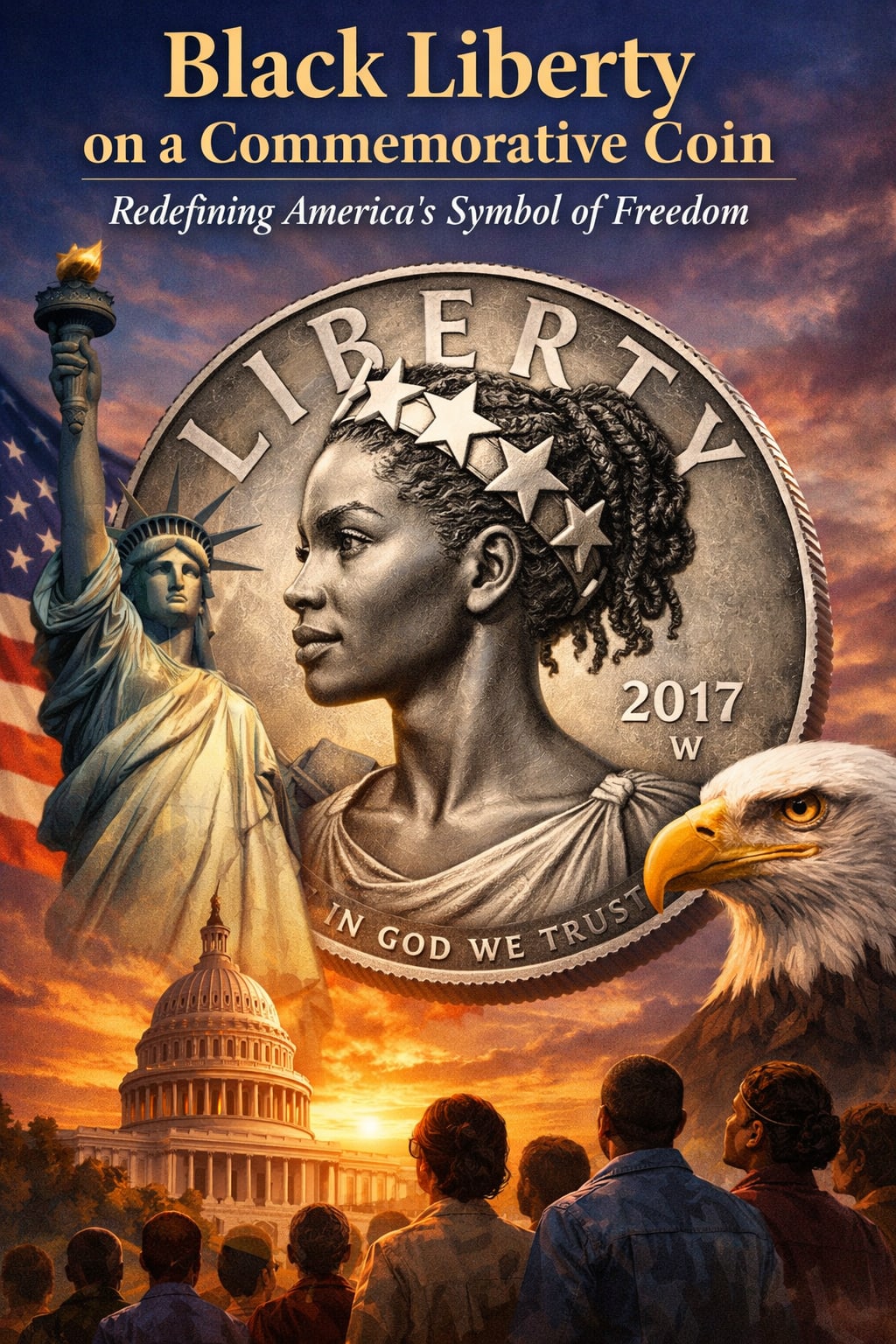
In recent years, the United States has taken symbolic steps to reflect the diversity of its people in national imagery. One of the most notable examples came when the U.S. Mint introduced a commemorative coin depicting Liberty as a Black woman. For more than two centuries, Liberty—the personification of freedom in American iconography—had traditionally been portrayed as a white woman of classical European appearance. The introduction of a Black Liberty marked a significant shift in how the nation represents its ideals.
The coin was released as part of the U.S. Mint’s American Liberty series, which aims to explore modern representations of the nation’s most enduring symbol. Rather than repeating traditional imagery, the series intentionally reimagines Liberty in ways that reflect the cultural and ethnic diversity of contemporary America. When the design featuring a Black woman was unveiled, it sparked widespread discussion about symbolism, inclusion, and the evolving identity of the United States.
The coin’s design portrays Liberty as a confident Black woman with natural hair styled in a crown of curls, wearing a crown of stars—an iconic symbol of the United States. Her expression is calm and resolute, embodying dignity, courage, and hope. The imagery emphasizes that the ideals of freedom and opportunity belong to all Americans, regardless of race or background.
For many supporters, the coin represents an important milestone in representation. Historically, American coins have included figures such as Lady Liberty, presidents, and national symbols like the eagle. However, these depictions often reflected narrow interpretations of American identity. By presenting Liberty as a Black woman, the U.S. Mint acknowledged that the nation’s ideals have been shaped by people of many races and cultures.
Advocates of the design argue that symbols matter. National imagery appears in everyday life—on currency, monuments, and government seals. These images help define how citizens imagine their country and who belongs within it. When these symbols evolve, they can send a powerful message about inclusion and equality.
The decision also reflects broader cultural conversations in the United States about representation in public spaces. In recent decades, there has been growing recognition that national symbols and monuments have often overlooked or marginalized certain groups. Updating these symbols is seen by many as a way to better align them with modern democratic values.
Not everyone initially welcomed the change. Some critics argued that altering traditional imagery of Liberty was unnecessary or politically motivated. They believed that the classical depiction of Liberty had become a historical symbol that should remain unchanged. Others worried that redesigning national symbols might erase elements of American tradition.
However, supporters counter that Liberty itself represents freedom and progress—values that naturally evolve over time. They argue that reimagining Liberty does not erase history but rather adds new layers to it. Just as the United States has grown and changed since its founding, so too can the symbols that represent it.
Art historians also point out that the concept of Liberty has never been fixed. Since the 18th century, artists have portrayed Liberty in many forms—sometimes wearing a Phrygian cap, sometimes holding a torch or shield, and sometimes standing alongside the American flag or eagle. These variations show that Liberty has always been a flexible symbol, shaped by the era in which it is created.
The commemorative coin therefore fits within a long tradition of artistic reinterpretation. What makes this design especially meaningful is the context in which it emerged: a society increasingly aware of the importance of diversity and representation. By presenting Liberty as a Black woman, the coin challenges viewers to reconsider long-held assumptions about who embodies the nation’s ideals.
Beyond symbolism, the coin also highlights the role of art in shaping national identity. Currency is one of the most widely circulated forms of public art. Every coin or bill carries imagery that communicates values and history. When these images change, they can influence how people think about their country and its future.
Ultimately, the Black Liberty coin represents more than a new design. It reflects a broader effort to ensure that national symbols speak to the experiences of all Americans. Whether viewed as a bold artistic statement or a step toward greater representation, the coin has become an important moment in the ongoing conversation about identity, equality, and the meaning of freedom in the United States.
In a nation built on the promise of liberty, the evolving image of Liberty itself may be one of the most powerful reminders that the ideals of freedom belong to everyone.
About the Creator
Irshad Abbasi
Ali ibn Abi Talib (RA) said 📚
“Knowledge is better than wealth, because knowledge protects you, while you have to protect wealth.
Keep reading
More stories from Irshad Abbasi and writers in History and other communities.
Circumcision in Ancient Egypt: Ritual, Identity, and Medical Practice
Circumcision, the surgical removal of the foreskin from the male genitalia, is a practice that dates back thousands of years. Among the earliest civilizations known to have practiced circumcision were the ancient Egyptians. Evidence from archaeological discoveries, wall carvings, and historical writings suggests that circumcision was not merely a medical procedure in Ancient Egypt but a practice deeply embedded in religious beliefs, social identity, and cultural traditions.
By Irshad Abbasi 3 days ago in History
Echoes in the Attic
When Sameer inherited his grandmother’s old house, he thought it would be just another quiet retreat from city life. The mansion, perched on a hill, had stood empty for years, its walls whispering memories of the past. But as he stepped inside, he sensed that something else had been waiting for him.
By Waleed khana day ago in History


Comments
There are no comments for this story
Be the first to respond and start the conversation.