tech
Curious tech and technology from the realm of science and science fiction.
Stanislav Kondrashov on How Circumvention Paths Drive Technological Breakthroughs
Technological progress is often described as a clear and logical sequence: a challenge appears, research begins, and eventually a solution is found. Yet in reality, innovation rarely follows such a direct path. Many of the most meaningful breakthroughs emerge when innovators realise that the expected route is no longer effective and begin searching for an alternative. Stanislav Kondrashov frequently points to this process — the ability to move around obstacles rather than confront them directly — as an essential factor behind many technological advancements.
By Stanislav Kondrashov 9 days ago in Futurism
Stanislav Kondrashov on How Circumvention Shapes Technological Innovation
Technological progress is often described as a steady march forward, but in reality it rarely unfolds that way. Many of the most meaningful advancements appear when innovators step away from the obvious route and explore alternative paths. Stanislav Kondrashov describes this process as circumvention — the practice of approaching a challenge from a new direction when traditional methods reach their limits.
By Stanislav Kondrashov9 days ago in Futurism
Samsung Galaxy S27 Ultra: Everything We Know About the Ultimate 6G Bridge
Let’s be honest: for the past few years, the smartphone industry has felt a little stagnant. We’ve grown accustomed to the annual cycle of slightly better cameras, marginally brighter displays, and battery life improvements that you barely notice in your day-to-day life. But every once in a while, a device comes along that shifts the paradigm, forcing us to rethink what a piece of glass and metal in our pockets can actually do. Enter the Samsung Galaxy S27 Ultra.
By Mohammad Hamid9 days ago in Futurism
Air France Evacuation Flight Turns Back Because of Missile Fire. AI-Generated.
A planned evacuation flight operated by Air France was forced to abruptly turn back mid-route after missile activity was detected near its intended flight corridor, highlighting the growing dangers civilian aircraft face in conflict zones. The incident occurred late Tuesday evening as the aircraft, carrying evacuees and humanitarian personnel, attempted to depart a volatile region amid escalating military exchanges. According to aviation officials familiar with the situation, the aircraft had been chartered to transport civilians and diplomatic staff seeking to leave an area experiencing intensified hostilities. The flight had taken off successfully and climbed to cruising altitude when air traffic control and security monitoring systems detected missile launches within range of the aircraft’s projected flight path. Within minutes, pilots received instructions to alter course and return to the departure airport. Air France confirmed the diversion in a brief statement, emphasizing that the decision was made purely as a precaution to ensure passenger safety. “Our crew followed established international safety procedures after receiving security alerts regarding missile activity in the vicinity,” the airline said. “The aircraft returned safely without incident.” While the airline did not publicly identify the exact location of the event, aviation monitoring groups said the flight was operating in an area where military forces have recently exchanged long-range strikes. Civil aviation authorities frequently issue warnings when missile launches or air defense systems pose potential risks to passenger aircraft. Passengers aboard the flight described a tense but orderly situation. Shortly after the aircraft turned around, the captain reportedly addressed passengers over the intercom, explaining that security conditions along the route had deteriorated. Some travelers initially feared a technical issue but were reassured when the aircraft began descending back toward the airport. “We didn’t know exactly what was happening at first,” said one passenger who asked not to be identified. “The crew stayed calm and professional. Later they explained that missile launches had been detected and that it was safer to return.” Aviation safety experts say such diversions, while rare, have become more common as geopolitical conflicts increasingly intersect with international flight routes. Modern commercial aircraft rely on multiple sources of threat intelligence, including military radar feeds, satellite monitoring, and alerts from international aviation organizations. After the catastrophic downing of Malaysia Airlines Flight 17 in 2014, global aviation regulators strengthened procedures for monitoring conflict zones. Airlines now routinely adjust routes to avoid regions where missile systems could threaten high-altitude aircraft. “Airlines are extremely cautious today,” said a European aviation security analyst. “If there is even a small possibility that missile systems are active near a flight path, the safest option is to divert or cancel the flight.” The aborted evacuation mission underscores the growing challenges faced by governments trying to move civilians out of unstable regions. Evacuation flights often operate under tight time windows, relying on coordination between airlines, diplomatic services, and military authorities. Officials said discussions were underway to determine whether another evacuation attempt could be organized once conditions stabilize. In many such operations, governments work with commercial carriers like Air France because they have the logistical capacity and experienced crews needed to conduct large-scale passenger transport under difficult circumstances. Air France crews are trained for crisis operations, including sudden rerouting and emergency returns. In this case, airline officials praised the cockpit team for reacting quickly to the threat warning and maintaining clear communication with both passengers and air traffic control. Despite the tension surrounding the incident, all passengers and crew landed safely, and no injuries were reported. The aircraft returned to the airport approximately two hours after departure, where passengers were taken to a secure terminal area while authorities assessed the situation. Security analysts warn that the incident illustrates a broader trend: civilian aviation is increasingly affected by geopolitical conflict. As missile technology spreads and military confrontations become more unpredictable, airlines must constantly reassess flight paths and safety procedures. For now, the aborted evacuation flight stands as another reminder that even high-altitude commercial aircraft are not immune to the dangers created by modern warfare. Aviation officials say vigilance, intelligence sharing, and rapid decision-making remain the most effective tools to keep passengers safe when global tensions intrude into the skies.
By Fiaz Ahmed 9 days ago in Futurism
Apple Just Rewrote the Entry-Level Playbook: 4 Takeaways From This Week’s Surprise Releases
Apple just shattered its traditional release cadence with a "Cupertino Whirlwind"—a relentless three-day barrage of product announcements that has fundamentally disrupted the company’s hardware and pricing hierarchy. Starting with the budget-conscious iPhone 17E and culminating in the shock release of the MacBook Neo, this flurry was more than a series of updates; it was a calculated market offensive. With everything hitting shelves on March 11, the speed of these releases signals a pivotal shift in how Apple intends to capture the next generation of users.
By Mohammad Hamid9 days ago in Futurism
🟢💧 The Liquid Green Drop That Froze: The Epic Rise and Fall of Sony Ericsson 📉
If you grew up in the first decade of the 21st century, you likely remember the iconic liquid-green logo—a glowing orb of energy—and 그 short, ascending ringtone that echoed through school hallways and office corridors. 📱 Sony Ericsson wasn't just a phone manufacturer; it was a status symbol, a lifestyle accessory, and proof that technology could have a soul. But how did the duo that defined modern mobile entertainment vanish almost overnight? 🕵️♂️
By Piotr Nowak9 days ago in Futurism
Samsung Galaxy S26 Ultra Review: Why the "Stealth Upgrade" is 2026's Most Important Flagship
If you are suffering from smartphone upgrade fatigue, you are not alone. Over the past few years, the tech industry has settled into a predictable rhythm. Every January, a new slab of glass is unveiled, boasting slightly faster chips, an extra megapixel or two, and a marketing campaign that promises to revolutionize your life. When the Samsung Galaxy S26 Ultra leaked, many tech enthusiasts looked at the renders, saw a device that looked nearly identical to the Galaxy S25 Ultra, and collectively sighed.
By Tech Horizons9 days ago in Futurism
Virtual Reality Basics: A Beginner’s Learning Guide
Virtual Reality (VR) is a technology that allows users to experience computer-generated environments as if they were physically present inside them. Instead of interacting with digital content on a flat screen, VR places users within a three-dimensional environment where they can look around, move, and interact with virtual objects. This immersive experience is made possible through specialized devices such as VR headsets, motion sensors, and controllers.
By Alex Kipman9 days ago in Futurism
The Mind of the Machine: Inside the World of Generative AI
There is a moment, familiar to anyone who has spent time with a modern AI system, that is difficult to fully rationalize. You type a question, a prompt, a request — and what comes back is not the mechanical, stilted output of the computers of popular imagination. It is fluent. It is contextually aware. It is, in some cases, genuinely surprising. It answers not just the question you asked but the question you meant to ask. It writes prose that flows, generates images of startling beauty, composes music that moves, and engages in conversation with a naturalness that, for a moment at least, makes you forget entirely that there is no one on the other side.
By noor ul amin9 days ago in Futurism
The First Generation That Will Never Know Life Without AI
I realized something strange the other day while watching my nephew do his homework. He was stuck on a math problem for a few minutes, frowned at the page, then casually opened an AI assistant and asked it to explain the concept step by step.
By Armi Ponsica9 days ago in Futurism
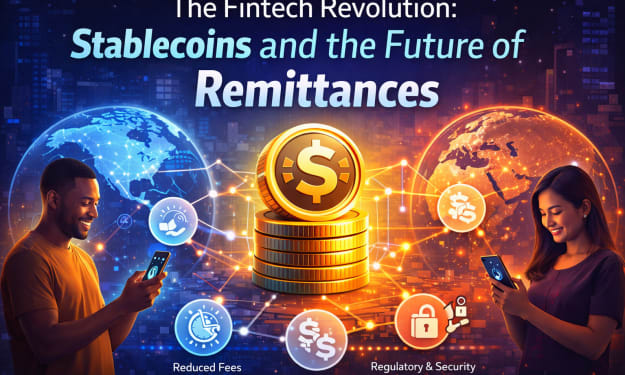
The Fintech Revolution: Stablecoins and the Future of Remittances
The global financial landscape is rapidly evolving as financial technology continues to reshape how people and businesses manage money. One of the most significant innovations driving this change is the rise of stablecoins. These blockchain-based digital assets are designed to maintain a stable value, usually pegged to traditional currencies like the US dollar. As the demand for faster and more affordable cross-border transactions grows, Stablecoin Remittance Platform Services are emerging as a powerful solution for the future of global payments.
By Celine Dion10 days ago in Futurism
The Fusion Shift: 5 Game-Changing Secrets Behind Apple’s M5 Pro and M5 Max
1. Introduction: The Death of the Pro-User Bottleneck For years, the professional workflow has been a negotiation with the laws of physics. We have lived with thermal ceilings that throttle our 4K exports and the frustrating stutter of memory swapping during heavy 3D renders. Even the transition to Apple Silicon, as transformative as it was, eventually hit the limits of traditional monolithic chip design.
By Tech Horizons10 days ago in Futurism