Book of the Day
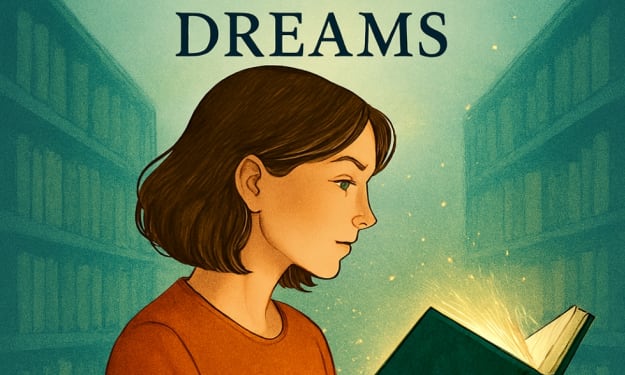
Elena had always loved libraries. The quiet aislesthe scent of old
Elena had always loved libraries. The quiet aisles, the scent of old paper, the way stories seemed to hum beneath the silence — it was her sanctuary. But the library she stumbled upon that autumn evening was unlike any she had ever seen.
By Alhouci boumizziabout a month ago in BookClub
Narrative Affect and the End of Public Opinion
In Narrative Affect: The End of Public Opinion, Peter Ayolov advances a forceful and timely argument: that contemporary mass media no longer operates primarily through persuasion, belief formation, or the shaping of public opinion, but through the orchestration of affective environments that precede and structure thought itself. The book proposes not merely a revision of existing media theory, but a conceptual displacement of one of its foundational assumptions—that influence flows through opinion. What governs contemporary public life, Ayolov argues, is not what people think, but what they are made to feel before thinking begins.
By Peter Ayolovabout a month ago in BookClub
Paper Walls and Iron Lies
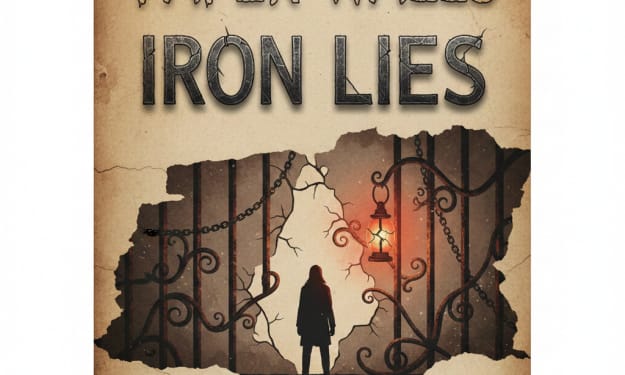
Paper Walls and Iron Lies The city of Verdant Heights was a maze of glimmering skyscrapers and narrow alleyways where sunlight struggled to touch the ground. Behind the glossy facades and sleek towers, secrets festered, hidden beneath layers of civility and whispered agreements. Among the inhabitants was Ayaan, a young journalist who had grown tired of living in a world where truth was a luxury few could afford.
By Samaan Ahmadabout a month ago in BookClub
The Day Honesty Became a Crime. AI-Generated.
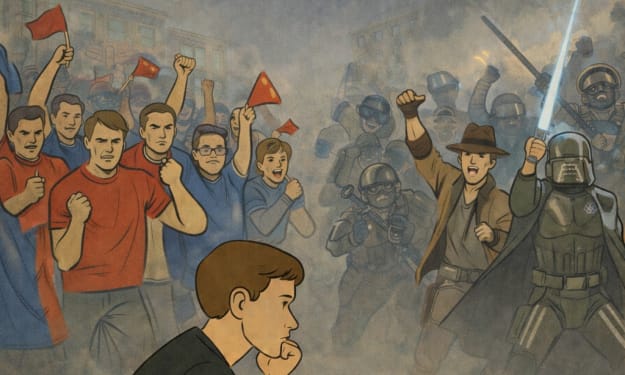
The Day Honesty Became a Crime In the city of Daryan, honesty had once been a cherished virtue. People smiled when a neighbor returned a lost wallet, praised a student who admitted a mistake, and trusted each other with the smallest secrets. But change, as it often does, crept in silently.
By Samaan Ahmadabout a month ago in BookClub
Ink Costs Less Than Blood, But Not Today. AI-Generated.
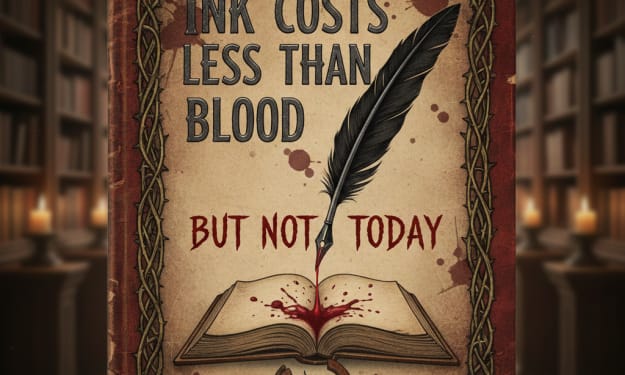
Ink Costs Less Than Blood, But Not Today The slogan was painted on the wall outside the newsroom in thick black letters: Ink Costs Less Than Blood. It had been there since before I joined, a reminder passed down like an heirloom. We said it to comfort ourselves when threats came in by phone, when anonymous notes slipped under the door, when our names appeared online with red circles drawn around them. We said it to believe that words—printed, published, preserved—could stop violence before it spilled.
By Samaan Ahmadabout a month ago in BookClub
The Conspicuous Elite
Peter Ayolov, Sofia University ‘St. Kliment Ohridski’, 2026 Abstract By 2026, the institutional power elite described by C. Wright Mills has not dissolved but reappeared as a conspicuous platform elite, whose authority depends on continuous visibility, biographical myth, and algorithmic amplification. Power is exercised less through discrete command and deliberation than through spectacle, attention, and the conversion of domination into an aspirational life-model. Rereading The Power Elite from the standpoint of 2026, the article foregrounds Mills’s 1956 warning about ‘higher immorality’: a structural condition in which decision-makers at the summits of corporate, political, and military power are insulated from the moral consequences of their actions by distance, scale, bureaucracy, and abstraction. The article argues that higher immorality was never a period detail of mid-century America but an early diagnosis of a durable logic of modern power that has since intensified under platform capitalism. In the contemporary environment of celebrity governance, technical delegation, and algorithmic mediation, higher immorality operates less through secrecy and denial than through public performance and normalisation. In this sense, elite rule culminates in what this article calls ‘The Conspicuous Elite’ or ‘Platform Elite’, where authority is no longer concealed by institutions but performed openly through visibility, narrative, and attention.
By Peter Ayolovabout a month ago in BookClub
Trinity 3
Trinity 3 is the story of my reincarnation journey and twin flame. I wrote it to confirm to myself that i did in fact have past lives and to also tell the stories of my past lives so they could all finally rest in peace. my past lives do in fact have effect on my present and final incarnation in this life. writing this was healing and therapuetic. this did help me to see myself for myself and that is all i wanted to see.
By Revista Miko:XCI about a month ago in BookClub
❤️ Love 🌕 Moon music 🎵 A novel by Rikki La Rouge
After the collapse of her metal career, Tionne experienced a crisis in her professional and personal life. She began abusing drugs and alcohol. But nothing could stop the crisis. It only made things worse.
By Revista Miko:XCI about a month ago in BookClub
The Art of Digital Intentionality: Reclaiming . AI-Generated.
In the modern era, the average person checks their smartphone dozens of times a day. We live in a state of perpetual connectivity, where the boundaries between our physical lives and our digital interfaces have become increasingly blurred. While technology has provided us with unprecedented access to information and global community, it has also introduced a unique set of psychological challenges: fragmented attention, decision fatigue, and the subtle erosion of presence.
By Chris Swainabout a month ago in BookClub
I read Half His Age
If there's one book you add to your reading list this year, make it Half His Age by Jennette McCurdy. I went into this one already a fan of McCurdy as an author, but this book solidified exactly why she's become one of my favourites. It's personal, it's immersive, and it's the kind of story that stays with you long after you turn the last page.
By Parsley Rose about a month ago in BookClub