
Real Menopause Education
What I Wish I’d Known at 20

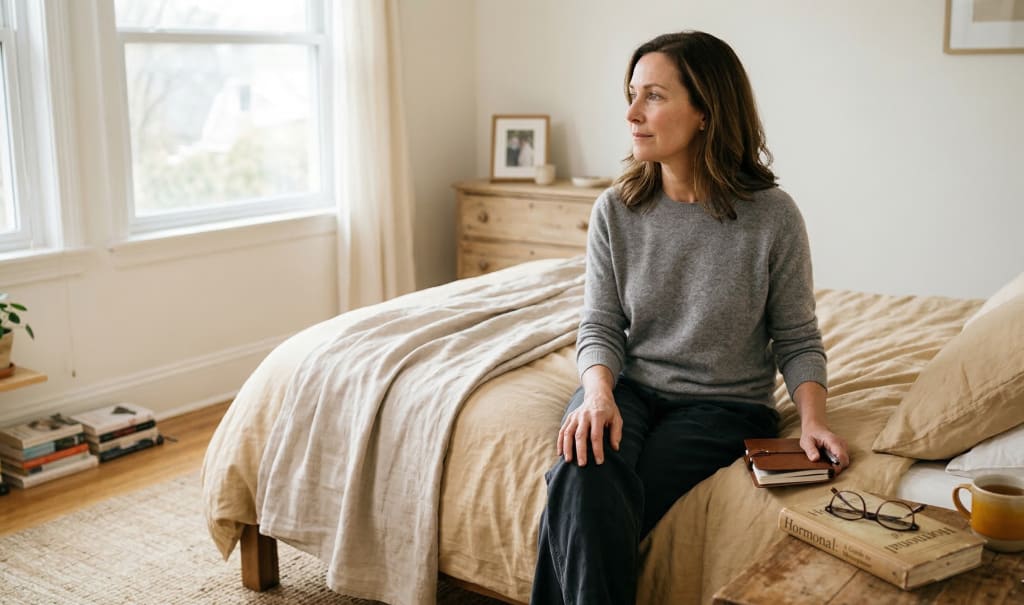
I hit menopause at 45, and it felt like my body had slammed a door I didn’t even know was closing.
That’s considered early, but later I found out I’d had PCOS my whole life.
Three decades of gynecologist visits and not one person connected my “irregular periods” and pain to anything real.
That’s why I’m writing this. Because most of us walk into puberty, birth control, fertility struggles, miscarriages, and menopause with less education than a drugstore pamphlet.
We get products and pills—but not actual menopause education about what’s going to happen to our bodies over time.
This is the honest, messy menopause education I wish I’d gotten at 20 instead of figuring it out the hard way at 45.
Menopause Education Actually Starts in Middle School
I didn’t grow up with a mom. My dad tried, but “woman stuff” wasn’t his area. School sex ed was basically the following:
Don't get pregnant; here’s a condom on a banana. Good luck out there.
Nobody explained what a normal period really looks like. Or what isn’t normal.
My first period hit at 12. I was the first girl in my class to bleed, grow boobs, and get hips. The boys were delighted;
I wanted to disappear. Every month turned into this awful routine:
Bleeding for 7–8 days like I’d been stabbed
Cramps so brutal I’d curl up on the bathroom floor.
Missing school because Midol knocked me out cold
My cycle was wildly irregular—a classic PCOS sign, which I now know—but every doctor shrugged and said,
“Some women are just irregular.”
End of conversation.
And that’s what still gets me. Not one adult stopped to ask, “Why is this teenager in that much pain?” No ultrasound.
No blood work. Nothing. I honestly think if we taught girls what PCOS looks like, more of us would be diagnosed before everything crashes in our 30s and 40s.
Birth control was the first thing that made me feel like I had any control at all. At 18, the pill:
Shortened my periods
Lightened the bleeding
Took the edge off the cramps
For a while, it felt like magic. Until it didn’t.
How Birth Control, PCOS, and Fertility Collide
In my 30s, the exact same pill that once saved me suddenly made my brain fall apart.
The moodiness I’d always had around my period turned into a dark, heavy depression.
I had suicidal thoughts that didn’t feel like “me” at all. Same brand. Same dose. Totally different reaction.
I stopped abruptly because I was terrified of what I was becoming.
We were about to get married and decided to “see what happens.”
What happened was three miscarriages before our son arrived when I was 38. I strongly suspect PCOS was involved—irregular ovulation, egg quality, and all of it—but no doctor ever tried to connect the dots.
They treated each issue like a separate chapter instead of one story.
One thing people rarely say out loud: miscarriages devastate men too.
My husband tried to be stoic, but I watched him break quietly each time. There’s almost no space for men to talk about that grief, and it shows.
After our son was born, I tried a birth control ring.
The physical side was fine, but the emotional crash came back like clockwork every month.
Finally, my husband said, “I’m getting a vasectomy. You’re not a lab experiment.” And he did.
By then I was painfully aware of age and fertility. I was 38, and my doctor finally spelled it out:
Your eggs don’t last forever. Quantity drops, quality drops, and the risks climb.
I’m still annoyed nobody told me that clearly when I was 25 instead of acting like I’d have endless time to figure it out.
So yes—real menopause education has to include honest talk about egg supply, PCOS, and how long we actually have.
not some vague “you can always do IVF” shrug.
What Menopause Really Does to Your Body (Below the Waist)
The word “menopause” sounds gentle, like you’re just hitting pause.
What actually happened for me felt more like my body filing a list of complaints I’d ignored for decades.
I never had the classic hot flashes, which almost made me question if it was “real” menopause. But the genital changes? Those were loud:
My labia minora shrank—visibly.
My clitoris got smaller and less sensitive.
The vaginal tissue dried and thinned.
Natural lubrication vanished almost overnight.
None of this had been mentioned in any appointment. Not once.
Sex went from enjoyable to
“I’d rather not, thanks."
in record time. Arousal stopped turning into lubrication. Penetration felt like sandpaper.
Even the slim plastic applicator for vaginal cream felt like an instrument of torture.
My brain still wanted intimacy.
My body was basically screaming no.
So I finally asked my doctor about hormone replacement therapy and vaginal estrogen.
I’d been scared of HRT for years—cancer headlines, horror stories, all of it—but I also knew I wasn’t ready to retire my sexuality at 45.
We started two things:
Low-dose hormone replacement therapy
Vaginal estrogen cream for dryness
The cream came with that tiny inserter, and it hurt so much I nearly gave up. When I told my doctor, she casually said, “Oh, just use your finger instead.”
That one sentence changed everything.
What actually worked:
Put a pea-sized amount of estrogen cream on your fingertip.
Gently swipe it around the vaginal opening at night.
Let it absorb while you sleep.
Within a couple of weeks, the tissue felt less fragile. Sex stopped feeling like an injury.
My husband stopped quietly wondering if he just didn’t turn me on anymore.
I told my sister, who’d been silently dealing with painful sex, and she had the same experience:
Miserable with the inserter, relief with the fingertip method, total convert a month later.
Here’s what my routine looks like now:
I use the cream twice a week.
I’ve had zero side effects.
It’s affordable enough to keep using long-term.
The systemic hormone therapy did something else I didn’t expect—it woke my libido up. Before HRT, my sex drive wasn’t “low”;
It was gone. Now I’m officially menopausal and somehow have more desire than I did in my 30s. I don’t fully understand the biology.
But I’m not complaining.
Do I wish someone had diagnosed my PCOS sooner and maybe softened the landing into menopause? Absolutely.
Would it have changed the timing? Maybe. I’ll probably never know.
We Have to Talk About Menopause Out Loud.
If I’ve learned anything, it’s this: nobody is going to show up with the full manual to your body.
You have to be that annoying patient who asks questions, pushes back, and insists on explanations.
And we have to talk to our daughters sooner. Not just about pads and tampons, but about:
Irregular periods and when they’re a red flag
PCOS and how it affects fertility and menopause
Miscarriage grief—for both partners
Egg shelf life and realistic timelines
Vaginal dryness, shrinking labia, changing libido
The embarrassing parts are usually the exact parts they’ll need later.
Silence didn’t protect us. It just left us blindsided. I’m not interested in passing that down.
About the Creator
abualyaanart
I write thoughtful, experience-driven stories about technology, digital life, and how modern tools quietly shape the way we think, work, and live.
I believe good technology should support life
Abualyaanart
Keep reading
More stories from abualyaanart and writers in Writers and other communities.
Industrial Adhesive Solutions Supporting Modern Aerospace Manufacturing
Introduction The aerospace industry continues to evolve as engineers and manufacturers seek lighter, stronger, and more efficient aircraft designs. While engines and avionics systems often receive the most attention, many essential improvements in aircraft construction come from advanced materials and bonding technologies. Adhesive solutions such as high-performance tapes play a vital role in maintaining structural integrity, protecting surfaces, and simplifying complex assembly processes.
By Beckett Dowhan4 days ago in Writers



Comments (2)
You've stolen this story from Alexandra Grant! I've reported it.
What a great story. I’m going through these changes now I started just a couple years ago and was shocked to see what my body was going through. Schools need to be required to tell about this just like sex.