
United States Ultrasound Device Market Size and Forecast 2026–2034
Rapid Adoption of Portable Imaging and AI-Driven Diagnostics Fuel Growth in the U.S. Ultrasound Device Market

Introduction
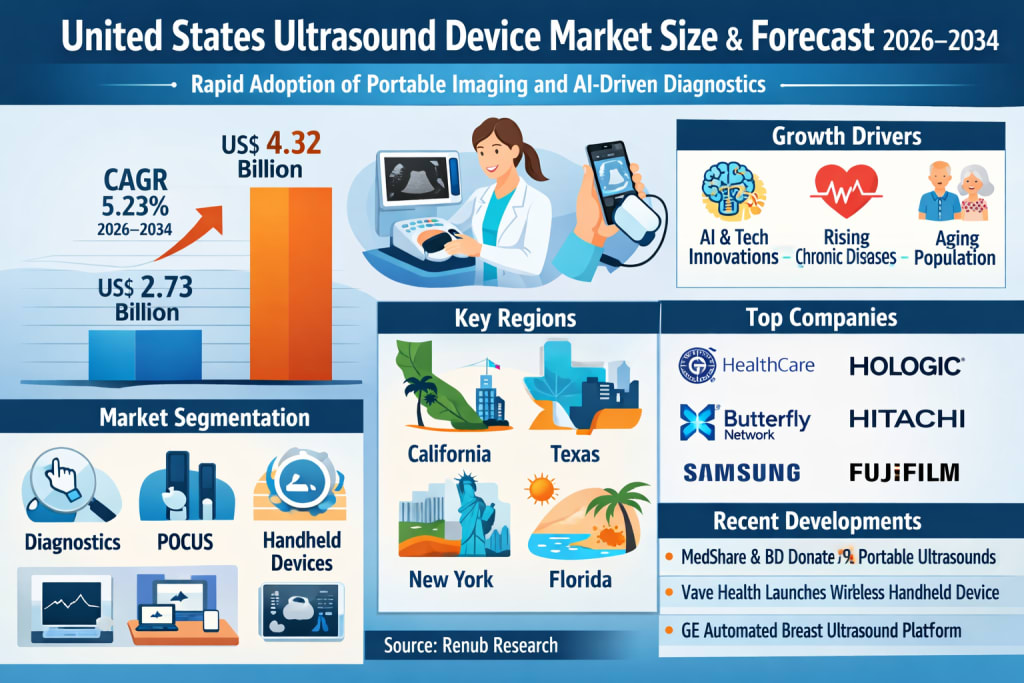
The United States Ultrasound Device Market is projected to grow significantly over the next decade as healthcare systems increasingly prioritize faster, safer, and more accessible diagnostic tools. According to Renub Research, the market is expected to reach US$ 4.32 billion by 2034, rising from US$ 2.73 billion in 2025, expanding at a compound annual growth rate (CAGR) of 5.23% from 2026 to 2034.
Ultrasound imaging plays a vital role in modern medicine because it provides real-time visualization of internal organs, tissues, and blood flow without exposing patients to radiation. As hospitals and clinics continue to adopt portable imaging technologies and integrate artificial intelligence into diagnostics, ultrasound devices are becoming even more essential across a wide range of medical specialties.
The growth of the U.S. ultrasound device market is driven by several key factors including the rapid adoption of portable and point-of-care ultrasound systems, the increasing prevalence of chronic diseases, and the expansion of AI-enhanced imaging technologies. Strong healthcare expenditure and a growing preference for non-invasive diagnostic methods further support the widespread adoption of ultrasound systems in hospitals, outpatient facilities, and emergency settings.
United States Ultrasound Device Industry Overview
Ultrasound devices are medical imaging systems that use high-frequency sound waves to create real-time images of structures inside the body. These systems are widely used across multiple medical specialties, including obstetrics, cardiology, oncology, emergency medicine, and primary care.
Unlike imaging modalities such as CT scans or X-rays, ultrasound does not use ionizing radiation. This makes it a safer option for repeated imaging procedures, particularly during pregnancy or long-term disease monitoring.
Modern ultrasound technology has evolved significantly in recent years. Healthcare providers can now choose from a wide range of devices, including:
Large cart-based ultrasound systems used in hospitals
Portable ultrasound machines used in clinics and ambulances
Handheld ultrasound probes that connect to smartphones or tablets
The introduction of 3D and 4D imaging, artificial intelligence-based measurements, and wireless connectivity has expanded the capabilities of ultrasound devices. These innovations enable clinicians to perform faster diagnoses while improving workflow efficiency across healthcare facilities.
In addition, ultrasound technology has become more accessible due to its cost-effectiveness compared to advanced imaging modalities such as MRI or PET scans. As healthcare systems aim to reduce diagnostic costs while maintaining high clinical standards, ultrasound continues to gain importance.
Key Growth Drivers in the U.S. Ultrasound Device Market
Technological Innovation and AI Integration
Technological advancements remain one of the most powerful forces driving the U.S. ultrasound device market. Modern ultrasound systems increasingly incorporate artificial intelligence (AI) to enhance diagnostic accuracy and reduce operator dependency.
AI-powered software can automatically:
Detect abnormalities in medical images
Measure anatomical structures
Optimize imaging settings
Provide real-time clinical guidance
These capabilities significantly improve clinical efficiency and reduce the time required for image interpretation.
Another major innovation is the development of portable and handheld ultrasound devices. These compact systems allow healthcare professionals to perform diagnostic imaging at the patient’s bedside, in emergency situations, or even in remote locations.
Portable ultrasound technology is particularly valuable in emergency medicine, rural healthcare, and telemedicine environments. Physicians can rapidly assess internal injuries, guide medical procedures, or monitor patient conditions without transferring patients to imaging departments.
In addition, 3D and 4D ultrasound imaging technologies provide more detailed visualization of organs and tissues. These tools are widely used in obstetrics for fetal monitoring, in cardiology for heart imaging, and in musculoskeletal assessments.
Wireless connectivity, cloud storage, and smartphone-compatible probes also allow healthcare providers to share imaging data instantly with specialists, enabling faster consultations and improved patient outcomes.
Increasing Chronic Diseases and an Aging Population
The growing prevalence of chronic diseases in the United States is another major driver of ultrasound device demand. Conditions such as cardiovascular disease, cancer, diabetes-related complications, and vascular disorders often require repeated imaging for diagnosis and ongoing monitoring.
Ultrasound is widely preferred in these situations because it is safe, quick, and relatively affordable, making it suitable for routine evaluations.
The aging population also contributes significantly to market expansion. Older adults are more likely to develop medical conditions that require imaging procedures, including:
Heart disease
Kidney disorders
Musculoskeletal problems
Vascular conditions
As the elderly population grows, healthcare systems are expected to perform higher volumes of diagnostic imaging procedures, further boosting demand for ultrasound equipment.
Ultrasound is also essential in women’s healthcare, particularly for prenatal imaging, reproductive health monitoring, and breast examinations. Increasing awareness of preventive healthcare and routine screenings continues to expand ultrasound usage across diagnostic centers and hospitals.
Expansion of Point-of-Care Ultrasound (POCUS)
Point-of-care ultrasound (POCUS) is transforming healthcare delivery in the United States. Instead of sending patients to specialized imaging departments, clinicians can now perform ultrasound scans directly at the bedside.
POCUS is widely used in:
Emergency departments
Intensive care units
Trauma centers
Family medicine practices
Anesthesia and surgical procedures
The ability to obtain immediate diagnostic information helps clinicians make faster decisions and initiate treatment sooner.
Handheld ultrasound devices have played a critical role in expanding POCUS applications. These portable systems allow imaging to be performed in ambulances, rural clinics, home healthcare settings, and disaster response environments.
Tele-ultrasound technology is also gaining momentum. With cloud-based connectivity, specialists can remotely guide imaging procedures or interpret scans performed by healthcare providers in remote locations.
As healthcare systems shift toward decentralized and value-based care, POCUS technologies are expected to play an increasingly important role in improving diagnostic efficiency and patient outcomes.
Challenges in the United States Ultrasound Device Market
Regulatory and Integration Limitations
Despite strong growth prospects, the ultrasound device market faces several regulatory and technological challenges.
Medical devices that incorporate artificial intelligence must undergo rigorous regulatory approval processes, including validation studies and safety evaluations. These requirements can delay the introduction of new products and increase development costs for manufacturers.
Smaller medical technology companies may face difficulties meeting compliance requirements due to limited resources.
Another challenge involves interoperability with electronic health records (EHRs). Some ultrasound systems use proprietary data formats, which can complicate integration with hospital information systems.
In addition, cybersecurity risks have become a growing concern as more ultrasound devices incorporate wireless connectivity and cloud-based data storage. Healthcare organizations must implement strong security protocols to protect sensitive patient data.
Competition From Advanced Imaging Modalities
Ultrasound devices also compete with other advanced imaging technologies such as CT scans, MRI systems, and PET imaging.
These imaging modalities offer extremely detailed anatomical visualization and are often preferred in complex diagnostic scenarios, particularly in oncology, neurology, and advanced cardiology.
While ultrasound remains cost-effective, high-end ultrasound systems equipped with advanced features can still be expensive for smaller healthcare facilities. Rural hospitals and outpatient clinics may face budget limitations when upgrading their imaging equipment.
Variations in reimbursement policies and ongoing maintenance costs can also influence purchasing decisions for healthcare providers.
Regional Insights: Key U.S. State Markets
California
California represents one of the largest ultrasound device markets in the United States due to its advanced healthcare infrastructure and large patient population. Major medical centers in cities such as Los Angeles, San Francisco, and San Diego rely heavily on ultrasound technology across cardiology, obstetrics, oncology, and emergency medicine.
The state’s leadership in healthcare innovation also encourages early adoption of AI-powered imaging technologies and handheld ultrasound systems.
Texas
Texas has a rapidly expanding ultrasound device market driven by its growing population and expanding healthcare infrastructure. Major healthcare hubs in Houston, Dallas-Fort Worth, and Austin utilize ultrasound extensively for cardiology, obstetrics, trauma care, and primary care diagnostics.
Portable ultrasound systems are particularly valuable in rural areas, where access to advanced imaging facilities may be limited.
New York
New York’s ultrasound device market benefits from world-class hospitals, research institutions, and diagnostic centers. Healthcare providers across the state rely on ultrasound imaging for high-volume procedures in cardiology, obstetrics, oncology, and emergency medicine.
Innovation-driven healthcare systems and strong reimbursement frameworks support the adoption of advanced ultrasound technologies.
Florida
Florida’s ultrasound device market is strongly influenced by its large aging population. The demand for diagnostic imaging related to cardiovascular disease, vascular conditions, and musculoskeletal disorders continues to grow.
Healthcare providers across Miami, Orlando, and Tampa increasingly rely on portable ultrasound systems to support rapid diagnostics and outpatient care.
Recent Developments in the U.S. Ultrasound Device Market
Several recent industry developments highlight the ongoing innovation within the ultrasound sector.
In March 2025, MedShare partnered with Becton, Dickinson and Company and the National Association of Free and Charitable Clinics to distribute 92 portable ultrasound units across 30 U.S. states, expanding diagnostic access for underserved communities.
In the same month, Vave Health introduced a wireless handheld ultrasound device designed for whole-body imaging using a single PZT transducer, improving diagnostic efficiency in both clinical and educational environments.
Also in March 2025, GE HealthCare launched its Automated Breast Ultrasound Premium platform, integrating artificial intelligence to support faster and more accurate breast cancer screening.
Earlier in January 2025, the U.S. Food and Drug Administration granted 510(k) clearance for GE HealthCare’s upgraded Voluson Expert Series, including the Voluson Expert 22, 20, and 18 models, further strengthening innovation in obstetric and gynecological imaging.
Market Segmentation
The United States ultrasound device market can be segmented across multiple categories.
By Product
Diagnostic Ultrasound
Therapeutic Ultrasound
By Portability
Trolley/Cart-Based Ultrasound Devices
Compact and Handheld Ultrasound Devices
By Application
Radiology / General Imaging
Cardiology
Gynecology
Vascular Imaging
Urology
Others
By End Users
Hospitals
Surgical Centers
Diagnostic Centers
Maternity Centers
Ambulatory Care Centers
Academic Institutions
Leading Companies in the Market
Key companies shaping the competitive landscape include:
GE HealthCare
Hologic Inc.
Butterfly Network
Hitachi Healthcare Americas
Samsung Electronics Co. Ltd
Fujifilm Holdings Corporation
These companies compete through technological innovation, AI integration, strategic partnerships, and new product launches.
Final Thoughts
The United States ultrasound device market is entering a transformative phase as healthcare providers increasingly adopt portable imaging technologies, artificial intelligence, and point-of-care diagnostics.
With rising chronic disease prevalence, a growing elderly population, and strong healthcare investment, ultrasound technology is expected to remain a critical component of modern medical diagnostics.
As innovation continues to reshape imaging capabilities and expand accessibility, ultrasound devices will play an even greater role in improving patient outcomes, reducing diagnostic delays, and enhancing healthcare delivery across the United States.
About the Creator
kospi index market update investors watch sudden shift in South Korea stocks
kospi index is one of the most important indicators of the South Korean stock market. Investors around the world track the kospi index daily to understand how major companies in South Korea are performing. When the kospi index moves, it reflects the overall mood of the market. Recently, the kospi index has shown a new trend that is attracting strong attention from traders and long-term investors. Market activity has increased, and several sectors are helping the kospi index maintain steady movement. Because of this change, many investors are closely watching the kospi index for signals about the next market direction.
By John.doe7987 days ago in Trader



Comments
There are no comments for this story
Be the first to respond and start the conversation.