
South Africa E-commerce Market Size & Forecast 2026–2034: Digital Retail Revolution Accelerates
Rising internet penetration, mobile payments, and expanding logistics networks are transforming South Africa into one of Africa’s fastest-growing digital commerce markets.

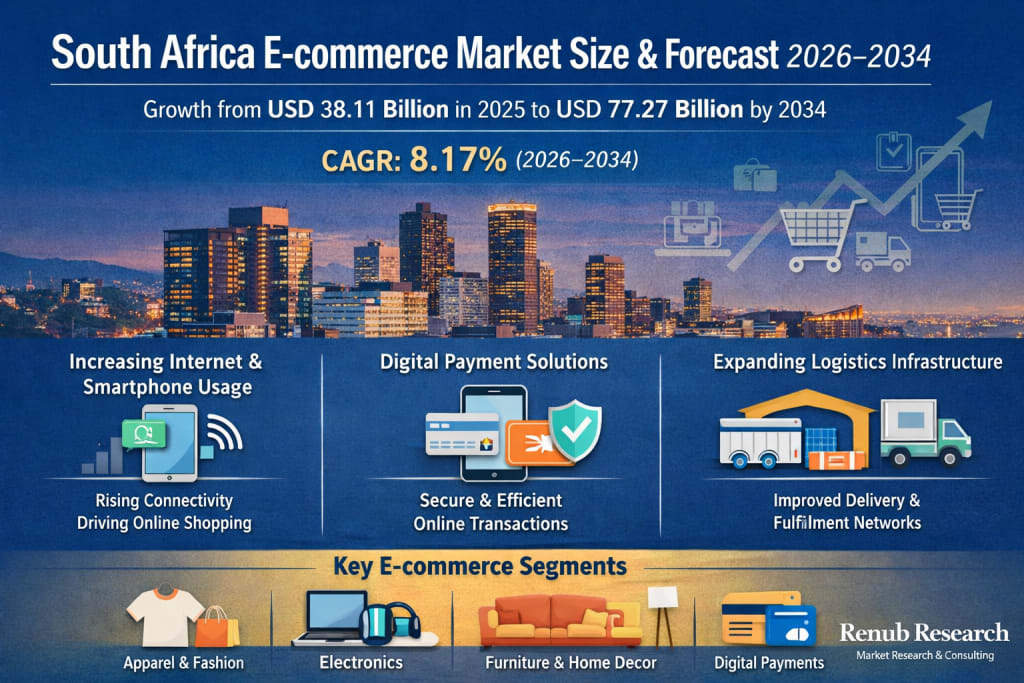
South Africa E-commerce Market Overview
The South Africa E-commerce Market is entering a period of strong expansion as digital adoption continues to reshape consumer shopping habits across the country. According to Renub Research, the market is projected to grow from US$ 38.11 billion in 2025 to US$ 77.27 billion by 2034, expanding at a Compound Annual Growth Rate (CAGR) of 8.17% during 2026–2034.
This steady growth highlights how online shopping has become an integral part of South Africa’s retail ecosystem. With rising smartphone usage, improved internet connectivity, and an expanding digital payment ecosystem, consumers are increasingly shifting from traditional retail stores to online platforms.
E-commerce refers to the buying and selling of goods and services through digital platforms using the internet. It enables businesses and consumers to conduct transactions online, including browsing products, placing orders, making payments, tracking shipments, and receiving home deliveries.
In South Africa, online retail has gained traction across multiple product categories such as fashion, electronics, groceries, and home furnishings. The COVID-19 pandemic accelerated this shift by encouraging consumers to explore safer and more convenient online shopping options. As businesses invest more heavily in digital infrastructure and logistics networks, the country’s e-commerce landscape continues to evolve rapidly.
The emergence of new online marketplaces and international retailers entering the South African market has further intensified competition and improved service quality. Today, e-commerce platforms are offering faster delivery, better pricing, and a broader selection of products, which continues to attract a growing number of online shoppers.
Growth Drivers of the South Africa E-commerce Market
Increasing Internet and Smartphone Penetration
One of the most important factors driving the expansion of South Africa’s e-commerce industry is the rapid increase in internet connectivity and smartphone adoption. Digital access is steadily improving across the African continent, and South Africa is among the countries leading the region in online retail growth.
Recent estimates suggest that internet penetration across Africa stands at roughly 37% of the total population, while smartphone penetration is projected to reach approximately 88% by 2030. The growing accessibility of affordable smartphones and mobile data packages has significantly expanded the number of consumers able to participate in online shopping.
Mobile devices have become the primary gateway to the internet for many South Africans, particularly among younger consumers. As a result, mobile commerce (m-commerce) is becoming a major segment of the country’s e-commerce industry.
Telecommunications providers are continuously investing in faster and more reliable network infrastructure, including 4G and expanding 5G connectivity. This has improved the overall digital experience for users and made online shopping easier and more convenient.
At the same time, businesses are investing heavily in mobile-friendly websites and shopping applications. These platforms provide smoother browsing experiences, personalized product recommendations, and simplified checkout processes, further encouraging consumers to embrace online retail.
Growth of Digital Payment Solutions and Financial Inclusion
Another key factor supporting the growth of e-commerce in South Africa is the rapid development of digital payment technologies.
Online payment solutions such as mobile wallets, debit cards, credit cards, and online banking have made it easier for consumers to complete transactions securely. The expansion of fintech services has also contributed to improved financial inclusion, enabling more people to access formal financial systems and participate in online commerce.
Digital payments are particularly appealing to consumers because they offer convenience, speed, and security. As trust in online financial services continues to increase, more people are choosing cashless payment methods when shopping online.
A major milestone in the evolution of South Africa’s digital payment ecosystem occurred in October 2023, when the Payment Ecosystem Modernisation (PEM) initiative was introduced. The program aims to transform the country’s National Payment System (NPS) by enabling faster, safer, and more affordable digital transactions.
The initiative also supports PayShap, a real-time payment platform designed to promote financial inclusion and enable instant low-cost payments between individuals and businesses. Such advancements are expected to significantly accelerate the adoption of digital commerce across South Africa.
Expansion of Logistics and Delivery Infrastructure
The development of logistics and delivery infrastructure has become another crucial growth driver for South Africa’s e-commerce industry.
Efficient delivery systems are essential for online retail success because customers expect their orders to arrive quickly and reliably. To meet these expectations, e-commerce companies and logistics providers are investing heavily in warehouse networks, fulfillment centers, and last-mile delivery solutions.
Courier services and third-party logistics providers are expanding their coverage across urban and semi-urban areas, helping retailers deliver products faster and more efficiently. The growth of same-day and next-day delivery services is also enhancing the customer experience.
In March 2024, South Africa and Namibia announced a US$ 411.9 million infrastructure development initiative aimed at improving regional logistics efficiency. These investments focus on rail and port infrastructure improvements that will strengthen supply chain connectivity across Southern Africa.
As logistics networks continue to improve, online retailers will be able to serve a wider customer base, including consumers living in previously underserved regions.
Challenges Facing the South Africa E-commerce Market
Logistics Barriers in Rural and Remote Areas
Despite strong growth prospects, the South African e-commerce market still faces several challenges.
One of the most significant issues is the difficulty of delivering products to rural and remote areas. Poor road infrastructure, long distances between towns, and limited courier coverage can make last-mile delivery expensive and time-consuming.
In some cases, delivery services are unavailable in certain areas, which prevents online retailers from reaching potential customers. High delivery costs may also discourage consumers from placing online orders, particularly for low-value items.
Addressing these logistical challenges will be essential for expanding e-commerce beyond major urban centers.
Security Concerns and Consumer Trust
Another major challenge in South Africa’s online retail industry is consumer concern about online security and fraud.
Some consumers remain hesitant to shop online because they fear identity theft, payment fraud, or receiving counterfeit or low-quality products. Lack of awareness regarding online safety practices can further reduce consumer confidence.
To overcome these barriers, e-commerce companies are investing in stronger cybersecurity systems, secure payment gateways, and customer protection policies. Features such as buyer protection programs, easy returns, and verified seller systems can help build trust among online shoppers.
Increasing consumer education about digital safety will also play a key role in strengthening the long-term growth of South Africa’s e-commerce ecosystem.
South Africa Apparel and Accessories E-commerce Market
The apparel and accessories segment is one of the most prominent categories in South Africa’s online retail industry.
Consumers increasingly prefer to purchase clothing, footwear, handbags, and fashion accessories online due to the wide range of options available on digital platforms. Online fashion retailers frequently offer attractive discounts, seasonal sales, and exclusive collections that are not available in physical stores.
Social media platforms and influencer marketing have also played a significant role in promoting fashion trends and encouraging online purchases.
Younger consumers, particularly those living in urban areas, are driving much of the demand for online fashion products. With improved delivery services and convenient return policies, the apparel segment is expected to continue expanding steadily in the coming years.
South Africa Computer and Consumer Electronics E-commerce Market
The computer and consumer electronics segment is experiencing rapid growth as demand for digital devices continues to rise.
Products such as smartphones, laptops, tablets, gaming devices, and other electronic accessories are among the most frequently purchased items online. Consumers often prefer buying electronics through online platforms because they can easily compare product specifications, prices, and customer reviews before making a purchase.
The rise of remote work, online education, and digital entertainment has further boosted demand for electronic devices.
E-commerce platforms also provide access to a wider range of international brands and models that may not be available in traditional retail stores, making them particularly attractive to tech-savvy consumers.
South Africa Furniture and Home Furnishing E-commerce Market
The furniture and home furnishing segment is another rapidly expanding category in South Africa’s online retail industry.
Consumers are increasingly using digital platforms to purchase furniture, home décor items, and household accessories. Online stores provide detailed product descriptions, images, and customer reviews, allowing buyers to make informed purchasing decisions.
Urbanization and the growth of modern housing developments have increased demand for home improvement products. Additionally, many consumers are investing in home renovation and interior design projects, further driving online furniture sales.
As delivery networks continue to improve, more consumers are expected to choose online platforms for furniture and home furnishing purchases.
Regional Insights: E-commerce Growth Across South Africa
Gauteng
Gauteng is the largest and most developed e-commerce market in South Africa. Cities such as Johannesburg and Pretoria serve as major economic hubs with large urban populations and high purchasing power.
The province benefits from advanced logistics networks, warehousing infrastructure, and efficient transport systems. These factors make it easier for online retailers to deliver products quickly.
In May 2024, a major milestone occurred when Amazon officially launched its e-commerce platform in South Africa, intensifying competition with established local retailers such as Takealot.
Western Cape
The Western Cape, particularly Cape Town, is another major center for e-commerce growth. The region has a high concentration of tech-savvy consumers with strong purchasing power.
The presence of innovative startups, technology hubs, and well-developed logistics infrastructure has helped create a thriving digital commerce ecosystem.
Mpumalanga
Mpumalanga is experiencing gradual growth in online shopping as smartphone usage and internet connectivity improve. Urban areas such as Mbombela and Witbank are leading the adoption of digital retail.
Younger consumers are particularly active in the region’s e-commerce market, purchasing products such as electronics, clothing, and household goods.
Limpopo
Limpopo represents an emerging e-commerce market with strong long-term growth potential. Increasing mobile internet access is enabling more consumers to shop online and access products that may not be available locally.
Although delivery times can be longer due to rural geography, ongoing investments in logistics and digital infrastructure are expected to improve service availability.
Competitive Landscape and Key Players
South Africa’s e-commerce market features a mix of domestic and international companies competing across multiple product categories.
Major players operating in the market include:
Takealot Online Pty Ltd
Evetech Pty. Ltd
Jumia
Walmart Inc.
Zando
SoFresh
Decathlon
UCook
These companies are investing heavily in digital platforms, product diversification, logistics networks, and customer service to strengthen their competitive positions.
Final Thoughts
The South Africa e-commerce market is poised for strong and sustained growth over the next decade. With a projected market size of US$ 77.27 billion by 2034, the country is becoming one of the most promising digital retail markets in Africa.
Key factors such as rising smartphone penetration, expanding internet access, improved digital payment systems, and stronger logistics networks are accelerating the adoption of online shopping across the country.
Although challenges such as rural delivery limitations and cybersecurity concerns remain, ongoing investments in infrastructure and digital innovation are expected to address these issues over time.
As more consumers embrace the convenience of online shopping and businesses continue expanding their digital capabilities, South Africa’s e-commerce sector will likely play an increasingly important role in shaping the future of the nation’s retail economy.
About the Creator
Sakshi Sharma
Content Writer with 7+ years of experience crafting SEO-driven blogs, web copy & research reports. Skilled in creating engaging, audience-focused content across diverse industries.
Keep reading
More stories from Sakshi Sharma and writers in Trader and other communities.
United States Liquid Biopsy Market Size & Forecast 2025–2034
The United States Liquid Biopsy Market is expected to witness remarkable growth in the coming years, driven by the increasing demand for non-invasive cancer diagnostic technologies. Liquid biopsy is rapidly emerging as a revolutionary diagnostic tool because it enables doctors to detect cancer through simple blood tests instead of traditional surgical procedures.
By Sakshi Sharmaabout 13 hours ago in Trader
A Case Study In Corporate Fear Podcast
When a business that is dominant in an industry, or even creates that industry via invention and innovation, fails and disappears, questions abound. How could such a dominant business fail? What mistakes did they make? Was it the competition? Or was it the internal dynamics inside the company?
By Frank Racioppi4 days ago in Trader
Pandora’s Burden
“My brother warned me to not accept gifts from the one who commissioned you,” said Epimetheus to the woman clad in silvery raiments standing at the entrance to the temple. Her silver tiara and the silver rings on her fingers and toes glinted in the firelight cast by torches set on either side of the doorway. Lingering in the shadows, beyond the reach of the flames as she was, he could not tell what she held in her hands. At first what appeared to be a box was perhaps a funerary urn, or maybe merely an apple.
By J. Otis Haasabout 5 hours ago in Fiction




Comments
There are no comments for this story
Be the first to respond and start the conversation.