
Philippines Remittance Market 2026: Overseas Workforce Growth, Digital Transfers & Financial Inclusion
How overseas Filipino workers, fintech innovation and mobile money platforms are transforming the Philippines’ remittance industry

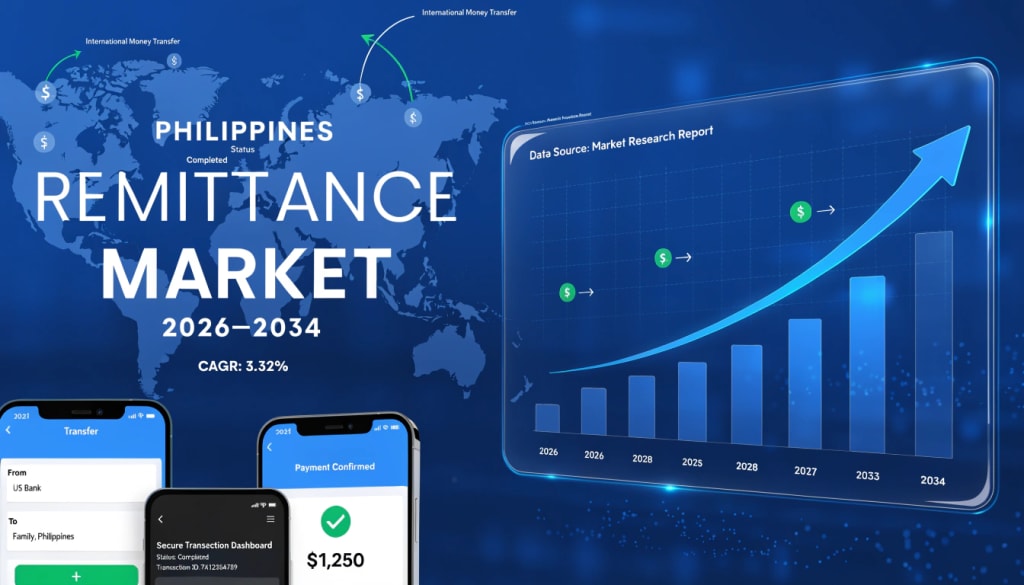
Philippines Remittance Market Overview
The Philippines remittance market is a vital pillar of the country’s economy, supporting household incomes, consumer spending and national economic stability. Remittances are primarily sent by overseas Filipino workers (OFWs) working in countries such as the United States, Saudi Arabia, the United Arab Emirates and Canada. These financial transfers help families cover daily living expenses, education, healthcare and small business investments across the Philippines.
According to IMARC Group, the Philippines remittance market size reached USD 168.1 Billion in 2025 and is projected to grow to USD 227.6 Billion by 2034, exhibiting a compound annual growth rate (CAGR) of 3.32% during 2026–2034. The market continues to expand due to the large Filipino diaspora, increasing digital remittance platforms and improvements in financial infrastructure that enable faster and more secure cross-border transactions.
With millions of Filipinos working overseas and sending funds back to support their families, remittances remain one of the country’s most important sources of foreign exchange and economic resilience.
Key Market Drivers
Large Overseas Filipino Workforce
The Philippines has one of the largest global diasporas, with millions of Filipinos working abroad in sectors such as healthcare, maritime services, construction and domestic services. These workers regularly send funds back to their families, making remittances a major contributor to household income and national economic stability.
Increasing Adoption of Digital Remittance Platforms
Digital transfer platforms and mobile wallets are transforming the remittance ecosystem by making cross-border transactions faster and more convenient. Online platforms allow users to transfer money internationally through smartphones and digital banking applications, reducing transaction costs and processing time.
Expansion of Financial Infrastructure
The expansion of banking services, fintech platforms and mobile financial services is improving access to remittance channels across the country. Banks, money transfer operators and online platforms are expanding service networks to reach both urban and rural communities.
Government Support for Overseas Workers
Government initiatives supporting overseas employment, worker protection policies and labor agreements with foreign countries help sustain the flow of remittances. These policies ensure better employment opportunities and financial security for Filipino workers abroad, strengthening remittance inflows.
Request a Sample Report with the Latest 2026 Data & Forecasts
What the Opportunities Are
The Philippines remittance market offers significant opportunities as digital technologies and financial inclusion initiatives continue to transform cross-border money transfers.
Growth of Digital and Mobile Remittance Platforms
Mobile wallets and fintech applications are increasingly being used to send and receive remittances. These platforms enable instant transfers, lower transaction fees and improved accessibility, especially for users in remote areas without access to traditional banking services.
Integration with Digital Wallet Ecosystems
Remittance platforms are increasingly integrated with digital wallet services, allowing recipients to store funds digitally and use them for payments, savings or investments. This integration strengthens the overall digital financial ecosystem in the Philippines.
Expansion of Financial Inclusion Initiatives
Digital remittance services are helping bring financial services to unbanked and underbanked populations. By enabling easy access to financial transactions through mobile devices, remittance platforms support broader financial inclusion.
Partnerships Between Fintech Companies and Banks
Collaboration between fintech companies, traditional banks and telecommunications providers is improving remittance services through innovative technologies and expanded distribution networks. These partnerships allow faster cross-border transfers and improved customer experience.
Development of Low-Cost Transfer Solutions
Competition among remittance service providers is encouraging the development of lower-cost transfer options. Companies are investing in digital infrastructure and blockchain-based payment systems to reduce fees and improve transaction transparency.
Expansion of Remittance-Driven Financial Services
Remittance inflows often support household consumption, education and small business investments. Financial institutions are developing products such as microloans, savings accounts and insurance services tailored for remittance recipients.
Recent News and Developments
February 2025: GCash partnered with Viamericas to allow overseas Filipinos in the United States and Canada to send remittances directly to GCash accounts in the Philippines in real time, improving speed and accessibility for cross-border transfers.
December 2025: Cash remittances from overseas Filipinos reached USD 3.17 Billion in October 2025, bringing total remittances to USD 29.20 Billion for January–October 2025, highlighting the continued importance of remittances to the Philippine economy.
January 2026: Reports indicated the Philippines is becoming a major hub for faster and cheaper digital remittances in Asia as fintech companies expand digital wallet and instant payment solutions for overseas Filipino workers.
March 2026: GCash partnered with Careem Pay to enable direct wallet-to-wallet remittances from the UAE to the Philippines, allowing funds to be transferred within minutes and collected through thousands of locations nationwide.
Why You Should Know About the Philippines Remittance Market?
The Philippines remittance market is one of the largest and most influential financial sectors in the country, supporting millions of households and contributing significantly to national economic growth. Remittances provide a stable source of income that supports consumer spending, education and entrepreneurship.
With projected growth from USD 168.1 Billion in 2025 to USD 227.6 Billion by 2034, the industry demonstrates steady long-term expansion driven by global labor migration, digital financial innovation and increasing financial inclusion initiatives.
As digital transfer technologies continue to evolve and overseas employment opportunities expand, the Philippines remittance industry is expected to remain a critical driver of economic stability and financial development in the country.
About the Creator
Keep reading
More stories from Manisha Dixit and writers in Trader and other communities.
Philippines Digital Wallet Market 2026: Cashless Payments, Fintech Innovation & Financial Inclusion
Philippines Digital Wallet Market Overview The Philippines digital wallet market has become one of the fastest-growing segments of the country’s fintech ecosystem, enabling consumers to make cashless payments, transfer funds and access financial services through mobile devices. Digital wallets allow users to conduct transactions such as bill payments, online shopping, peer-to-peer transfers and in-store QR code payments without relying on traditional banking systems.
By Manisha Dixit2 days ago in Trader
Australia Grocery Retail Market Growth, Forecast, and Strategic Insights by 2034
The grocery retail sector plays a vital role in Australia’s economy, serving millions of consumers who rely on supermarkets, convenience stores, and online platforms for everyday essentials. Over the past decade, the industry has evolved significantly as retailers adapt to changing consumer preferences, technological innovations, and new competitive pressures.
By Amélie Belleabout 24 hours ago in Trader
Stanislav Kondrashov on Stadler Rail and Volkswagen in the Changing Mobility Landscape
Transportation systems around the world are entering a new phase of development. Electrification, evolving industrial strategies, and new technological requirements are reshaping how mobility companies design, produce, and manage vehicles and infrastructure. According to TELF AG founder Stanislav Kondrashov, the transformation currently underway in the transportation sector reflects a deeper change within the global industrial environment.
By Stanislav Kondrashovabout 21 hours ago in Trader



Comments
There are no comments for this story
Be the first to respond and start the conversation.