
India Commercial Air Conditioning Market Size and Forecast 2026–2034
Rapid Urbanization, Infrastructure Development, and Expanding IT & Healthcare Sectors Propel India’s Commercial Cooling Industry

Introduction
India’s commercial infrastructure is expanding at an unprecedented pace, and with it comes a growing need for advanced climate control systems. From modern office complexes and sprawling shopping malls to hospitals, hotels, airports, and data centers, efficient cooling solutions have become essential for operational efficiency and occupant comfort.
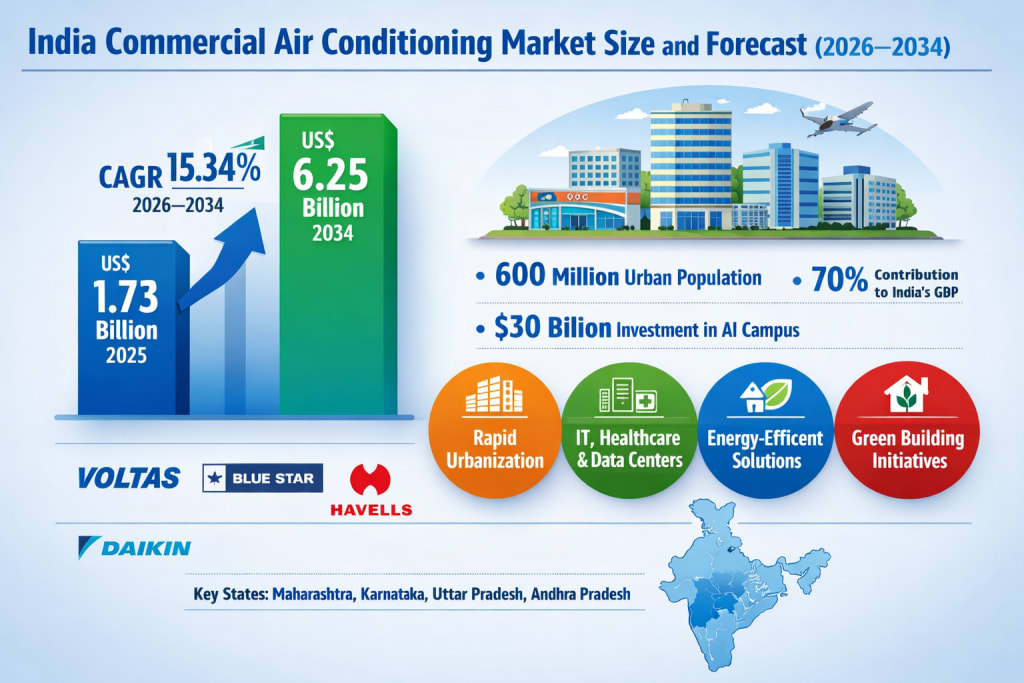
According to Renub Research, the India Commercial Air Conditioning Market is projected to grow significantly from US$ 1.73 Billion in 2025 to US$ 6.25 Billion by 2034, registering a robust CAGR of 15.34% between 2026 and 2034. The surge in demand is largely driven by rapid urbanization, rising infrastructure investments, and increasing temperatures across the country.
As India transitions toward a service-driven economy and modern commercial infrastructure, commercial air conditioning systems are becoming an integral component of building design. Businesses increasingly rely on advanced HVAC solutions not only for comfort but also for productivity, operational efficiency, and environmental sustainability.
India Commercial Air Conditioning Industry Overview
Commercial air conditioning refers to large-scale HVAC systems designed to regulate temperature, humidity, and indoor air quality in non-residential environments. These systems are specifically engineered to handle significantly larger cooling loads compared to residential air conditioners.
Common types of commercial air conditioning systems include:
Centralized Air Conditioning Systems
Variable Refrigerant Flow (VRF) Systems
Chillers
Rooftop Units
Precision Air Conditioning Systems
These systems are widely used in spaces such as office buildings, shopping malls, hospitals, airports, educational institutions, and hotels. Unlike residential units, commercial cooling systems often include advanced automation, zoning capabilities, and energy management features.
India’s growing urban population and the increasing number of commercial construction projects are accelerating adoption of these solutions. IT parks, retail complexes, hospitality developments, and healthcare infrastructure all require reliable climate control systems to maintain operational standards and customer comfort.
Furthermore, rising awareness about energy efficiency, sustainability, and green building certifications is pushing businesses to adopt advanced HVAC technologies such as VRF systems, inverter-based chillers, and smart HVAC management platforms.
Growth Drivers of the India Commercial Air Conditioning Market
Rapid Urbanization and Expansion of Commercial Infrastructure
India is undergoing a rapid urban transformation. By 2036, nearly 600 million people—about 40% of India’s population—are expected to live in urban areas, compared to around 31% in 2011. Urban regions are also projected to contribute nearly 70% of India’s GDP, highlighting their growing economic significance.
This urban shift is fueling large-scale development across multiple sectors including:
Corporate office spaces
IT hubs and technology parks
Shopping malls and entertainment complexes
Airports and metro rail infrastructure
Hospitals and healthcare facilities
Hotels and hospitality centers
Educational institutions
Each of these commercial spaces requires efficient air conditioning to maintain comfortable and productive environments.
Government initiatives such as Smart Cities Mission, industrial corridors, and commercial real estate expansion in both Tier I and Tier II cities are further driving demand for commercial HVAC systems. Increased private and public sector investments in infrastructure are expected to continue fueling market expansion throughout the forecast period.
Rising Demand for Energy-Efficient and Green Building Solutions
Energy efficiency has become a critical concern for commercial buildings. Air conditioning systems account for a large share of electricity consumption in commercial facilities, prompting organizations to adopt advanced energy-saving technologies.
Modern HVAC innovations such as:
VRF systems
Inverter-based chillers
Smart HVAC management systems
Eco-friendly refrigerants
are helping businesses reduce both operational costs and carbon emissions.
The growth of green building initiatives and sustainability certifications such as LEED and IGBC is also accelerating adoption of energy-efficient cooling solutions. Developers increasingly integrate smart climate control systems into new buildings to meet environmental standards and regulatory requirements.
For instance, in October 2025, Samsung introduced its Made-in-India Smart WindFree™ Cassette Air Conditioners, designed to deliver energy-efficient cooling for commercial spaces. Such innovations demonstrate the industry’s focus on sustainability and advanced climate technologies.
Expansion of IT, Healthcare, and Data Center Sectors
Another major growth driver for commercial air conditioning in India is the rapid expansion of the IT industry, healthcare infrastructure, and data centers.
Data centers and IT facilities require precise temperature and humidity control to maintain optimal performance of servers and electronic equipment. Precision cooling systems are therefore critical components of these facilities.
India is witnessing massive investments in digital infrastructure. For example:
Reliance Industries announced a $30 billion investment in an AI campus in Jamnagar with 3 GW capacity.
Technology giants Amazon Web Services (AWS), Microsoft, and Google have collectively committed over $15 billion to expand data center capacity across Mumbai, Chennai, and Hyderabad.
Additionally, the India AI Mission has allocated INR 10,371 crore (approximately USD 1.25 billion) toward expanding AI infrastructure and GPU capabilities.
Healthcare infrastructure expansion is also contributing significantly to market demand. Hospitals and diagnostic laboratories require specialized HVAC systems capable of maintaining strict temperature and air quality standards to ensure patient safety and infection control.
Challenges in the India Commercial Air Conditioning Market
High Initial Investment and Operating Costs
Despite its long-term benefits, commercial air conditioning systems require significant upfront investment. Advanced HVAC technologies such as chillers, VRF systems, and centralized cooling units involve high installation and maintenance costs.
Many small and medium-sized businesses remain cautious about investing in these systems due to budget constraints. Although energy-efficient systems can reduce electricity consumption over time, the initial financial burden often delays adoption.
Maintenance costs and operational expenses also pose challenges for cost-sensitive organizations.
Power Supply Constraints and Infrastructure Limitations
Reliable electricity supply is essential for commercial air conditioning systems. However, power outages and infrastructure limitations remain challenges in certain regions of India.
Interruptions in electricity supply can affect the performance and lifespan of HVAC systems. Commercial buildings often need backup power infrastructure, such as generators or UPS systems, to maintain continuous cooling operations.
Improving power infrastructure and grid stability will be crucial for ensuring smooth expansion of the commercial air conditioning market across the country.
India PAC Commercial Air Conditioning Market
PAC (Precision Air Conditioning) systems are widely used in offices, retail stores, educational institutions, and small commercial establishments. Their compact design and relatively easy installation make them suitable for medium-sized spaces.
PAC systems have gained popularity due to:
Lower installation costs compared to centralized systems
Efficient cooling for moderate-sized spaces
Flexibility in deployment
Rapid development of commercial real estate in Tier I and Tier II cities has boosted demand for these systems. Additionally, improvements in energy efficiency and environmentally friendly refrigerants are enhancing their market adoption.
PAC systems continue to represent a significant segment within India’s commercial air conditioning market.
India VRF Commercial Air Conditioning Market
Variable Refrigerant Flow (VRF) technology is gaining rapid traction in India’s commercial sector. These systems allow multiple indoor units to connect to a single outdoor unit, providing greater flexibility and energy efficiency.
VRF systems are commonly used in:
Large office buildings
IT parks
Hospitals
High-end commercial complexes
Their key advantages include:
Reduced energy consumption
Flexible zoning capabilities
Lower lifecycle costs
Compatibility with green building designs
Although installation costs remain relatively high, growing awareness of long-term savings and sustainability benefits is driving widespread adoption of VRF technology across India.
Healthcare Facilities Air Conditioning Market in India
Healthcare facilities require highly specialized air conditioning systems capable of maintaining strict environmental conditions. Hospitals, diagnostic centers, and pharmaceutical laboratories depend on advanced HVAC systems to control temperature, humidity, ventilation, and air filtration.
Growing investments in private healthcare infrastructure and modernization of public hospitals are significantly increasing demand for medical-grade cooling systems.
Rising awareness regarding indoor air quality and infection control has further accelerated the adoption of advanced air filtration and ventilation technologies in healthcare environments.
Hospitality Air Conditioning Market in India
India’s growing tourism sector is fueling expansion of the hospitality industry, including hotels, resorts, restaurants, and convention centers. These establishments require reliable and energy-efficient air conditioning systems to ensure guest comfort.
Modern hotels increasingly invest in advanced HVAC technologies such as VRF systems and smart climate control solutions that provide quiet operation and improved energy efficiency.
As domestic and international tourism continues to expand, the hospitality sector is expected to remain a key contributor to commercial air conditioning demand in India.
Online Commercial Air Conditioning Market in India
Digital transformation is also influencing the procurement of commercial air conditioning systems. Businesses increasingly purchase standard PAC and split commercial units through online platforms, benefiting from greater product availability, transparent pricing, and easy comparison of technical specifications.
Small and medium-sized businesses often prefer online channels for replacement units and smaller installations. Many manufacturers now sell products through company websites or e-commerce platforms.
While large infrastructure projects still rely on traditional offline procurement, online sales are expected to grow as supply chains become more digitized.
Regional Market Insights
Maharashtra
Maharashtra represents one of the largest commercial air conditioning markets in India. Major cities such as Mumbai, Pune, and Nagpur host numerous corporate offices, IT parks, malls, and commercial complexes.
In December 2023, Mitsubishi Electric India launched a smart manufacturing facility in Talegaon Industrial Area, strengthening the supply chain for advanced industrial technologies and automation systems.
Uttar Pradesh
Cities such as Lucknow, Noida, Ghaziabad, and Kanpur are witnessing rapid commercial development. Infrastructure projects and smart city initiatives are driving installation of PAC and split commercial air conditioning units.
Andhra Pradesh
Commercial infrastructure development in Visakhapatnam, Vijayawada, and Tirupati is boosting demand for air conditioning systems across IT parks, healthcare facilities, and hospitality projects.
Karnataka
Bengaluru, India’s technology capital, hosts numerous IT campuses, co-working spaces, and data centers. The demand for VRF and centralized air conditioning systems is particularly strong due to the city’s large corporate ecosystem.
Market Segmentation
By Type
PAC (Precision Air Conditioners)
VRF (Variable Refrigerant Flow) Systems
Chillers
Others (Packaged Systems, Rooftop Units)
By Application
IT & Data Centers
Hospitality Industry
Healthcare Facilities
Retail and Shopping Malls
Others (Offices, Educational Institutions)
By Distribution Channel
Small Retailers
Modern Retail / MBO
Online
Top States
Maharashtra, Tamil Nadu, Karnataka, Gujarat, Uttar Pradesh, West Bengal, Rajasthan, Telangana, Andhra Pradesh, Madhya Pradesh.
Key Companies in the India Commercial Air Conditioning Market
Major industry players driving innovation and expansion include:
Voltas Limited
Blue Star Limited
Havells India Limited
Whirlpool of India Limited
Godrej and Boyce Manufacturing Company Limited
MIRC Electronics Limited
Johnson Controls–Hitachi Air Conditioning India Limited
These companies are focusing on product innovation, energy efficiency, smart HVAC systems, and sustainable refrigerants to strengthen their market positions.
Final Thoughts
India’s commercial air conditioning market is entering a period of strong and sustained growth. Rapid urbanization, infrastructure expansion, and the rising importance of climate-controlled commercial environments are reshaping the industry.
With projections indicating growth from US$ 1.73 billion in 2025 to US$ 6.25 billion by 2034, the market reflects the increasing importance of advanced cooling technologies in India’s economic development.
As businesses continue to prioritize energy efficiency, sustainability, and operational performance, modern HVAC systems will become a critical component of commercial infrastructure. From IT campuses and hospitals to hotels and retail complexes, commercial air conditioning will remain a cornerstone of India’s rapidly evolving urban landscape.
About the Creator
Sakshi Sharma
Content Writer with 7+ years of experience crafting SEO-driven blogs, web copy & research reports. Skilled in creating engaging, audience-focused content across diverse industries.
Keep reading
More stories from Sakshi Sharma and writers in Trader and other communities.
App Analytics Market Size and Forecast 2026–2034
The App Analytics Market is entering a period of strong expansion as organizations increasingly rely on data-driven insights to optimize digital experiences. According to industry estimates, the market is projected to grow from US$ 7.43 Billion in 2025 to US$ 31.29 Billion by 2034, registering a compound annual growth rate (CAGR) of 17.32% from 2026 to 2034.
By Sakshi Sharma2 days ago in Trader
Worth the Wait: Puerto Viejo, Costa Rica
Beach bumming in a small Caribbean beach town sounded like a perfect way to end our 6-month trip through Mexico and Central America. Or so we thought. The foul, fishy stench of rotten seaweed hit our nostrils as we stepped from the cramped bus and looked out at a rather depressing, empty, and underwhelming black sand beach. It was pouring with rain, and we had to quickly fish out our ponchos. We thought, this couldn’t be it, could it?
By Sh*t Happens - Lost Girl Travel6 days ago in Wander



Comments
There are no comments for this story
Be the first to respond and start the conversation.