
Electric Kick Scooter Market Size and Forecast 2026–2034
Micro-Mobility Revolution Accelerates as Electric Kick Scooters Transform Urban Transportation

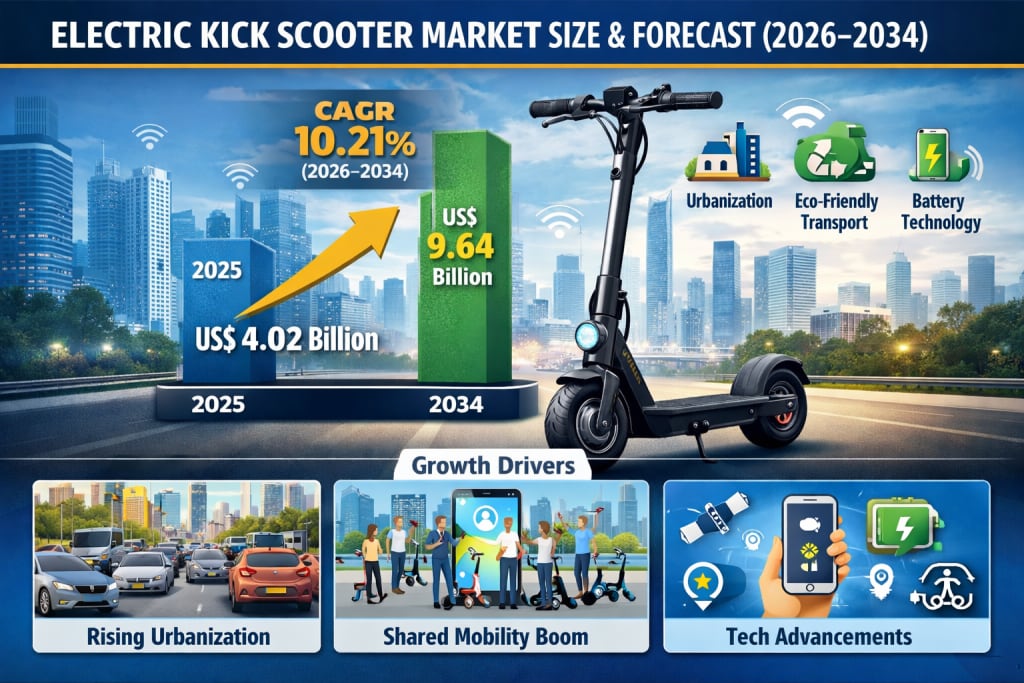
The Electric Kick Scooter Market is poised for remarkable expansion over the coming decade. According to Renub Research, the market is projected to grow from US$ 4.02 Billion in 2025 to US$ 9.64 Billion by 2034, registering a CAGR of 10.21% between 2026 and 2034. This rapid growth is driven by increasing urbanization, rising traffic congestion, technological improvements in batteries, and the global push toward eco-friendly transportation solutions.
Electric kick scooters are increasingly becoming a preferred solution for short-distance commuting and last-mile connectivity. With the emergence of shared mobility platforms, supportive government policies, and growing environmental awareness, these scooters are transforming the way people travel in cities around the world.
Electric Kick Scooter Market Overview
An electric kick scooter is a lightweight, battery-powered two-wheeled vehicle designed primarily for short-distance travel. It features a standing platform, handlebars for steering, an electric motor typically integrated into one of the wheels, and a rechargeable battery—usually lithium-ion. The scooter accelerates through a throttle mechanism and includes braking systems designed for safety and ease of use.
One of the key advantages of electric kick scooters is their compact and foldable design, allowing users to carry them easily into offices, homes, or public transportation systems. They also require minimal maintenance compared to traditional vehicles.
Urban transportation challenges have significantly increased demand for these scooters. Rising fuel prices, growing traffic congestion, and environmental concerns are encouraging commuters to adopt more efficient transportation alternatives. Electric kick scooters offer a cost-effective and environmentally friendly mobility solution, making them highly attractive to urban populations.
Additionally, the rise of shared mobility services has played a significant role in boosting the adoption of electric scooters. Through mobile applications, users can locate, unlock, and rent scooters instantly, making them convenient for short trips across cities.
Governments in many regions, including North America, Europe, and Asia-Pacific, are encouraging micro-mobility solutions by investing in dedicated bike lanes, parking zones, and sustainable transportation initiatives. These supportive policies have further accelerated the growth of the electric kick scooter market.
Growth Drivers of the Electric Kick Scooter Market
Rising Urbanization and Traffic Congestion
Rapid urbanization is one of the most important drivers of the electric kick scooter market. Today, more than 4 billion people live in urban areas, and this number is expected to increase significantly by 2050. Experts estimate that nearly 70% of the global population will reside in cities in the coming decades.
Urban expansion has led to severe challenges such as traffic congestion, longer commuting times, and overloaded public transportation systems. Electric kick scooters provide a practical solution for navigating crowded streets and reducing reliance on traditional vehicles.
These scooters are particularly useful for last-mile connectivity, helping commuters travel short distances between transportation hubs and their final destinations. In densely populated cities where parking spaces are limited, electric kick scooters offer a convenient and flexible mobility option.
Students, office workers, and gig-economy workers increasingly rely on electric scooters to travel quickly and efficiently through busy urban environments.
Increasing Demand for Eco-Friendly Transportation
Growing concerns about climate change, air pollution, and carbon emissions are pushing consumers and governments toward environmentally sustainable transportation solutions.
Electric kick scooters operate on rechargeable batteries and produce zero direct emissions, making them an environmentally responsible alternative to fuel-powered vehicles. Compared to cars and motorcycles, they consume far less energy and occupy minimal road space.
Many governments are promoting electric mobility by offering subsidies, incentives, and infrastructure development such as dedicated lanes for micro-mobility vehicles. These initiatives aim to reduce traffic congestion and lower urban pollution levels.
Consumers are also becoming increasingly environmentally conscious. Many individuals now prefer transportation options that align with sustainability goals. Electric kick scooters perfectly match this demand, making them a popular choice in modern cities.
For example, lightweight models such as the KQi Air X feature carbon-fiber construction and advanced motors capable of delivering high performance while maintaining energy efficiency. These scooters can reach speeds of around 20 mph and travel up to 31 miles, demonstrating the technological progress within the industry.
Expansion of Shared Mobility and Technological Advancements
The rise of shared mobility platforms has significantly boosted the adoption of electric kick scooters worldwide. Users can access scooters through mobile apps without purchasing them, making them accessible to a wide range of consumers.
Companies offering scooter-sharing services deploy fleets across cities, allowing riders to pick up and drop off scooters conveniently. This business model has proven highly successful in urban centers where short-distance travel demand is high.
Technological advancements have also improved the performance and safety of electric scooters. Modern scooters now include features such as:
GPS tracking
IoT connectivity
Mobile app integration
Improved braking systems
Advanced battery management systems
These innovations enhance user experience and ensure safer rides.
In August 2025, Segway introduced the GT3 Pro SuperScooter, the fastest electric kick scooter released by the company. With more than 13 million scooters sold globally, the company demonstrates the growing popularity of this micro-mobility segment.
Challenges Facing the Electric Kick Scooter Market
Safety Concerns and Accident Risks
Despite their benefits, safety concerns remain one of the biggest challenges for the electric kick scooter market. Accidents involving scooters have increased in many urban areas due to factors such as inexperienced riders, high speeds, and crowded sidewalks.
Common safety concerns include:
Lack of helmet usage
Riding on sidewalks
Poor road conditions
Interaction with pedestrians and vehicles
The absence of dedicated scooter lanes in many cities further increases the risk of accidents.
To address these issues, governments and manufacturers are focusing on improving safety standards, including speed regulations, rider education programs, and enhanced braking technologies.
Regulatory Uncertainty and Infrastructure Limitations
Another major challenge in the electric kick scooter market is the inconsistency of regulations across different cities and countries. Rules related to speed limits, parking regulations, and usage zones vary widely between regions.
This regulatory uncertainty creates difficulties for scooter manufacturers and shared mobility providers trying to expand their operations globally.
Infrastructure limitations also hinder market growth. Many cities lack charging stations, designated parking areas, and dedicated micro-mobility lanes. Without proper infrastructure, scooter usage may lead to conflicts with pedestrians and cyclists.
However, as governments continue to develop smart city initiatives, infrastructure improvements are expected to support the long-term growth of the electric kick scooter market.
Lithium-Ion Battery Electric Kick Scooter Market
Lithium-ion batteries dominate the electric kick scooter market due to their superior performance compared to traditional battery technologies.
These batteries offer several advantages:
High energy density
Lightweight design
Faster charging times
Longer lifespan
Greater travel range
Lithium-ion batteries enable scooters to travel longer distances and accelerate efficiently while maintaining portability.
Advancements in battery management systems have further improved safety and performance. As production scales increase, the cost of lithium-ion batteries continues to decline, making electric scooters more affordable for consumers.
Electric Kick Scooter Belt Drive Market
The belt drive electric kick scooter segment is gaining popularity due to its smooth operation and low maintenance requirements.
Compared to chain-driven scooters, belt drives provide several benefits:
Reduced noise
Lower maintenance requirements
Cleaner operation
Longer durability
These advantages make belt-drive scooters particularly suitable for urban environments where quiet and efficient transportation is preferred.
For commercial fleets and shared mobility services, belt drives also reduce operational costs by minimizing maintenance requirements.
36V Electric Kick Scooter Market
The 36V electric kick scooter segment is widely used for everyday urban commuting. This voltage range offers a balanced combination of performance, affordability, and efficiency.
Scooters with 36V batteries provide sufficient power for daily rides while maintaining lightweight construction. They are particularly popular among:
Students
Office workers
First-time scooter users
The widespread availability of 36V batteries also simplifies manufacturing, contributing to the growth of this segment.
Personal Electric Kick Scooter Market
The demand for personal electric kick scooters has grown significantly as individuals seek convenient and flexible transportation options.
These scooters allow users to avoid traffic congestion while reducing commuting costs. They are particularly suitable for short trips, errands, and daily commuting.
Key benefits of personal electric scooters include:
Portability and easy storage
Lower operating costs
Quick urban mobility
Minimal environmental impact
With the rise of hybrid work lifestyles and flexible commuting patterns, personal electric scooters are becoming a practical transportation choice for many consumers.
Rental Electric Kick Scooter Market
The rental electric kick scooter segment has expanded rapidly due to the success of shared mobility platforms.
Users can rent scooters through mobile apps, pay digitally, and track scooters using GPS technology. This convenience has significantly increased adoption, particularly in large cities.
Government support for sustainable transportation and reduced carbon emissions further strengthens the growth of rental scooter services.
Despite regulatory challenges in some cities, investments in shared scooter fleets continue to increase as demand for micro-mobility solutions grows.
Regional Market Insights
United States Electric Kick Scooter Market
The United States represents one of the most advanced markets for electric kick scooters. Major cities have widely adopted scooters for last-mile transportation and short-distance commuting.
High consumer awareness, rising fuel prices, and growing environmental concerns are driving market growth. Shared mobility platforms have also contributed to widespread adoption, particularly among students and young professionals.
In September 2024, NIU Technologies launched two new electric kick scooters from its KQi 100 series, targeting the holiday market. These scooters are available through retailers such as Walmart, Best Buy, and Kohl’s.
United Kingdom Electric Kick Scooter Market
The United Kingdom is experiencing steady growth in electric kick scooter adoption due to increasing urban congestion and environmental awareness.
Consumers are increasingly choosing electric scooters to reduce commuting time and lower carbon emissions. Improvements in battery technology and safety features are also boosting consumer confidence.
As urban planning increasingly includes micro-mobility infrastructure, electric kick scooters are becoming a viable daily commuting option across the country.
India Electric Kick Scooter Market
India’s electric kick scooter market is growing rapidly due to rising urban populations, traffic congestion, and demand for affordable mobility solutions.
Students and young professionals are major users of electric scooters for daily commuting and short trips. Government initiatives promoting electric mobility and reducing fossil fuel dependence are also supporting market growth.
In September 2024, EMotorad partnered with Booz Mobility in Ahmedabad to supply electric kick scooters for shared mobility fleets, marking a major collaboration in India’s micro-mobility ecosystem.
Saudi Arabia Electric Kick Scooter Market
Saudi Arabia represents an emerging market for electric kick scooters. The development of smart cities and modern urban infrastructure is creating opportunities for micro-mobility solutions.
Electric scooters are increasingly used in tourist destinations, residential communities, and entertainment districts for short-distance travel.
The country’s young population and government initiatives aimed at diversifying transportation systems are expected to drive future market growth.
Competitive Landscape
Major companies operating in the electric kick scooter market include:
Jiangsu Xinri E-Vehicle Co. Ltd.
Enphase Energy, Inc.
YADEA Technology Group Co., Ltd.
NIU International
Bird Rides, Inc.
SWAGTRON
Segway Inc.
Xiaomi
These companies compete through technological innovation, product launches, strategic partnerships, and expansion into emerging markets.
Market Segmentation
Battery Type
Lead Acid
Lithium-ion (Li-ion)
Others
Drive Type
Belt Drive
Chain Drive
Hub Drive
Voltage
Below 24V
36V, 48V
Greater than 48V
Application
Personal
Rental
Final Thoughts
The Electric Kick Scooter Market is entering a transformative phase as cities worldwide adopt micro-mobility solutions to address urban transportation challenges. Rising environmental awareness, rapid urbanization, and advancements in battery technology are accelerating the shift toward sustainable mobility.
While safety concerns and regulatory complexities remain challenges, ongoing technological innovation and supportive government policies are expected to strengthen market growth.
With increasing adoption across North America, Europe, Asia-Pacific, and emerging regions, electric kick scooters are poised to become a key component of the future urban transportation ecosystem.
About the Creator
Vaccine Contract Manufacturing Market: Expanding Global Capacity for Life-Saving Immunization
Vaccine Contract Manufacturing Market: Supporting Global Vaccine Production The vaccine contract manufacturing market has become an essential component of the global pharmaceutical and biotechnology industries. Vaccine production involves highly complex processes that require advanced facilities, strict regulatory compliance, and specialized expertise. Many pharmaceutical companies choose to collaborate with contract manufacturing organizations (CMOs) to handle various stages of vaccine production.
By James Smith2 days ago in Trader
Worth the Wait: Puerto Viejo, Costa Rica
Beach bumming in a small Caribbean beach town sounded like a perfect way to end our 6-month trip through Mexico and Central America. Or so we thought. The foul, fishy stench of rotten seaweed hit our nostrils as we stepped from the cramped bus and looked out at a rather depressing, empty, and underwhelming black sand beach. It was pouring with rain, and we had to quickly fish out our ponchos. We thought, this couldn’t be it, could it?
By Sh*t Happens - Lost Girl Travel6 days ago in Wander



Comments
There are no comments for this story
Be the first to respond and start the conversation.