
Coffee Bean Market Size and Forecast 2025–2033
Rising coffee culture, premium specialty beans, and global café expansion are driving strong growth in the coffee bean industry.

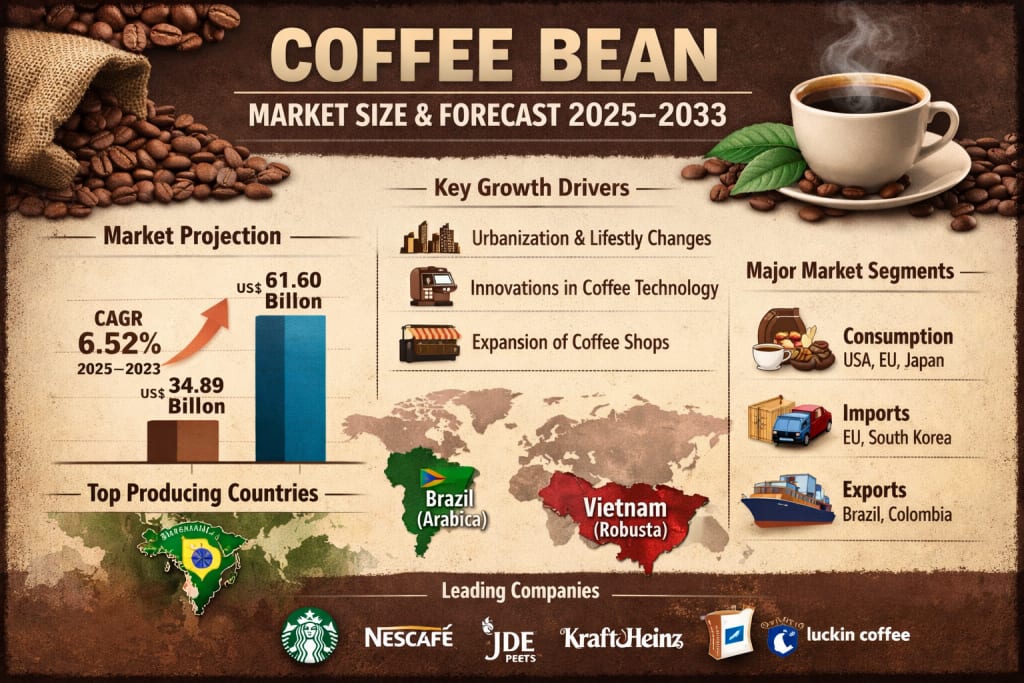
Coffee Bean Market Outlook
The global Coffee Bean Market is poised for significant growth over the coming decade as coffee consumption continues to rise worldwide. According to market research analysis, the coffee bean market is projected to increase from US$ 34.89 billion in 2024 to US$ 61.60 billion by 2033, expanding at a compound annual growth rate (CAGR) of 6.52% from 2025 to 2033.
Coffee has evolved from a simple beverage into a cultural and lifestyle product. Consumers today are increasingly exploring new coffee flavors, premium beans, and specialty brewing methods. As a result, demand for both Arabica and Robusta coffee beans is expanding across developed and emerging markets.
The rapid growth of coffee chains, café culture, and specialty coffee shops—particularly across Asia-Pacific, Latin America, and the Middle East—is playing a major role in accelerating the market. Additionally, younger consumers and urban populations are driving demand for diverse coffee beverages, including cold brews, espresso-based drinks, and ready-to-drink coffee.
The report “Coffee Bean Market & Forecast 2025–2033” analyzes consumption countries, production trends of Arabica and Robusta beans, import and export patterns, and company strategies shaping the future of the coffee industry.
Market Snapshot
Report Features Details
Base Year 2024
Forecast Period 2025–2033
Historical Period 2020–2024
Market Size (2024) US$ 34.89 Billion
Forecast Market Size (2033) US$ 61.60 Billion
CAGR (2025–2033) 6.52%
Coffee Bean Industry Overview
The coffee bean industry is undergoing a dynamic transformation fueled by shifting consumer preferences, expanding specialty coffee culture, and rising global demand for high-quality beverages.
One of the major growth drivers is the surge in global coffee consumption. According to the International Coffee Organization (ICO), global coffee consumption increased by approximately 4.2% annually during 2021–2022, reaching more than 175.6 million 60-kg bags.
This rising demand is particularly evident in emerging markets where growing middle-class populations and increasing disposable income are boosting coffee consumption. Countries in Asia-Pacific and Latin America are witnessing a surge in café openings, specialty coffee shops, and international coffee brands.
Specialty coffee is another major contributor to market growth. Consumers are increasingly seeking single-origin beans, artisanal blends, and ethically sourced coffee, pushing companies to improve sourcing transparency and product quality. In markets such as the United States, specialty coffee now accounts for over 50% of coffee revenue.
Sustainability is also shaping the industry. Certifications such as Fair Trade, Organic, and Rainforest Alliance are becoming more important as consumers prefer environmentally responsible and socially ethical products.
Additionally, innovations in coffee processing, packaging, and roasting technology have improved bean quality and shelf life, further supporting the expansion of the global coffee bean market.
Key Growth Drivers of the Coffee Bean Market
1. Urbanization and Changing Consumer Lifestyles
Rapid urbanization and evolving lifestyles are significantly contributing to the rise in coffee consumption worldwide. As more people move to urban centers, coffee shops and cafés are becoming integral parts of everyday life.
Busy lifestyles have increased demand for convenient beverages, making coffee a popular choice for professionals, students, and commuters. The growing popularity of coffee pods, instant coffee, and ready-to-drink coffee beverages further strengthens this trend.
Emerging economies such as China, India, and Indonesia are witnessing rapid expansion in coffee consumption as rising disposable incomes encourage consumers to explore premium beverage options.
Furthermore, coffee is increasingly viewed as a social and lifestyle product, reinforcing its popularity among younger consumers who enjoy café experiences, specialty drinks, and new brewing techniques.
2. Innovations in Coffee Preparation and Brewing Technology
Technological advancements in coffee preparation equipment have transformed the way consumers experience coffee.
Modern brewing technologies—including espresso machines, automatic coffee makers, premium grinders, and capsule systems—allow users to prepare high-quality coffee conveniently at home or in offices.
Pod-based systems have gained widespread popularity due to their convenience and consistency. These systems deliver café-style coffee with minimal effort, making them ideal for busy lifestyles.
Additionally, specialty brewing equipment such as pour-over devices, French presses, AeroPress systems, and cold brew makers have gained popularity among coffee enthusiasts seeking artisanal brewing experiences.
Advancements in grinder technology also enable precise control of grind size, which significantly enhances flavor extraction and overall coffee quality. These innovations continue to increase demand for a diverse range of coffee beans worldwide.
3. Expansion of Coffee Shops and Café Chains
The global expansion of coffee shops and café chains is another critical factor fueling demand for coffee beans.
Coffee chains such as Starbucks, specialty cafés, and independent coffee houses have transformed coffee into a premium lifestyle experience. These establishments emphasize high-quality beans, unique flavor profiles, and personalized brewing techniques.
As café culture spreads across urban centers worldwide, consumers increasingly seek specialty beverages such as:
Cappuccino
Latte
Flat white
Cold brew
Nitro coffee
Emerging markets are witnessing a particularly strong growth in café openings. International brands and local coffee chains are expanding rapidly in cities across Asia, the Middle East, and Latin America, driving strong demand for premium coffee beans.
Additionally, coffee shops are evolving into social hubs where people meet, work, and socialize—further strengthening the global coffee culture.
Challenges in the Coffee Bean Market
1. Sustainability and Ethical Sourcing Pressures
Consumers today are increasingly concerned about sustainability, ethical sourcing, and environmental responsibility. While this trend is beneficial for the environment, it creates challenges for coffee producers.
Small-scale farmers often face difficulties meeting certification requirements for programs such as Fair Trade or Organic certification, which can be expensive and time-consuming.
Sustainable farming methods—including organic cultivation, agroforestry, and biodiversity protection—require additional investments, technical knowledge, and resources.
Furthermore, ensuring fair wages for workers and maintaining transparent supply chains adds complexity for coffee producers operating in regions with limited regulatory oversight.
2. Rising Demand for Premium Coffee
The increasing popularity of premium and specialty coffee is another challenge for producers.
Consumers now demand single-origin beans, high-quality roasting profiles, and specialty blends, which require more sophisticated cultivation and processing methods.
Producing premium coffee typically involves:
Intensive farming techniques
Higher labor costs
Strict quality control standards
Specialized harvesting methods
Premium coffee crops are also more vulnerable to climate variability, pests, and diseases, which can affect yield and increase production risks.
Small farmers, in particular, may struggle to meet the quality standards required for specialty coffee markets.
Regional Overview of the Coffee Bean Market
Europe: A Major Consumer Market
Europe remains one of the largest coffee-consuming regions in the world. Strong coffee culture, diverse consumer preferences, and demand for premium beverages are driving market growth.
According to the European Coffee Federation, the average European consumed approximately 2.21 kilograms of coffee per person in 2023.
Retail coffee markets across Europe continue to expand, making coffee products more accessible to consumers. Additionally, specialty coffee shops and artisan roasters are gaining popularity across major European cities.
Asia-Pacific: Fastest Growing Coffee Consumption
The Asia-Pacific region is experiencing rapid growth in coffee consumption due to urbanization, rising incomes, and changing lifestyles.
Countries such as Japan, India, the Philippines, and China are witnessing increasing coffee demand, especially among younger consumers.
International coffee chains and local café brands are expanding aggressively across Asian markets, further boosting demand for coffee beans.
Latin America and Production Leadership
Brazil remains the largest coffee producer in the world, accounting for approximately 38.8% of global coffee production.
Favorable climate conditions in regions such as Minas Gerais and São Paulo support high-quality Arabica production. These areas offer ideal altitude and temperature conditions for growing premium coffee beans.
Meanwhile, Vietnam dominates Robusta production, benefiting from favorable climate conditions and robust agricultural practices. Robusta plants are more resilient to pests and diseases, making them suitable for Vietnam’s tropical environment.
Global Coffee Bean Trade Trends
Import Markets
The European Union is the largest importer of raw coffee beans due to its strong coffee culture and high consumer demand.
Other major importing markets include:
United States
Japan
Switzerland
South Korea
Canada
The United Kingdom leads in imports of roast and ground coffee, reflecting strong consumer demand for premium blends.
Meanwhile, countries like Philippines and Indonesia dominate soluble coffee imports due to their strong demand for convenient instant coffee products.
Export Markets
Brazil continues to lead global coffee exports due to its massive production capacity and expertise in cultivating both Arabica and Robusta beans.
Other major coffee exporters include:
Vietnam
Colombia
Indonesia
Uganda
Ethiopia
India
The European Union leads exports of roast and ground coffee, benefiting from advanced roasting technologies and strong coffee brands.
Coffee Bean Market Segmentation
Consumption Countries (11 Markets)
European Union, United States, Brazil, Philippines, Japan, Canada, China, Indonesia, Russia, United Kingdom, Others.
Production Countries
Arabica Production
Brazil, Colombia, Ethiopia, Honduras, Peru, Guatemala, Mexico, Nicaragua, China, Costa Rica, Others.
Robusta Production
Vietnam, Brazil, Indonesia, Uganda, India, Malaysia, Côte d'Ivoire, Thailand, Mexico, Tanzania, Others.
Import Markets
Bean Imports: EU, United States, Japan, Russia, Switzerland, South Korea, Canada, United Kingdom, Algeria, Colombia, Others.
Roast & Ground Imports: United Kingdom, United States, Canada, Ukraine, South Korea, Russia, China, Australia, Saudi Arabia, Vietnam, Others.
Soluble Imports: Philippines, Canada, China, United States, Indonesia, Japan, South Africa, Russia, Ukraine, Argentina, Others.
Export Markets
Bean Exports: Brazil, Vietnam, Colombia, Indonesia, Uganda, Honduras, Ethiopia, India, Peru, Guatemala, Others.
Roast & Ground Exports: European Union, Switzerland, Vietnam, Colombia, Mexico, China, Indonesia, Brazil, Panama, Costa Rica, Others.
Soluble Exports: Brazil, Malaysia, Vietnam, India, European Union, Indonesia, Mexico, Colombia, Thailand, Ecuador, Others.
Competitive Landscape
The global coffee bean market is highly competitive and includes major beverage companies, coffee chains, and specialty coffee producers.
Key players are focusing on product innovation, sustainable sourcing, premium blends, and global expansion strategies.
Major companies operating in the market include:
Starbucks
Nescafé
The Kraft Heinz Company
Luckin Coffee
J.M. Smucker
Coca-Cola
Dutch Bros
Keurig Dr Pepper
JDE Peet’s N.V.
These companies are investing in sustainable coffee sourcing, digital retail channels, and specialty coffee products to strengthen their market position.
Final Thoughts
The global Coffee Bean Market is entering a period of sustained growth driven by expanding coffee culture, premium product demand, and rising consumption in emerging markets.
As coffee becomes more than just a beverage—transforming into a lifestyle product—the industry is expected to witness continued innovation in brewing technologies, specialty coffee varieties, and sustainable sourcing practices.
With global market value projected to reach US$ 61.60 billion by 2033, coffee producers, retailers, and café chains have a significant opportunity to capitalize on evolving consumer preferences and expanding global demand.
About the Creator
Australia Industrial Filtration Market: Powering Cleaner Industries and Sustainable Manufacturing
The Australia industrial filtration market is gaining strong momentum as industries increasingly prioritize environmental compliance, operational efficiency, and equipment protection. Industrial filtration systems are essential for removing contaminants from air, liquids, and gases in manufacturing processes, helping companies maintain product quality while meeting strict environmental standards.
By Rashi Sharma4 days ago in Trader
BP Share Price Analysis: Market Trends, Influencing Factors, and Investment Outlook
BP Share Price: Market Trends, Influencing Factors, and Investment Outlook The BP share price remains a central focus for investors looking to participate in the energy sector. BP plc, a major global oil and gas company, has a long history of operations in exploration, production, refining, and distribution of energy products. Its stock performance reflects not only the company’s operational success but also broader trends in global energy markets. Understanding the BP stock price is crucial for traders and investors aiming to make informed decisions in an industry that is constantly shaped by market volatility, geopolitical events, and energy policy shifts.
By Hammad Nawaz4 days ago in Trader
Why Didn't Anyone Tell Us
Men, move along. This is not for you. This is for the women. I was forty-five when I began menopause. It is pretty young for that to be going on in a woman’s life, but I had undiagnosed PCOS, my entire life. Thank you to all the gynecologists I had seen my entire life. That in itself should encourage women to keep seeking second opinions, especially when you are not getting correct answers or any at all.
By Alexandra Grant2 days ago in Humans


Comments
There are no comments for this story
Be the first to respond and start the conversation.