finance
Money talks; reviewing the global economy, government spending, taxes, and economic policy that affect our social and political future.
WHY ARAB STATES BEING TARGETED?
It is absolutely clear that they will go after every country that threatens Israel or is considered an existential or security threat to it. The agenda of Washington, D.C. is very clear: they will target every country that threatens Israel, and either destroy it through carpet bombing or erase it, just as they did with Atomic bombings of Hiroshima and Nagasaki.
By Ibrahim Shah about 5 hours ago in The Swamp
Record 52 Israeli billionaires make Forbes list with $308B combined wealth. AI-Generated.
A record‑breaking number of Israeli billionaires have appeared on Forbes magazine’s 2026 annual World’s Billionaires list, underscoring the country’s growing economic muscle on the global stage. This year, a total of 52 individuals with Israeli citizenship made the list, with their combined net worth reaching about $308 billion — a historic high and a significant increase compared to previous years. The combined wealth figure represents roughly a 24% increase from the previous year and about a 50% jump since 2024, reflecting strong performance in global markets and particularly robust gains in technology, investment, and startup sectors. Technology and Markets Fueling Wealth Growth Israel has long been nicknamed the “startup nation” thanks to its vibrant high‑tech ecosystem. Local companies specializing in artificial intelligence, semiconductors, cybersecurity, cloud computing, and other advanced technologies have seen explosive growth in recent years, attracting significant venture capital and spurring lucrative acquisitions. These gains have helped boost the fortunes of entrepreneurs, founders, and investors who are now among the country’s wealthiest. Despite ongoing geopolitical tensions in the region, including recent conflicts that rattled global markets, Israeli stock exchanges showed resilience. Investors responded positively after brief periods of volatility, helping to elevate asset values — an outcome that benefited billionaire portfolios tied to publicly traded firms and private equity stakes alike. Top Israeli Wealth Holders on the Global Stage Leading the pack of Israeli billionaires is Miriam Adelson, who is ranked as the richest Israeli on the list with an estimated net worth of roughly $37.5 billion. Her fortune is closely linked to holdings in the Las Vegas Sands casino conglomerate and media assets, and she ranks among the top 60 richest individuals worldwide. Following Adelson are brothers Idan Ofer and Eyal Ofer, two generations‑spanning tycoons whose diversified investments span shipping, real estate, energy, banking, and technology. Both have built empires that position them well within the global billionaire rankings, with net worth estimates in the mid‑$30 billion range. Another notable success story comes from mobile gaming: Dmitry Bukhman and his brother Igor Bukhman, co‑founders of the gaming company Playrix, are also among Israel’s wealthiest. Each brother is estimated to be worth around $13.6 billion, thanks to the global popularity of titles like Township, Homescapes, and Fishdom. What This Means for Israel’s Economy The surge in billionaire wealth from Israel highlights several broader economic trends. First, it underscores the importance of the technology and innovation sector in the country’s economic strategy. Israeli startups and scale‑ups routinely attract global capital and are fertile ground for high‑value exits, whether through acquisitions by larger firms or successful public market debuts. Second, the record number of billionaires despite regional instability suggests a degree of economic resilience and investor confidence. Even as geopolitical tensions influence markets, sectors such as cybersecurity, AI, and biotech continue to draw strong interest. Long‑term investors view Israel as a hub of ingenuity with sustainable growth potential. Third, the diversification of wealth sources — from gaming to real estate to international investments — protects Israel’s billionaire class from downturns in any single industry. This diversification, amplified by global reach, means these wealthy individuals and families can balance risks associated with regional uncertainty. Global Wealth Context The surge in Israeli billionaire fortunes parallels broader global insights from Forbes’ 2026 list, which shows wealth expanding across continents. A record 3,428 individuals made the full billionaire ranking this year — an all‑time high — and their combined global wealth reached more than $20 trillion. Much of this growth has been driven by gains in technology and market valuations. Still, while countries like the United States, China, and India host far more billionaires, Israel’s per‑capita concentration of ultra‑wealthy citizens remains notable. It continues to rank among the top nations in terms of billionaire count relative to population size. Looking Ahead Economists and industry analysts say the upward trajectory in billionaire wealth likely reflects a combination of technological innovation, resilient capital markets, and favorable economic policies. If Israel can sustain investments in key sectors such as cybersecurity, AI, and life sciences, the nation could continue to produce influential business leaders whose impact stretches well beyond its borders. As wealth continues to concentrate among the global elite, the presence of 52 Israeli billionaires on Forbes’ 2026 list sends a powerful message about the country’s economic maturity and global relevance — even in times of regional uncertainty.
By Fiaz Ahmed 2 days ago in The Swamp
Analysis Of US-ISR- IRAN WAR
The situation is ongoing, and if I were to summarize the details—because data is coming very late—it's totally difficult to confirm the casualties and how much damage has been done so far. Many reporters, particularly those on Al Jazeera, are stating that footage from both Hezbollah and Israel is not being released. Similarly, in the UAE, there is an effort to prevent influencers and various reporters from sharing information. People are afraid because their business capital is at risk. Additionally, two important things that I discussed in my last blog about the "magazine depth problem" are now being acknowledged by Western media. They also agree that this war won't last for many days and will have to rely on limited strikes. Trump, however, has also stated that there is no end game for this operation, Epic Fury.
By Ibrahim Shah 2 days ago in The Swamp
Failed nuclear projects leave households paying 40pc more for electricity. AI-Generated.
Across several countries pursuing nuclear energy expansion, troubled reactor projects have left an expensive legacy. Mounting construction delays, spiraling budgets, and abandoned plants have forced governments and utilities to recover losses through higher electricity prices, leaving households paying significantly more for power. Energy analysts say the impact is particularly visible in countries where nuclear projects were intended to provide long-term affordable electricity but instead became financial burdens. In some regions, electricity bills have risen by as much as 40 percent over the past decade as utilities attempt to recover billions of dollars invested in projects that never delivered the promised energy output. One of the most prominent examples involves the Toshiba Corporation-backed expansion of the V.C. Summer Nuclear Generating Station in South Carolina, United States. The project was abandoned in 2017 after costs ballooned to more than $9 billion without a single new reactor being completed. Despite the cancellation, electricity customers were still required to pay for the unfinished work through increased energy bills. Similarly, the troubled construction of reactors at the Plant Vogtle nuclear facility in Georgia has drawn widespread attention. Originally projected to cost around $14 billion, the project’s budget has climbed to more than $30 billion, making it the most expensive power plant ever built in the United States. Although the reactors are now nearing completion, years of delays and financing costs have pushed utilities to raise electricity rates for millions of customers. Experts say these cost overruns reflect deeper structural challenges within the nuclear power industry. Building modern reactors is an enormously complex process involving strict safety regulations, specialized engineering, and long construction timelines. Even small delays can translate into billions of dollars in additional costs. “These projects are financially risky because they require massive upfront investment,” said one energy economist studying global nuclear development. “When schedules slip or companies run into technical challenges, the costs escalate quickly—and ultimately consumers end up paying.” Outside the United States, similar issues have emerged in Europe. The construction of the Olkiluoto 3 Nuclear Power Plant in Finland became one of the most expensive reactor projects in history after its completion was delayed by more than a decade. Initially scheduled to start operating in 2009, the reactor only began commercial production in 2023 after years of legal disputes and engineering setbacks. In United Kingdom, the ongoing construction of the Hinkley Point C Nuclear Power Station has also sparked debate over the long-term cost of nuclear power. The project, backed by EDF Energy, has faced multiple delays and cost increases. Critics argue that the government’s guaranteed electricity price for the plant could leave consumers paying significantly higher power bills for decades. Supporters of nuclear energy, however, argue that focusing only on troubled projects overlooks the technology’s long-term benefits. Nuclear power plants produce large amounts of electricity with almost no carbon emissions, making them an important tool for combating climate change and reducing reliance on fossil fuels. Proponents say that once nuclear plants are operational, they can generate stable electricity for 60 years or more, providing energy security and helping stabilize power grids dominated by renewable sources such as wind and solar. Still, critics counter that the financial risks remain too high. Renewable energy technologies like wind and solar farms can be built much faster and at significantly lower cost. As a result, some governments are reconsidering whether investing in new nuclear projects is the best way to meet future energy demands. For households, the debate often feels less theoretical. Rising electricity bills have become a growing concern in many regions, especially during periods of economic pressure and inflation. Consumer advocates argue that families should not bear the financial consequences of poorly managed infrastructure projects. In response, several governments have introduced reforms aimed at limiting the financial risk of future nuclear developments. These measures include stricter oversight of construction budgets, new financing models, and greater transparency in how energy projects are funded. Despite these efforts, the legacy of failed or delayed nuclear plants continues to shape the energy landscape. Utilities still carry large debts associated with incomplete reactors, and those costs are often passed on to consumers through higher electricity prices. As countries around the world search for reliable and low-carbon energy solutions, the experience of these troubled nuclear projects offers a cautionary lesson. While nuclear power remains a potentially powerful tool in the global energy transition, the financial challenges of building new reactors highlight the importance of careful planning, realistic budgets, and strong oversight. For millions of households already facing rising electricity costs, the consequences of past mistakes are being felt every month when the power bill arrives.
By Fiaz Ahmed 4 days ago in The Swamp
The next generation of dairy-free cheese may be made from rice.
Cheese is often the final "hard thing" to give up. Both vegans and others who wish to stay away from dairy because it bothers them miss it. The issue of allergies comes next. A lot of non-dairy cheeses contain gluten-based ingredients, and many rely on nuts. The "safe" options might quickly disappear if you have a gluten, dairy, or nut allergy.
By Francis Dami5 days ago in The Swamp
Doing the Wash
Congress. An entity of our government that is supposed to be working for us, is just a money laundering criminal endeavor. If you aren't paying attention to what our government does, then you are part of the problem.Money laundering is a crime, and we are funding it.
By Alexandra Grant6 days ago in The Swamp
China’s PBOC Extends Gold Buying as Middle East Tension Simmers. AI-Generated.
Amid escalating tensions in the Middle East, China’s People’s Bank of China (PBOC) has reportedly increased its gold reserves, signaling a cautious hedging strategy against geopolitical uncertainty and market volatility. Analysts suggest the move reflects Beijing’s effort to protect its financial stability while diversifying its foreign reserves beyond the U.S. dollar. The PBOC has quietly purchased significant amounts of gold over the past quarter, according to domestic and international sources tracking global bullion markets. China, already the world’s largest gold consumer, is taking advantage of recent dips in the yellow metal’s price to bolster its reserves. Some estimates indicate that these purchases could add tens of billions of dollars in value to Beijing’s holdings. The backdrop to this move is a surge in regional tensions, particularly involving Iran and neighboring Gulf states. Military escalation in the Persian Gulf and attacks on shipping lanes have created uncertainty in oil markets, prompting central banks worldwide to seek stability in alternative assets such as gold. “Gold remains a safe haven in times of geopolitical risk,” said Li Wen, a commodities analyst in Shanghai. “By increasing its holdings, China is hedging against currency fluctuations and potential disruptions in energy supplies.” China’s strategy is consistent with its long-term goal of diversifying reserves. While the U.S. dollar dominates global trade and reserve holdings, Beijing has gradually been shifting toward assets less exposed to external shocks. Gold provides a tangible store of value immune to political interference, making it an attractive option amid rising U.S.-Middle East tensions. The current wave of purchases also coincides with increased volatility in global energy markets. Iran, a major oil exporter, has become central to international concern following a series of attacks on commercial vessels and heightened military activity in the Gulf. Crude oil prices have fluctuated sharply in response to these developments, prompting financial institutions to reassess risk exposure. China relies heavily on Middle Eastern oil to fuel its growing economy, with imports from the Gulf making up a substantial portion of national demand. By bolstering gold reserves, the PBOC is indirectly insulating the economy from potential supply shocks or price spikes resulting from regional instability. International observers note that China’s gold buying is part of a broader trend among central banks seeking alternative reserves. In recent months, central banks from India, Russia, and other major economies have also increased gold purchases, citing similar concerns about geopolitical risks and financial market uncertainty. Despite the strategic significance, China has not publicly disclosed the full scale of its bullion acquisitions. PBOC statements emphasize the importance of maintaining diversified reserves while supporting domestic financial stability, avoiding commentary on specific geopolitical considerations. Analysts, however, argue that timing and scale strongly suggest the purchases are linked to the ongoing Middle East situation. The move has implications beyond Beijing’s balance sheet. Increased demand from central banks can influence global gold prices, which are already sensitive to currency fluctuations, interest rate expectations, and geopolitical developments. Markets have responded with slight upward pressure on bullion prices, reflecting investor sentiment regarding safety and liquidity. China’s extended gold accumulation reflects both financial prudence and geopolitical calculation. By hedging against potential shocks in global markets, the PBOC is signaling a cautious approach to international uncertainty, particularly in the oil-rich Middle East region. Observers believe this trend may continue if tensions escalate further, as gold remains a globally recognized hedge against risk. For Beijing, expanding its reserves is not only an economic safeguard but also a strategic tool, ensuring that China remains resilient in a volatile global landscape. With the Middle East crisis showing no immediate signs of de-escalation, China’s PBOC is likely to maintain, if not accelerate, its gold purchases, securing an asset that has historically proven its value in times of uncertainty and geopolitical unrest.
By Fiaz Ahmed 6 days ago in The Swamp
U.S. strategic competition with China.
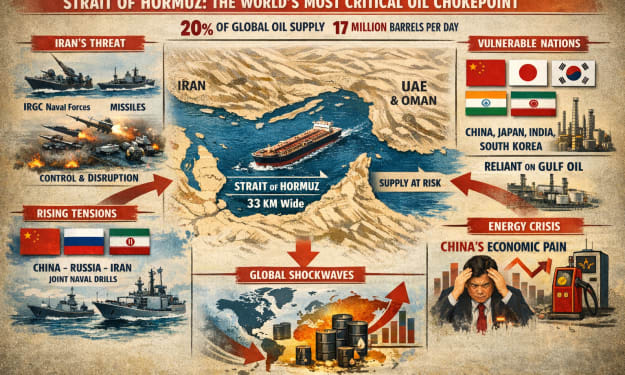
This war Stop being a medley story the moment the first oil tanker changed course in the Persian Gulf. What I mean is, Strait of Hormuz is the most important energy bottleneck on earth. Everybody knows it is the most important energy bottleneck on earth. And if it was the threat from Iran last time, this time Iran has partially done it. It is so narrow, IRGC has a lot of control over it. Just like in the Strait of Malacca, army/navy has control over it. Similarly, here the Iranians have control over it. And recently, China, Russia, and Iran have already conducted war games. So it is this narrow, 33 kilometers wide, you are hearing about it everywhere, everybody is talking about it. It is the width of a large city. So in this narrow passage, which holds 20% of the world's oil, one fifth of the world's oil and gas goes through, it is around 17 million barrels per day. There is no realistic alternative route except the Strait of Hormuz. If we close this passage, its consequences will not stop at any one border. Europe will pay, Japan will pay, India, South Korea, China, everybody pays the price. So a theory is floating around, which backs my argument that China is the target. It is that in Washington circles, there is a discussion going on, let's be honest, if this happens, what do we have to do? The hawkish people there say that this disruption should be allowed because it does not impact them as much as it impacts those countries, which I have just mentioned. So let's take this opportunity that the slowdown of China's energy supply can be slowed down. Trap Beijing in such an expensive moment as long as this congestion remains in the Strait of Hormuz, it remains closed, partially or completely. Iran keeps Beijing hit very badly from an energy security point of view. So the containment policy of China that is already going on is an added bonus. So imagine, on one hand, you are doing everything with technology and trade, imposing tariffs, treating them in the South China Sea, imagine all this. And from the other side, almost 90% of the oil and gas supplies go to China. If it is blocked for a few days, how badly it will hit China. So imagine, while the world is suffering, they are only having strategic designs in their minds.
By Ibrahim Shah 6 days ago in The Swamp