
Mass firings leave national security ranks thinned as war raises threats
Sweeping dismissals across key agencies spark concern that the U.S. may face rising global risks with fewer experienced officials managing intelligence and security operations.


A wave of mass firings across several U.S. national security agencies has raised alarm among lawmakers and policy experts, who warn that the country’s defense and intelligence institutions may be increasingly strained at a time of growing global conflict. The dismissals, which have affected analysts, policy advisers, and security officials, come as tensions escalate in several regions, including the Middle East and Eastern Europe.
Officials familiar with the situation say the layoffs have reduced staffing levels in key departments responsible for monitoring global threats, coordinating intelligence, and advising government leaders on military and diplomatic responses. Critics argue that the sudden loss of experienced personnel could weaken the country’s ability to respond effectively to emerging crises.
Some of the firings have reportedly occurred within agencies connected to the United States Department of Defense and the Central Intelligence Agency, where specialized analysts and operational experts play crucial roles in tracking security developments around the world. Although officials have not released detailed numbers, insiders say the impact has been felt across multiple national security units.
Growing Concerns Amid Global Conflict
The timing of the dismissals has heightened concern because they coincide with increasing geopolitical tensions. The ongoing confrontation involving the Iran, the United States, and Israel has already placed heavy demands on intelligence agencies responsible for monitoring military movements, cyber threats, and regional instability.
National security experts warn that intelligence work relies heavily on experienced analysts who possess deep regional knowledge and long-developed networks of contacts. Losing these professionals can slow the government’s ability to interpret complex situations and anticipate potential threats.
“National security institutions depend on continuity and expertise,” said one former intelligence official. “When you remove large numbers of experienced staff during a period of international instability, you risk weakening the system that protects the country.”
Political and Administrative Factors
The dismissals are believed to be part of a broader effort to restructure government agencies and reduce bureaucratic inefficiencies. Supporters of the policy argue that national security organizations must adapt to new technologies and changing strategic priorities.
However, critics contend that the scale and speed of the firings may undermine the institutional knowledge that has been built over decades. Many of the affected employees reportedly worked on highly specialized areas such as counterterrorism, cyber defense, and geopolitical analysis.
Lawmakers from both political parties have called for more transparency about the decisions, urging government officials to clarify how national security capabilities will be maintained despite the staffing reductions.
Intelligence Gaps and Operational Risks
Experts say that sudden workforce reductions could create gaps in intelligence coverage, particularly in areas requiring continuous monitoring. Modern national security threats—from cyberattacks to drone warfare—often evolve rapidly, making constant analysis essential.
The challenge becomes even greater during wartime or periods of heightened international tension. Intelligence agencies must track multiple developments simultaneously, ranging from military deployments to economic sanctions and diplomatic negotiations.
In addition to operational risks, morale within national security institutions could also be affected. Former officials note that uncertainty about job security may discourage skilled professionals from entering or remaining in government service.
Balancing Reform and Security
Supporters of the restructuring argue that national security agencies must become more efficient and technologically advanced. They say investments in artificial intelligence, data analysis, and automated surveillance systems could offset some of the effects of personnel reductions.
Yet many analysts believe that technology alone cannot replace the experience and judgment of trained professionals. Interpreting intelligence data often requires contextual understanding that machines cannot easily replicate.
As global tensions continue to rise, the debate over the firings is likely to intensify. Policymakers will face increasing pressure to ensure that national security institutions remain capable of addressing threats while pursuing administrative reforms.
Looking Ahead
The long-term consequences of the mass firings remain uncertain. Much will depend on whether agencies can quickly recruit new personnel and reorganize their operations without losing critical expertise.
For now, the developments have sparked a broader discussion about how governments should balance efficiency and preparedness in an increasingly unpredictable world. At a time when international conflicts are expanding and technological threats are multiplying, maintaining strong and capable national security institutions remains a central challenge for policymakers.
About the Creator
Fiaz Ahmed
I am Fiaz Ahmed. I am a passionate writer. I love covering trending topics and breaking news. With a sharp eye for what’s happening around the world, and crafts timely and engaging stories that keep readers informed and updated.
Keep reading
More stories from Fiaz Ahmed and writers in The Swamp and other communities.
Typhoon Spotted Loaded With Rocket Pods for the First Time
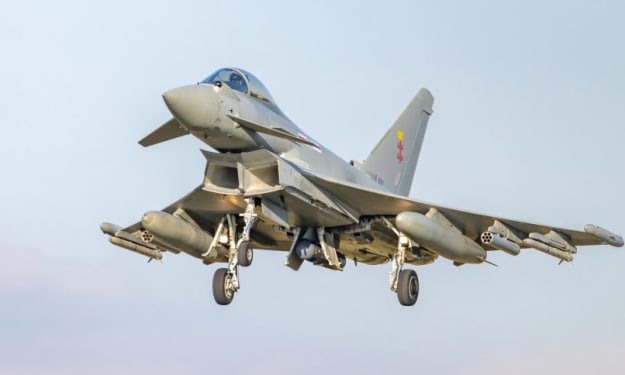
A rare and notable sighting of a combat aircraft has drawn attention from defense analysts around the world after a Eurofighter Typhoon was photographed carrying rocket pods for the first time. The unusual weapons configuration suggests that the advanced fighter jet may be expanding its operational role beyond traditional air-to-air combat and precision strike missions. Images of the aircraft, released during a recent training exercise, show the Typhoon equipped with unguided rocket pods mounted beneath its wings. The development has sparked discussion among military experts about how modern air forces are adapting their fleets to respond to evolving battlefield demands. The Eurofighter Typhoon is widely regarded as one of the most capable fourth-generation fighter aircraft in service today. Designed primarily as an air-superiority fighter, the jet has gradually been adapted over the years to perform a broader set of roles, including ground attack, reconnaissance, and electronic warfare. Traditionally, the Typhoon has been armed with precision-guided bombs, air-to-air missiles, and sophisticated targeting systems. The addition of rocket pods, however, indicates that military planners may be exploring new ways to use the aircraft in close air support (CAS) missions, where pilots provide direct assistance to ground troops during combat operations. Rocket pods typically carry multiple unguided rockets, which can be fired rapidly in succession to suppress enemy positions or provide firepower against lightly armored vehicles and defensive positions. These weapons have long been used by attack aircraft and helicopters, but they are less commonly seen on high-performance fighter jets like the Typhoon. Defense analysts say that adding rocket pods could give Typhoon pilots greater flexibility in certain operational scenarios. While precision-guided munitions remain highly effective against strategic targets, unguided rockets can be useful in situations where rapid firepower is required against dispersed enemy forces. The new configuration also highlights the adaptability of the Typhoon platform. The aircraft was originally developed through a multinational partnership involving several European countries, including United Kingdom, Germany, Italy, and Spain. These nations continue to upgrade the jet’s capabilities to ensure it remains competitive in a rapidly evolving security environment. Some analysts believe the rocket pod configuration could be linked to recent conflicts where air forces have needed to engage a wide variety of targets, ranging from armored vehicles to irregular militia forces. In such conflicts, having multiple weapon options available on a single aircraft can significantly enhance operational flexibility. Another factor behind the development may be the increasing emphasis on multi-role capability in modern air forces. As defense budgets come under pressure and security challenges multiply, militaries are seeking aircraft that can perform several missions without requiring specialized platforms for each task. The Typhoon has already proven its versatility in several international operations. The aircraft has been deployed in air-policing missions across Europe, participated in NATO exercises, and carried out combat operations in regions such as the Middle East. Each deployment has led to further upgrades in the aircraft’s weapons systems, sensors, and mission software. Despite the excitement generated by the recent sighting, defense officials have not yet confirmed whether the rocket pod configuration will become a standard option for Typhoon squadrons. It is possible that the setup is being tested as part of an experimental evaluation or training program. If the configuration does enter regular service, it could represent a subtle but important shift in how modern fighter aircraft are used in complex conflicts. By combining high-speed performance, advanced sensors, and diverse weapon systems, the Typhoon would be able to operate effectively in both high-intensity warfare and lower-intensity battlefield support roles. For now, the images of the rocket-armed Typhoon serve as a reminder that even well-established military platforms continue to evolve. As technological innovation and changing battlefield requirements shape the future of warfare, aircraft like the Typhoon are likely to undergo further modifications to meet the challenges of modern combat.
By Fiaz Ahmed 6 days ago in The Swamp
Parallel Protests
I haven't written for quite some time, but I have A LOT of thoughts about yesterday's protest rally against our government's involvement and complicity in America's war on Iran, on the harbourside of my home city Bristol, and I need to put them somewhere. My gorgeous girlfriend is always a loving and listening ear and sharing it all with her will always be a healthy and happy way of processing the mental and emotional weight, but getting it straight in my brain to share means writing it all down in straight lines, so, here we are and thanks for being here.
By Steph Cole10 days ago in The Swamp
Worth the Wait: Puerto Viejo, Costa Rica
Beach bumming in a small Caribbean beach town sounded like a perfect way to end our 6-month trip through Mexico and Central America. Or so we thought. The foul, fishy stench of rotten seaweed hit our nostrils as we stepped from the cramped bus and looked out at a rather depressing, empty, and underwhelming black sand beach. It was pouring with rain, and we had to quickly fish out our ponchos. We thought, this couldn’t be it, could it?
By Sh*t Happens - Lost Girl Travel7 days ago in Wander


Comments
There are no comments for this story
Be the first to respond and start the conversation.