
The Man Who Became a Lightning Rod: The Unbelievable Life of Roy Sullivan
Real life story

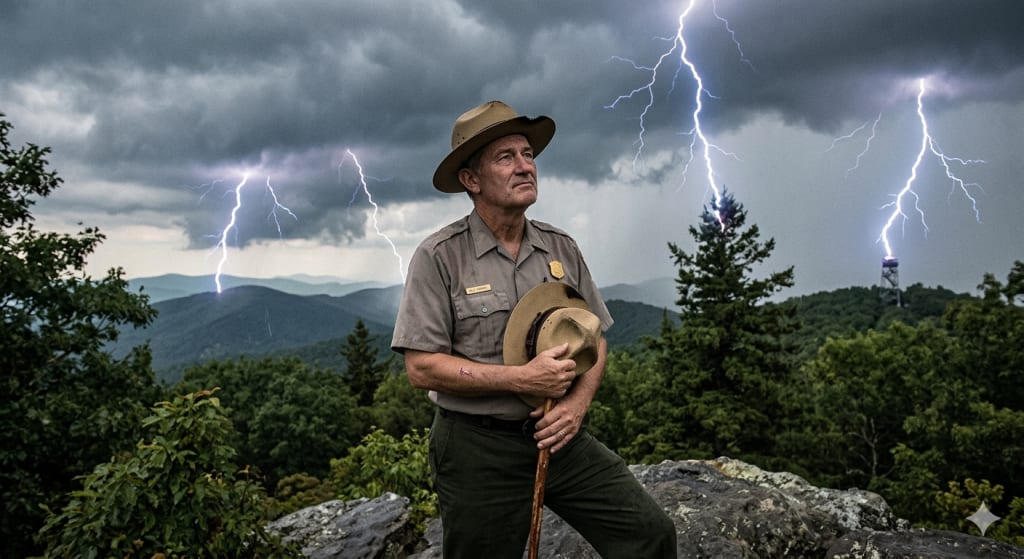
In the vast, unpredictable theater of the natural world, there are statistical anomalies, and then there is Roy Cleveland Sullivan. To the average person, the odds of being struck by lightning in a given year are roughly one in a million. The odds of being struck seven times? Those are calculated at approximately 1 in 100,000,000,000,000,000,000,000,000 (that’s a septillion).
Yet, for Roy Sullivan, a soft-spoken Virginia park ranger, these weren't just numbers—they were the milestones of his life. Known to history as the "Human Lightning Rod," Sullivan’s life was a harrowing, thirty-five-year duel with the heavens. His story is more than a meteorological curiosity; it is a deep dive into the limits of human resilience, the psychological toll of being "chosen" by a terrifying force, and the thin line between a miracle and a curse.
Born in the Blue Ridge: A Destiny in the Clouds
Roy Sullivan was born in 1912 in Greene County, Virginia, cradled by the rugged beauty of the Appalachian Mountains. Growing up in the early 20th century, the rhythms of life were dictated by the land. In the Blue Ridge, storms aren't just weather; they are visceral events. They roll over the peaks with a guttural roar, turning the sky a bruised purple and shaking the very foundation of the earth.
As a young man, Sullivan felt a calling to the wilderness. In 1936, he joined the newly formed Shenandoah National Park as a ranger. It was the perfect vocation for a man who loved the quietude of the forest. However, the geography of Shenandoah—high elevations, mineral-rich soil, and frequent atmospheric shifts—made it a literal playground for electrical discharges.
Sullivan was a tall, sturdy man with a quiet disposition. He spent his days patrolling trails and manning fire lookouts. He respected nature, but he didn't fear it. That was about to change.
1942: The First Strike
The "streak" began on a humid April afternoon in 1942. Sullivan was stationed at the Miller’s Head fire lookout tower when a sudden, violent thunderstorm materialized. The tower was new and lacked a lightning rod; it was struck seven or eight times. Inside, Sullivan watched as fire leaped around the small room.
Fearing the tower would burn, he bolted for the exit. He didn't make it ten feet. A bolt of lightning found him, traveling down his right leg and blowing the nail off his big toe. His boot was filled with blood, and a hole was burned through the leather.
He survived, shaken but functional. At the time, he likely viewed it as a freak accident—a "once in a lifetime" brush with death. He was wrong.
The Decades of Silence and the Storm’s Return
For twenty-seven years, the sky remained silent. Sullivan lived his life, rose through the ranks of the Park Service, and perhaps began to believe the 1942 incident was a fluke. But in 1969, the "curse" returned with a vengeance.
While driving a park truck on a mountain road—a situation normally safe due to the Faraday cage effect of vehicles—the lightning acted defied physics. It struck nearby trees, deflected through the open windows of his truck, and knocked Sullivan unconscious. His eyebrows and eyelashes were scorched off, and his hair was set on fire. The truck, uncontrolled, rolled to the edge of a cliff before stopping.
From that point on, the intervals between strikes shrank drastically.
* 1970 (Strike Three): While standing in his own front yard, a bolt hit a nearby transformer and jumped to his left shoulder, searing the skin.
* 1972 (Strike Four): While working at a ranger station, his hair was set ablaze again. This was the strike that broke his spirit. Sullivan began to believe that a force was actively pursuing him. He started carrying a jug of water in his truck specifically to douse his head if he was hit again.
* 1973 (Strike Five): Sullivan saw a storm cloud and tried to outrun it in his truck. When he thought he was safe, he stepped out, only to be hit immediately. This strike moved through his left arm and leg, blowing his shoe off once more.
The Psychological Weight of the "Human Lightning Rod"
It is difficult to fathom the mental state of a man who feels hunted by the sky. By the mid-1970s, Sullivan was a living legend, but he was also a pariah. People were terrified to stand near him during a cloudy day. He recalled once walking with the Chief Ranger when a flash of lightning appeared in the distance; the Chief Ranger reportedly turned and walked the other way, saying, "See you later, Roy."
The isolation was profound. Even his wife was not spared; she was once struck by lightning while hanging clothes on a wire line in their backyard. Roy was with her, helping, and though he wasn't hit that time, the message was clear: proximity to Sullivan was a hazard.
The sixth strike occurred in 1977, followed quickly by the seventh. The final strike happened while he was trout fishing. After the bolt hit him—scorching his chest and stomach—he had to fend off a bear that was trying to steal the trout he had caught. It was a surreal, almost biblical series of trials.
The Science of Survival: How?
How does a human body survive seven direct or indirect hits from an average of 300 million volts?
Meteorologists and doctors have theorized that Sullivan's outdoor lifestyle and the specific "paths" the lightning took saved him. Often, the electricity traveled over the surface of his skin—a phenomenon known as "flashover"—rather than passing through his internal organs or heart. His wet clothes (from rain) may have acted as a conductive path that diverted the current away from his core.
Still, the physical toll was immense. He suffered from chronic pain, permanent scarring, and hearing loss. But the invisible scars—the "lightning nerves"—were the hardest to heal.
A Quiet End to a Stormy Life
Roy Sullivan was recognized by the Guinness World Records as the most lightning-struck person in history. He became a reluctant celebrity, appearing on talk shows and in newspapers. Yet, he remained a humble ranger at heart.
In 1983, at the age of 71, Roy Sullivan passed away. While he had survived the fury of the heavens seven times, he ultimately succumbed to the darkness of his own mind, dying of a self-inflicted gunshot wound. Some say the psychological burden of his "fated" life became too heavy to carry; others suggest personal heartbreak played a role.
The Legacy of Roy Sullivan
Today, Roy Sullivan’s ranger hat—complete with a burn hole from the 1972 strike—is on display at the Guinness World Records museums. He remains a symbol of the inexplicable.
His story forces us to confront the reality of the "impossible." We like to believe the world operates on predictable patterns, but Sullivan is proof that sometimes, the universe focuses its attention on a single individual for reasons we can never understand.
Key Takeaways from the Sullivan Saga:
* Resilience is Human: Sullivan went back to work after every strike. He didn't hide in a basement; he continued to serve the park he loved.
* Nature is Arbitrary: His story reminds us that we are guests in a world governed by forces far greater than ourselves.
* The Power of Story: Decades later, his name is synonymous with the strange and the miraculous.
Roy Sullivan didn’t just survive lightning; he lived through a storm that lasted forty years. He reminds us that even when the sky seems to be falling, the human spirit has a remarkable capacity to stand back up, douse the flames, and keep walking.
Tips for Staying Safe in a Storm
While you likely won't face Roy's luck, the National Weather Service recommends:
When thunder roars, go indoors.
Avoid corded phones and plumbing during a strike (electricity travels through pipes).
The 30-30 Rule: After seeing lightning, if you can't count to 30 before hearing thunder, get inside. Stay there for 30 minutes after the last clap.
About the Creator
Frank Massey
Tech, AI, and social media writer with a passion for storytelling. I turn complex trends into engaging, relatable content. Exploring the future, one story at a time
Keep reading
More stories from Frank Massey and writers in Motivation and other communities.
Stop Making Excuses. Someone Is Already Doing What You Think Is Impossible
The Brutal Truth About Excuses : Right now, somewhere in the world, someone with fewer advantages than you is doing the exact thing you believe is impossible. They might have less money. Less education. Less support. Yet they are moving forward while many others remain stuck in the same place — not because they lack potential, but because they are trapped in a cycle of excuses. Excuses are comforting. They protect us from failure and embarrassment. But they also quietly steal our potential. The uncomfortable truth is that the biggest obstacle for most people is not lack of ability. It’s hesitation.
By Shahid Zaman4 days ago in Motivation


Comments
There are no comments for this story
Be the first to respond and start the conversation.