
The AI Trap: Why Building an App in 2 Hours Won’t Let You Quit Your Job
"I got access to Claude Code today. I opened my terminal, gave it a prompt, and it just... did it...

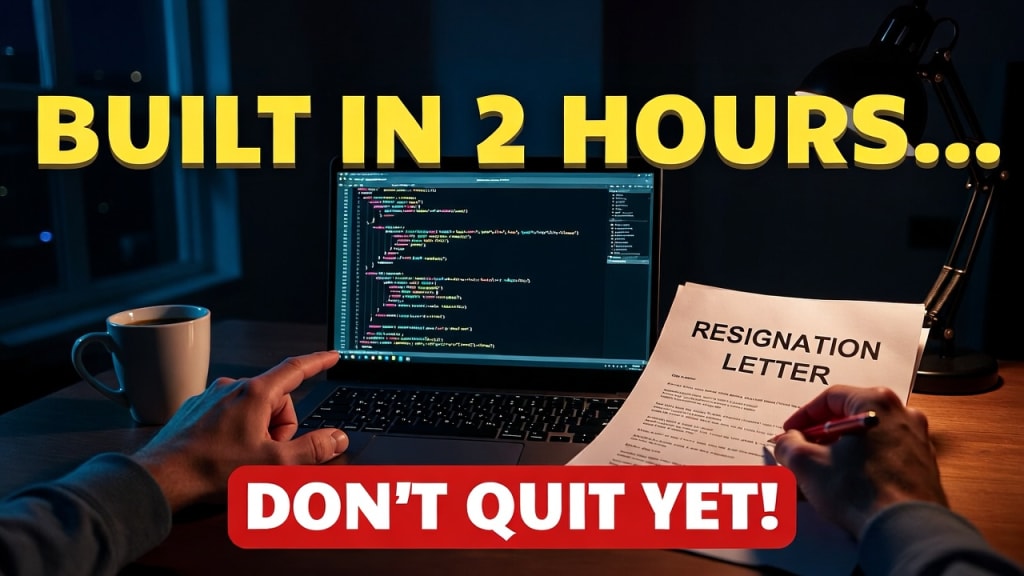
It was 11:45 PM on a Tuesday when my phone lit up. The caller ID showed Tarek, a buddy I’ve known since our college days. Tarek is a senior front-end developer at a mid-sized tech company, the kind of guy who is usually asleep by 10 PM because his brain is fried from endless Jira tickets and pointless zoom meetings.
So, when I picked up the phone and heard him talking a mile a minute, breathing heavy like he just ran a marathon, I knew something was up.
"I'm putting in my two weeks tomorrow," he blurted out before I could even say hello. "I'm done. I'm building my own SaaS. I just built the entire beta version in two hours."
I sat up in bed, instantly wide awake. "Whoa, slow down. Two hours? You’ve been talking about this app idea for three years."
"Man, you don't understand," he said, his voice cracking with a mix of exhaustion and pure adrenaline. "I got access to Claude Code today. I opened my terminal, gave it a prompt, and it just... did it. It read my files, wrote the backend, hooked up the database, and fixed its own bugs. I don't need my boss anymore. I don't need the team. I'm a one-man agency now."
I rubbed my eyes, feeling a massive wave of déjà vu wash over me. I knew exactly what he was feeling. I call it the "AI God Mode Complex." It’s that intoxicating, dangerous high you get the first time an artificial intelligence tool does a week's worth of your job in forty-five seconds.
I took a deep breath. Over the next hour, I had to walk him off a financial ledge. Later that week, I posted a thread about this conversation on my private community forum, and it blew up. The title of that post was simple: My friend tried Claude Code and wants to quit his job. Here is what I said.
Because if you are sitting at your desk right now, secretly running an AI agent in your terminal and fantasizing about throwing your company laptop out the window, you need to read this. I am a successful website owner who has been through this exact hype cycle. I built a thriving online business, but I made every painful mistake in the book getting here.
Grab a cup of coffee. Let’s talk about reality.
The Intoxication of the Blank Terminal
Before we get into the advice I gave Tarek, you have to understand why this specific tool is causing so much quiet chaos in the tech world right now.
If you aren't familiar, Claude Code isn't just a chatbot where you copy and paste code snippets. It lives right inside your computer's terminal. It acts like an autonomous engineer. You tell it, "Hey, build a login page, connect it to Stripe, and make it look modern." It will literally search your computer files, write the code, run tests, see an error, fix the error, and deploy it.
For a developer like Tarek, who spends 80% of his day arguing with middle managers about button colors and fixing broken code from junior devs, this tool feels like magic. It removes all the friction from creating.
He was experiencing the ultimate dopamine hit. He saw a future where he could wake up at noon, sip an espresso, type three sentences into a black screen, and watch a profitable business build itself.
But there is a massive difference between writing code and running a business. And that is exactly where I crashed and burned a few years ago.
My Own Ghost of 2024: The Day I Almost Ruined My Life
I didn't try to lecture Tarek. Instead, I told him the story I rarely share publicly—the story of how my first attempt at building an automated online empire almost put me on the street.
A couple of years ago, I was doing freelance digital marketing and running a small portfolio of niche affiliate websites. I was making okay money, but I was burning the candle at both ends. Then, the first wave of really good AI writing and website-building tools hit the market.
I spent one weekend playing with them. By Sunday night, I was convinced I was the smartest guy in my city. I built three niche websites in 48 hours. The AI wrote the articles, generated the images, and formatted the pages.
On Monday morning, feeling like an absolute king, I emailed my three biggest freelance clients and fired them. I told my wife I was going full-time on passive income. I thought the AI was my employee, and I was finally the CEO.
Here is what happened over the next six months:
The Traffic Crash: Google realized what I was doing and de-indexed two of my completely automated sites. My traffic flatlined overnight.
The Customer Service Nightmare: On the one site that actually got sales, the automated fulfillment system broke. I spent 14 hours a day manually answering angry customer emails because the AI couldn't soothe a human being who wanted a refund.
The Isolation: Sitting alone in a room, watching a computer do the work, sounds great until you realize you have zero human interaction. I became paranoid, anxious, and depressed.
The Cash Flow Crunch: AI tools cost money. Hosting costs money. Ads cost money. Without my freelance retainer income, my savings bled out in four months. I remember sitting on my living room floor, staring at a $12 bank balance, wondering how I was going to pay for groceries.
I told Tarek all of this over the phone. I could hear the silence on his end of the line. The excitement was wearing off, replaced by the heavy gravity of reality.
My friend tried Claude Code and wants to quit his job. Here is what I said.
We met up the next day at a loud, crowded coffee shop downtown. He brought his laptop and showed me the app he built. I will admit, it was impressive. It was clean, functional, and ready for users.
"Okay," I said, sliding his laptop back to him. "You have a great product. Now, tell me how you are going to get your first 1,000 paying users without spending a dime on ads, because if you quit tomorrow, you have no marketing budget."
He blinked. "I was just going to post it on Product Hunt and Twitter."
"Tarek, there are ten thousand guys just like you doing the exact same thing today. Claude Code didn't just give you superpowers. It gave everyone superpowers. The barrier to entry for building an app just went to zero. Which means the competition just went to infinity."
This is the core truth of the current tech market. When the cost of writing code drops to zero, the value of the code itself drops to zero. The new currency isn't the software; it's the distribution, the marketing, the brand, and the customer trust.
I grabbed a napkin and a pen, and I wrote down a battle plan for him. If you are reading this and thinking about handing in your resignation letter, this is the exact framework you need to follow.
Step 1: Treat Your Day Job Like an Angel Investor
"Right now, you view your 9-to-5 as a prison," I told him. "You need to flip your mindset immediately. Your job is not a prison. Your job is your Series A funding round."
When you quit your job to build a startup, a ticking time bomb starts in your head. It's called your burn rate. If you have six months of savings, you have six months to become profitable. That desperation leaks into everything you do. You make bad decisions, you push products before they are ready, and you stress out your family.
But if you keep your job? You have infinite runway.
I told Tarek to let Claude Code do the heavy lifting for his side hustle. "Use the AI to build the app from 7 PM to 10 PM. Let your day job pay your rent, buy your groceries, and fund your marketing tests. Every paycheck you get is an investment into your SaaS."
When you have a salary covering your living expenses, you can make clear, calm business decisions. You don't panic when an ad campaign fails. You just learn from it and try again next week.
Step 2: Stop Coding and Start Selling
This is the hardest pill for tech guys to swallow. Because AI makes coding so fun and fast, developers want to spend 100% of their time adding new features.
"Your app is done," I said, tapping the screen. "Do not write another line of code. Do not ask the AI to build a dark mode. Do not ask it to add a fancy dashboard."
The reality of being a successful website owner or SaaS founder is that building the product is only 10% of the battle. 90% is sales. I challenged Tarek to spend the next 30 days doing absolutely nothing but talking to potential customers.
Join Facebook groups where his target audience hangs out.
Cold DM people on LinkedIn.
Write blog posts about the problem his app solves.
Get on Zoom calls and actually listen to human beings complain about their pain points.
AI cannot look a customer in the eye and build trust. AI cannot hustle for that first massive B2B contract. If you quit your job because you think the AI will handle the business for you, you will fail. You have to become the marketer.
Step 3: The 150% Overlap Rule
Tarek asked the million-dollar question: "So, when do I actually get to quit?"
I gave him the rule that saved my business the second time around. I call it the 150% Overlap Rule.
You do not quit your job when your side hustle makes enough to cover your bills. You quit your job when your side hustle makes 150% of your day job salary, consistently, for three months in a row.
Why 150%? Because being your own boss comes with hidden taxes you don't see right now. You have to pay your own health insurance. You have to pay self-employment tax. You have to account for the fact that next month, the algorithm might change and your revenue could drop by 30%.
"If you make $8,000 a month at your job," I explained, "you don't quit until this app is pulling in $12,000 a month in recurring revenue. Until then, you smile, you nod in your zoom meetings, and you quietly build your empire in the background."
How I Run My Business Today (The Right Way)
I could see the relief wash over his face. The manic energy was gone, replaced by a cold, calculated focus. He didn't have to jump off a cliff tomorrow. He just had to walk a very strategic path.
I shared how my own websites run today. I didn't abandon AI after my first failure. I just learned its proper place.
Today, my websites generate a full-time income, and I work about four hours a day on them. I use AI constantly, but I use it as a tool, not a crutch.
When I build a new site, I don't let the AI generate 100 garbage articles and publish them blindly. Instead, I use it to analyze search trends. I use it to outline content based on exactly what people are searching for. I write the core stories myself—adding my real-world experience, my failures, and my voice—and then I use the AI to edit for clarity and grammar.
If I need a script to automate my Pinterest pinning, I don't spend three days learning Python. I open my terminal, ask the AI to write the script, and I move on to high-level strategy.
I own the business. The AI is simply my fastest, cheapest worker. It does not dictate my strategy; it executes my vision. I built a system that is robust enough to survive Google updates because real humans actually want to read my content and buy my products.
The Aftermath: Where Tarek is Now
It has been a few months since that coffee shop meeting.
Tarek didn't quit his job. He went into work the next day, did exactly what was required of him, and logged off at 5 PM. Then, he went home and started marketing.
He used Claude Code to build a landing page and an email capture system. He started making short-form videos explaining the problem his app solves. He ran small, targeted ads funded by his tech salary.
Last week, he called me. He wasn't frantic this time. He was calm.
"I hit $2,000 in monthly recurring revenue," he said. "I have 100 paying users. The app crashed twice, and the AI helped me patch it in minutes while I was on my lunch break at the office."
He is on track to hit his 150% goal by the end of the year. He is building real wealth, without the heart-stopping anxiety of not knowing how to pay rent.
Actionable Takeaways for the AI-Drunk Employee
If you are reading this, staring at an amazing piece of code your AI just wrote, and drafting an email to HR, stop. Close your email. Read these takeaways and internalize them.
Don't mistake efficiency for a business model. Writing code 10x faster just means you have more time to market the product. It doesn't mean the product will sell itself.
Keep your salary to fund your dream. Use your secure income to pay for software, ads, and freelancers. Let your boss unknowingly fund your future freedom.
Build an audience, not just an app. In a world where anyone can code an app in an hour, the only thing that separates you from the crowd is the people who trust you. Start a newsletter, a YouTube channel, or a Twitter account. Document your journey.
Talk to humans. For every hour you spend prompting an AI, spend two hours talking to potential customers. Find out what they actually want to buy.
Wait for the 150% mark. Do not leap until your side hustle provides an overwhelming safety net. The peace of mind will make you a better entrepreneur.
The technology we have access to right now is truly life-changing. It is the greatest equalizer in the history of business. You have the power of a whole engineering team sitting on your laptop.
But a team still needs a CEO. It needs someone to steer the ship, talk to the clients, and handle the money. Don't let the magic of the machine blind you to the hard work of building a real business. Use the tools, keep your head down, and play the long game. That is how you win.
About the Creator
John Arthor
seasoned researcher and AI specialist with a proven track record of success in natural language processing & machine learning. With a deep understanding of cutting-edge AI technologies.
Keep reading
More stories from John Arthor and writers in Humans and other communities.
Why Guarding Mark Zuckerberg Costs More Than Protecting Five Tech Titans Combined
Let’s talk about safety. We all get it. You lock your door at night. Maybe you have an alarm system. Perhaps you’re cautious walking alone after dark. It’s a basic human instinct to protect ourselves and our loved ones. Now, imagine that instinct amplified by billions of dollars, global fame, and the kind of controversy that seems permanently glued to your name. That’s the reality for Mark Zuckerberg, and the price tag for keeping him safe isn’t just high – it’s staggering, unprecedented, and frankly, hard to wrap your head around.
By John Arthor7 months ago in Humans
Memento Mori
Life is not short. I’ll explain: we feel like it’s short because time passes by quickly. And if it isn’t, on hindsight, it did. But when we think we have quantified it quite well, we don’t, really. It happens to me. It happent to everyone. It’s human, actually. Because time is beyond our full comprehension.
By Maya Or Tzur2 days ago in Humans



Comments
There are no comments for this story
Be the first to respond and start the conversation.