
Why Russia Wants Ukraine? | Russia Ukraine Conflict Explained part 1
Why Russia Wants Ukraine?

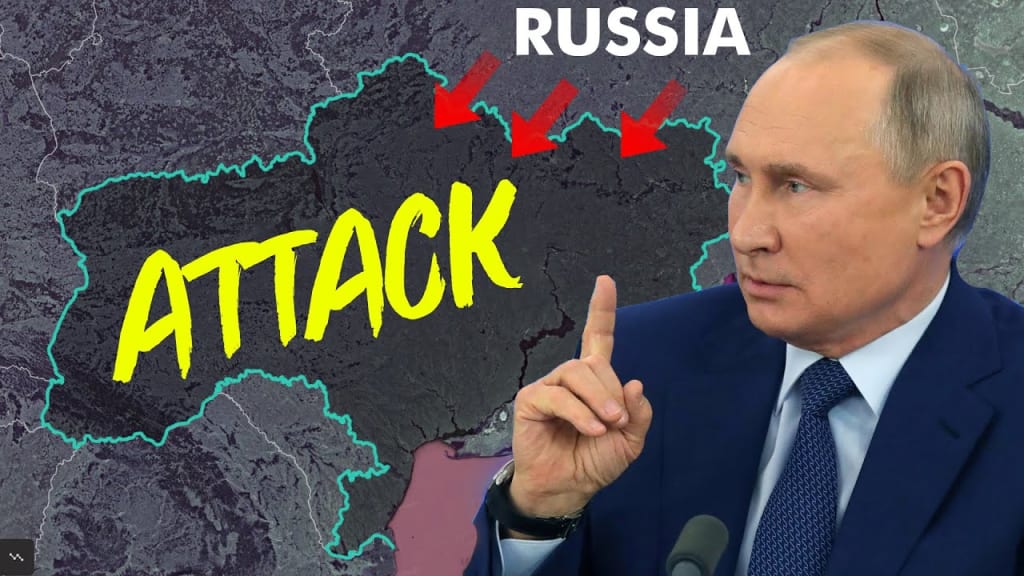
On 24 February 2022, Russian forces attacked Ukraine from all sides. Russian President Vladimir Putin warned the world that if anyone tried to interfere, the consequences would be severe.
Russian helicopters and fighter jets were seen flying low over many Ukrainian cities and, in some cases, firing rockets. Among the main targets was the Ukrainian capital, Kyiv.
In this sudden attack, hundreds of people lost their lives. At the same time, millions of Ukrainians were forced to leave their homes. To stay safe, many people hid in basements, while others considered metro stations to be safe shelters.
Soon, every corner of Ukraine echoed with the sounds of explosions and emergency sirens. Europe was witnessing a war of this scale for the first time since World War II.
For the past 70 years, the map of Europe had been shaped by political alliances. But now Putin wanted to redraw it according to his plans—and by using military power.
But why?
Despite being 27 times larger than Ukraine, why is Russia afraid of a smaller country like Ukraine? Why is the Russian president so interested in Ukraine? And what would Russia lose if it didn’t act?
To understand this issue properly, it is important to look at some historical events.
About a hundred years ago, Ukraine was part of Russia when the region was ruled by the Romanov Dynasty for centuries. In the early 1900s, people grew tired of the rule of the Russian monarchy.
Finally, in 1917, the Russian Revolution overthrew the Romanov dynasty and ended the Russian Empire. People wanted a new form of government.
However, during the formation of this new government, revolutionaries fought among themselves, leading to a civil war across Russia. When the civil war ended, 13 republics—including Russia and Ukraine—formed a new country in 1922 called the Soviet Union, also known as the USSR.
Ukraine had gained independence from the Russian Empire only five years earlier, but now it became part of the Soviet Union. For many Ukrainians, it felt like a bird being taken out of one cage and put into another.
Over time, the Soviet Union became extremely powerful. After World War II, its influence expanded across much of Eastern Europe. Europe became divided into two major camps—one under the influence of the Soviet Union and the other under Western powers such as the United States, United Kingdom, and Canada.
Although World War II had ended, political hostility between the United States and the Soviet Union continued. The biggest reason for this tension was the difference in their political and economic systems.
The Soviet Union followed communism, where businesses and industries were controlled by the state and wealth was distributed based on people's needs. In contrast, the United States and its allies supported capitalism, where individuals and companies could run businesses and earn profits freely.
Both sides wanted their system to spread across the world. Because of this ideological conflict, a long political rivalry known as the Cold War began.
Although this war did not involve direct fighting between the two powers, both sides tried to weaken each other politically, economically, and through influence around the world.
In 1949, countries supporting the United States formed a military alliance called NATO (North Atlantic Treaty Organization). Members agreed that if any NATO country were attacked, all others would defend it together.
This alliance worried the Soviet Union because it meant NATO countries could unite against it.
In response, the Soviet Union and its allies created their own alliance called the Warsaw Pact.
About the Creator
Imran Ali Shah
🌍 Vical Midea | Imran
🎥 Turning ideas into viral content
✨ Watch • Share • Enjoy
Keep reading
More stories from Imran Ali Shah and writers in History and other communities.
The Middle East Question: Power, Peace, and Double Standards
The Middle East Question: Power, Peace, and Double Standards In recent years, the conflict in the Middle East has once again raised serious questions about global politics, justice, and the meaning of peace. Many observers around the world ask the same question: if powerful countries speak so often about peace and human rights, why did they remain silent when violence and suffering were happening earlier?
By Wings of Time 7 days ago in History
Why Didn't Anyone Tell Us
Men, move along. This is not for you. This is for the women. I was forty-five when I began menopause. It is pretty young for that to be going on in a woman’s life, but I had undiagnosed PCOS, my entire life. Thank you to all the gynecologists I had seen my entire life. That in itself should encourage women to keep seeking second opinions, especially when you are not getting correct answers or any at all.
By Alexandra Grant3 days ago in Humans


Comments
There are no comments for this story
Be the first to respond and start the conversation.