
Why Even Russia & China Fear This Jet
Russia & China Fear This Jet

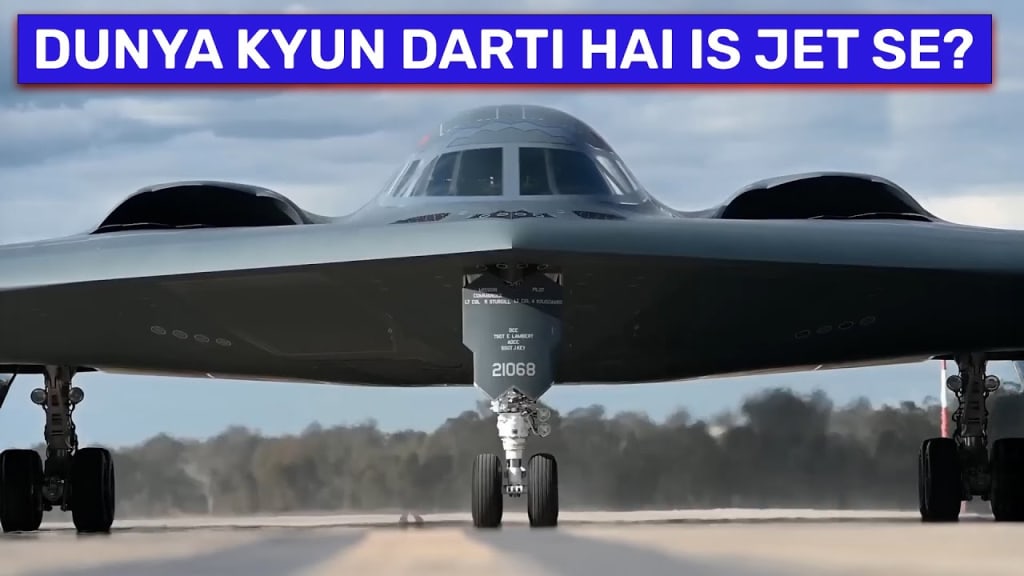
The B-2 Spirit Bomber is an aircraft that no missile can easily destroy. Even though it looks as big as a football field, on enemy radar it appears only as small as a fly.
No matter how complex the radar network is, fooling it is an easy task for the B-2 Spirit bomber. Built at a cost of billions of dollars, it is the most expensive aircraft ever made.
Compared to other jets, it is not only extremely quiet but can also deceive heat-seeking and infrared-guided missiles.
It is an aircraft that could potentially change the map of the world. But the real question is: why does a 52-meter-wide aircraft not appear on radars? What science is behind it that the United States has kept secret for 37 years?
The Incident That Led to Its Creation
The story behind the B-2 bomber begins with an event that once brought great embarrassment to the United States.
1 May 1960
From Peshawar Air Base, an American Lockheed U‑2 spy plane took off on a secret Central Intelligence Agency mission to spy on the Soviet Union.
This was during the Cold War, when both superpowers tried to outdo each other technologically.
The U.S. believed its U-2 aircraft could fly at 80,000 feet, a height where Soviet missiles could not reach it.
But as soon as the aircraft entered Soviet territory, radar detected it.
The Soviets launched several fighter jets and missiles, but initially none could hit it at that altitude.
Then the Soviet military fired the S‑75 Dvina missile.
Even the U.S. believed this missile could not reach such heights.
But the unexpected happened — the missile successfully struck the U-2 at around 80,000 feet.
The plane crashed near the city of Yekaterinburg, and the pilot ejected.
At first, the U.S. claimed it was a NASA weather research aircraft. But when the Soviets revealed the captured pilot and surveillance equipment, the U.S. faced global embarrassment.
The Birth of Stealth Technology
This event changed everything.
The Soviet Union began strengthening its air defense systems, while the U.S. started developing technology that could become literally invisible to radar.
At that time the U.S. had B‑52 Stratofortress bombers, but they were easily detectable.
By 1976, the Soviets had developed powerful surface-to-air missile systems like the S‑300 missile system that could destroy aircraft from 100 km away.
An American Air Force general even said sending a B-52 into Soviet territory would be like throwing a stone at a beehive.
So in 1978, the U.S. launched the Advanced Technology Bomber (ATB) program, aiming to build a bomber that could enter Soviet territory, drop bombs, and leave without being detected.
The result was the B-2 Spirit, which first flew in 1989 and was revealed to the public in 1997.
Why Radar Cannot Detect It
The biggest advantage of the B-2 is its stealth design.
Every part of the aircraft is shaped so radar waves do not reflect back to the radar source. Instead, the signals scatter in different directions.
That is why the B-2 has no vertical tail like normal aircraft.
Tail fins normally reflect radar waves like mirrors, making planes easy to detect. But the B-2’s zig-zag flying-wing design deflects radar signals away.
It also uses a special radar-absorbing coating that absorbs radar energy.
Because of this, the aircraft has an incredibly small radar cross-section of just 0.0001 square meters — about the size of a fly on radar.
For comparison:
B‑52 Stratofortress appears as big as a two-bedroom apartment
McDonnell Douglas F‑15 Eagle appears like a small room
JF‑17 Thunder appears like a single bed
Dassault Rafale appears like a large pillow
Despite being larger than these aircraft, the B-2 looks like a tiny insect on radar.
Heat and Missile Protection
The B-2 also has an extremely low heat signature.
Its engines are hidden inside the body, and the hot exhaust mixes with cold air before leaving the aircraft. This reduces infrared detection.
If a General Dynamics F‑16 Fighting Falcon can be detected from 100 km away using infrared sensors, the B-2 might only be detected at about 10 km.
Range and Power
The B-2 can fly at altitudes of around 15,000 meters and travel about 11,000 km on a full fuel tank.
It can carry about 18,000 kg of weapons, including:
80 JDAM GPS-guided bombs
16 B83 nuclear bombs
16 AGM-158 JASSM stealth cruise missiles
All weapons are stored inside internal bays to maintain stealth.
Real Combat Missions
The B-2 has been used in several military operations:
Kosovo War NATO bombing campaign
Iraq War
2011 military intervention in Libya
In one mission during the War in Afghanistan, the bomber took off from Missouri in the U.S., flew about 9,500 km, bombed targets in Afghanistan, and returned without landing — a mission lasting 45 hours.
Cost and Rarity
Only 21 B-2 bombers have ever been built.
Each aircraft costs over $2 billion, making it one of the most expensive military machines ever created.
These aircraft are owned exclusively by the United States and are not sold to other countries.
Even operating them is expensive — they burn around $150,000 worth of fuel per hour and require special maintenance after every flight.
Even a tiny dent in its surface can reduce its stealth capability.
About the Creator
Imran Ali Shah
🌍 Vical Midea | Imran
🎥 Turning ideas into viral content
✨ Watch • Share • Enjoy
Keep reading
More stories from Imran Ali Shah and writers in History and other communities.
Hidden Void Discovered Inside the Great Pyramid of Khufu
For centuries, the Great Pyramid of Khufu in Egypt has fascinated historians, archaeologists, and travelers from around the world. Built more than 4,500 years ago during the reign of Pharaoh Khufu, the pyramid is the largest and oldest of the three pyramids of Giza. Despite decades of research and exploration, many secrets of this ancient structure remain hidden. Recently, scientists revealed one of the most intriguing discoveries yet — a large hidden void inside the pyramid that had remained unknown for thousands of years.
By Irshad Abbasi 3 days ago in History



Comments
There are no comments for this story
Be the first to respond and start the conversation.