
Digital Out-Of-Home Advertising Market to hit USD 60 Billion By 2033
Rising adoption of programmatic advertising and smart digital displays is driving market expansion globally.


The Global Digital Out-Of-Home (DOOH) Advertising Market is projected to reach approximately USD 60 Billion by 2033, increasing from USD 19 Billion in 2023, growing at a CAGR of 11.8% during the forecast period from 2024 to 2033. This significant growth is fueled by the rising demand for dynamic, interactive, and data-driven advertising solutions that engage consumers in high-traffic outdoor environments. As digital screens, interactive kiosks, and other forms of digital signage continue to replace traditional static billboards, DOOH advertising is becoming a dominant force in the advertising landscape.
Explore Detailed 2025-2035 Market Report Forecasts Today
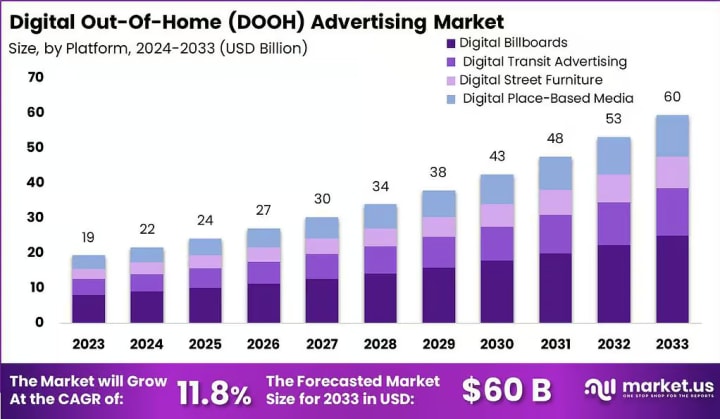
With advancements in technology such as real-time data analytics, artificial intelligence, and programmatic advertising, digital out-of-home ads are offering increased targeting capabilities, personalization, and audience engagement. Brands are increasingly turning to DOOH to enhance their visibility, interact with audiences, and improve the efficiency of their advertising campaigns. The growing trend of smart cities and infrastructure upgrades also presents opportunities for the market, with digital screens becoming integrated into urban environments, transportation hubs, and retail spaces.
What is the Digital Out-Of-Home (DOOH) Advertising Market?
The Digital Out-Of-Home (DOOH) advertising market refers to the use of digital displays such as LED screens, video walls, interactive kiosks, digital billboards, and other digital signage platforms to deliver advertisements to consumers in public spaces. Unlike traditional static billboards, DOOH advertising allows for dynamic content, real-time updates, and targeted messaging based on location, time of day, audience demographics, and external data sources.
DOOH is increasingly popular due to its ability to engage viewers through high-impact visual content and its capacity for real-time adjustments, making it more effective at reaching audiences in high-traffic areas such as shopping malls, airports, transit stations, and city streets. It allows advertisers to run campaigns that are flexible, measurable, and adaptable, offering significant opportunities for creativity and customer engagement.
The Role of Technology in DOOH
Technology plays a pivotal role in the growth and effectiveness of the Digital Out-Of-Home advertising market. The integration of technologies such as Artificial Intelligence (AI), data analytics, and programmatic advertising enables DOOH platforms to deliver highly targeted and personalized content based on real-time audience behavior. AI algorithms analyze data such as traffic patterns, weather conditions, and audience demographics to optimize the content displayed on digital screens.
Programmatic DOOH advertising, which automates the buying and placement of digital ads, is also becoming a key driver of market growth. It allows advertisers to target specific audiences at the right time and place, making DOOH advertising more efficient and measurable. This technological advancement is helping to attract more advertisers who previously relied on traditional advertising formats.
Scope and Research Methodology
The scope of the Digital Out-Of-Home (DOOH) advertising market includes all forms of digital advertising that are displayed in public places, including digital billboards, transit media, retail signage, interactive kiosks, and digital screens in stadiums or other event venues. The market spans across various industries including retail, automotive, entertainment, real estate, and hospitality, among others.
Market research methodology generally involves analyzing industry trends, technological innovations, and advertising spend across different regions. Data is gathered from advertising agencies, digital signage providers, and industry reports to estimate the market’s growth, key drivers, challenges, and emerging opportunities. The research also takes into account consumer behavior and shifts in media consumption patterns.
Key Forces Driving Market Expansion
One of the primary drivers of the Digital Out-Of-Home advertising market is the increasing urbanization and modernization of infrastructure. As cities evolve into smart cities with more public digital displays, the opportunities for DOOH advertising grow. Digital screens are being integrated into public transportation systems, airports, shopping malls, and even billboards in high-traffic areas, providing advertisers with more points of engagement with consumers.
Another significant force driving growth is the increased effectiveness and efficiency of targeted advertising. DOOH offers flexibility and the ability to tailor content in real time based on audience behavior, weather conditions, or specific events happening around the area. This targeting capability improves the return on investment (ROI) for advertisers and makes DOOH more attractive compared to traditional OOH formats.
Emerging Trends Analysis
One emerging trend in the DOOH advertising market is the use of interactive digital signage. Interactive displays, such as touchscreens or motion-sensor-based installations, allow consumers to engage with the content, making the advertising experience more immersive. These displays are becoming more common in retail spaces, museums, airports, and even outdoor environments.
Another growing trend is the integration of real-time data in DOOH campaigns. By utilizing data from mobile devices, social media, and IoT sensors, advertisers can deliver dynamic and contextually relevant content. This real-time aspect allows advertisers to adjust messages based on factors such as time of day, local events, or consumer sentiment, enhancing engagement and effectiveness.
Driver Analysis
A key driver of the DOOH market is the increasing shift towards digital advertising. As more advertisers move away from traditional print media, they are investing in digital formats that offer greater flexibility, better targeting, and more measurable results. DOOH is an attractive option for advertisers seeking to create high-impact campaigns that stand out in busy environments.
Another important driver is the growing demand for sustainable advertising solutions. Digital billboards and signage are more energy-efficient compared to traditional static billboards. Additionally, digital screens offer the ability to display multiple ads in a single space, reducing waste and contributing to a more sustainable advertising model.
Restraint Analysis
One of the restraints to the growth of the Digital Out-Of-Home market is the high initial cost of installation and maintenance of digital screens. Although the cost of technology has been decreasing, the initial investment required to install high-quality digital signage can still be significant. Smaller businesses may find it difficult to justify the cost of these advanced advertising systems.
Another limitation is the potential for content overload. With an increasing number of digital screens in public spaces, there is a risk of overwhelming audiences with too much advertising. Advertisers need to ensure that their content remains engaging and relevant, and avoid saturation that could lead to reduced effectiveness.
Opportunity Analysis
A significant opportunity in the DOOH market lies in the growth of programmatic advertising. As programmatic DOOH becomes more advanced, it allows for the automation of ad placement and real-time bidding. This trend is making DOOH advertising more accessible to smaller advertisers and increasing its adoption across various industries.
Another opportunity exists in the expansion of digital signage networks in emerging markets. As urbanization continues to rise in regions such as Asia-Pacific, Latin America, and Africa, the potential for DOOH advertising in public spaces grows. Digital infrastructure in these regions is expected to improve, providing more opportunities for DOOH networks.
Challenge Analysis
One of the key challenges in the DOOH market is ensuring effective content management across multiple digital screens. With a large number of digital signage locations, it can be difficult for advertisers to manage and schedule content in a way that maximizes impact. Efficient content management systems are essential to ensure that the right ads are displayed to the right audience at the right time.
Another challenge is the regulation of digital advertising in public spaces. As the DOOH market grows, cities and governments may introduce stricter regulations regarding the placement of digital signage, such as zoning laws, advertising content restrictions, and environmental concerns. Navigating these regulations can be challenging for advertisers and technology providers.
Top Use Cases
DOOH advertising is widely used in high-traffic locations such as airports, train stations, shopping malls, and city streets. Digital billboards and screens in these locations offer a prime opportunity to reach a large audience, especially for brand awareness and product promotions.
Retail environments are also leveraging DOOH advertising to enhance the shopping experience. Interactive screens and digital signage in stores are used for product promotions, customer engagement, and even in-store navigation, helping retailers boost sales and improve customer experience.
Conclusion
The Digital Out-Of-Home advertising market is set for substantial growth as digital technologies continue to transform the advertising landscape. DOOH offers high-impact, dynamic, and data-driven advertising solutions that help brands engage with their target audience in innovative ways.
North America continues to lead the market due to its advanced infrastructure, high urbanization, and adoption of digital technologies. As digital signage networks expand globally, DOOH advertising will play an increasingly important role in shaping the future of outdoor advertising, offering more opportunities for advertisers to create personalized and interactive campaigns.
About the Creator
Roberto Crum
I am blogger, digital marketing pro since 4.5 years and writes for Market.us. Computer Engineer by profession. I love to find new ideas that improve websites' SEO. He enjoys sharing knowledge and information about many topics.
Keep reading
More stories from Roberto Crum and writers in Futurism and other communities.
Kids Digital Advertising Market to hit USD 25.9 Billion By 2033
The Global Kids Digital Advertising Market is projected to reach approximately USD 25.9 Billion by 2033, rising from USD 3.4 Billion in 2023, and is expected to expand at a CAGR of 22.5% during the forecast period from 2024 to 2033. This growth is driven by the increasing digital consumption among children, the growing influence of social media, and the rising importance of targeted, interactive advertising methods. With the increasing use of smartphones, tablets, and other digital devices among kids, advertisers are increasingly focusing on creating engaging, child-friendly content that can capture the attention of younger audiences.
By Roberto Crum3 days ago in Futurism
Smart Home Technology: What Life Looks Like When Your Home Can Actually Think
It is seven in the morning and the kitchen already knows. The blinds have lifted just enough to let in soft light without waking anyone who is still sleeping. The kettle began heating two minutes ago.
By CurlsAndCommas5 days ago in Futurism
The Ink Isn’t Dry on the iPhone 17e, and the 18e is Already “Finalized”
The Exhausting Speed of "New" It’s early March 2026, and if you’re reading this on a brand-new iPhone 17e, I have some unsettling news: your tech is already haunted by the ghost of its successor. We’ve reached a point where the "new" doesn't even have time to gather dust before the "next" starts taking up rent in our collective consciousness. It’s an exhausting, hyper-accelerated loop that keeps us perpetually looking past the glass in our hands toward a horizon that never actually arrives.
By Tech Horizonsa day ago in Futurism
Worth the Wait: Puerto Viejo, Costa Rica
Beach bumming in a small Caribbean beach town sounded like a perfect way to end our 6-month trip through Mexico and Central America. Or so we thought. The foul, fishy stench of rotten seaweed hit our nostrils as we stepped from the cramped bus and looked out at a rather depressing, empty, and underwhelming black sand beach. It was pouring with rain, and we had to quickly fish out our ponchos. We thought, this couldn’t be it, could it?
By Sh*t Happens - Lost Girl Travel6 days ago in Wander




Comments
There are no comments for this story
Be the first to respond and start the conversation.