
AI Skeptics vs AI Optimists
Why Both Are Wrong About the Real Long-Term Value of AI

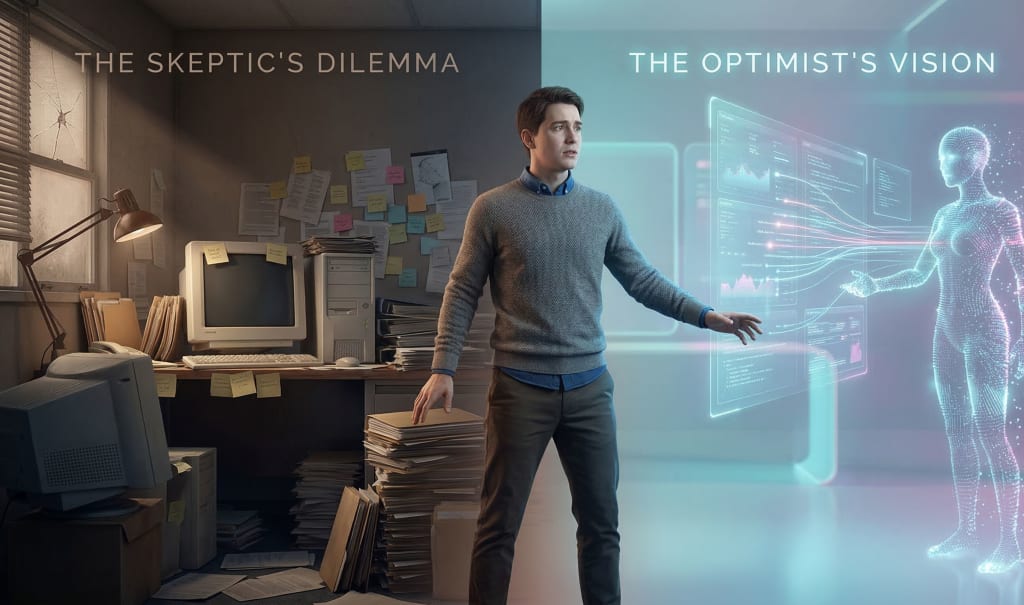
The brutal truth about AI nobody wants to admit (but you probably feel already)
I was sitting in a cramped conference room last year, watching a very confident man explain how AI was going to “replace 40% of jobs by 2030,” when I realized something weird.
Half the room looked terrified.
The other half looked like they’d just discovered religion.
Same slide deck. Same graphs. Completely different reactions.
And I remember thinking: this isn’t about the tech anymore — it’s about what people are afraid to admit about their own future.
The night I realized both AI skeptics and optimists were kind of lying
The moment it really hit me wasn’t at a conference though.
It was 11:47 p.m.
I was hunched over my laptop, trying to get an AI model to write something that didn’t sound like a robot pretending to be a human who’d never actually met another human.
It kept giving me the same bland stuff: polished, safe, totally forgettable.
So I did what any desperate person does at midnight: I started scrolling Twitter.
On one side: threads about “AI will end humanity,” “we’re building our own replacement,” “shut it all down before it’s too late.”
On the other: founders bragging “we run our company with 2 people and 23 AI agents,” “we fired all our writers,” “if you’re not all‑in on AI you’re already obsolete.”
That’s when I noticed something nobody in either camp wanted to admit:
The skeptics were exaggerating the danger to protect their status.
The optimists were exaggerating the upside to protect their narrative.
And almost nobody was talking about the boring middle — the part that’s actually going to change our lives.
So… who’s right about the long-term value of AI?
Short answer: both and neither.
The skeptics are right that AI is being oversold, misused, and pushed way faster than we understand it.
The optimists are right that AI will rewire how we work, learn, and build things in a way that’s bigger than a “new tool.”
But here’s the thing nobody likes saying out loud:
AI won’t destroy your future or magically save it. It’ll just brutally amplify who you already are.
If you’re lazy, AI will help you be lazy at scale.
If you’re curious, it’ll give you superpowers.
So the real long-term value of AI isn’t “AI vs humans.”
It’s what happens when average humans suddenly get unfair advantages — and what they do with them.
AI Skeptics: What they’re right about (and what they’re dead wrong about)
I get the skeptics. Honestly, I used to be one.
I rolled my eyes at every “AI tool of the week” post.
I said things like, “This is just fancy autocomplete,” or “I can tell AI writing a mile away.” (Spoiler: I couldn’t. Not always.)
Here’s what the skeptics are absolutely right about:
Most AI content is garbage.
Low-effort, copy-paste, no soul. It’s already flooding LinkedIn and blog posts nobody reads. The internet’s turning into a landfill of AI sludge.
Companies are using AI as an excuse to cut corners.
I’ve seen teams lay off 5 people, replace them with one “AI power user,” and act like that’s progress. It works for a quarter or two — then quality quietly collapses.
We don’t fully understand the long-term risks.
We barely understand TikTok’s impact on attention spans, and now we’re wiring models into law, healthcare, education, finance. It’s not hard to imagine that going sideways.
But here’s where skeptics completely misread the room:
They underestimate how much people love convenience more than they fear risk.
People stayed on Facebook after the data scandals.
They kept using Uber despite all the drama.
They’re not going to swear off AI because someone wrote a thoughtful 4,000‑word essay about existential risk.
And I say this as someone who cares deeply about those risks: fear doesn’t beat convenience at scale. It never has.
So when skeptics say, “We should slam the brakes,” what I actually hear is:
“I don’t like where this is going, and I don’t know how to stay valuable inside it.”
AI Optimists: What they’re right about (and what they’re selling you that’s fake)
On the other side, you’ve got the AI optimists — the “this is the new electricity” people.
Some of them are thoughtful. A lot of them are… selling something.
They’re right about a few huge things:
AI massively compresses time for certain tasks.
I’ve watched a single person build a full prototype in a weekend that used to take a small dev team a month.
AI levels the playing field — a bit.
A kid with a laptop in Lagos has more access to world-class knowledge now than entire universities did twenty years ago. That matters. A lot.
AI helps non‑experts do expert‑adjacent work.
You might not be a designer, but you can rough draft 10 logo concepts in an afternoon. You might not be a lawyer, but you can get a decent first pass on a contract.
But the optimists also tell three dangerous half-truths:
“AI will do everything for you.”
No, it won’t. It’ll do everything obvious for you. The boring, pattern-based, past-data stuff. The new, weird, context-heavy, emotionally messy decisions? Those stay on your plate.
“If you use AI, you’ll automatically win.”
Not if everyone else is using it too. Using AI will become like using Google — the baseline. The advantage comes from how you use it, not that you use it.
“AI will create more jobs than it destroys.”
Maybe in the long run. But “the long run” doesn’t pay your rent this year. There’s a messy, painful middle nobody wants in their keynote.
The part that bothers me most though?
Optimists talk like AI is this benevolent force arriving to help humanity. It’s not. AI is a mirror. A very fast, very scalable mirror of human incentives.
Give it to a scammer, they’ll run better scams.
Give it to a teacher, they’ll run better classes.
Same tech. Different intent.
The 7-year rule: How to think about AI’s real long-term value
Here’s the framework I started using to stay sane:
If AI can do your job right now, your job was already in trouble — AI just sped up the reveal.
Think in three time horizons:
1. Next 12 months: “Cheat code” phase
Everyone’s experimenting. Tools are half-baked.
People post screenshots of cool prompts and side projects.
The unfair advantage goes to people who’re curious enough to play and disciplined enough to integrate.
You can 2–3x your output if you stop treating AI like magic and start treating it like a mediocre intern that never sleeps.
2. Next 3–7 years: “Compression” phase
This is where things get uncomfortable.
Entire layers of middle-skill tasks get compressed — not fully removed, just squashed.
Teams shrink. Expectations rise. The same job title now means “you + AI + more responsibility.”
Here’s the uncomfortable truth:
AI won’t take most people’s jobs. But it will take all the parts of their job they secretly dislike — and then ask them, “So what’s left that only you can do?”
Most people don’t have a good answer ready. That’s where the panic comes in.
3. Beyond 7 years: “Character amplifier” phase
By this point, AI tools are everywhere, mostly invisible, built into everything.
The gap isn’t between “AI users” and “non‑users.”
It’s between people who grew with it vs people who let it happen to them.
The curious, experimental people look strangely “lucky.”
The rigid, status-quo people feel strangely “unlucky.”
But it’s not luck. It’s accumulated tiny choices over years.
The 4-Type AI Matrix: Which one are you becoming?
I started mapping people I met into four buckets. It’s not scientific, but it’s uncomfortably accurate.
1. The Fearful Traditionalist
“AI is bad, I’m ignoring it.”
Doesn’t experiment. Reads headlines, shares outrage posts.
Long-term outcome: slowly sidelined, even if they’re very talented.
2. The Shiny Object Chaser
Signs up for every tool. Has 37 AI apps, uses none consistently.
Talks a lot about “productivity,” still misses deadlines.
Long-term outcome: busy, burned out, not actually strategic.
3. The Quiet Power User
Uses 2–3 AI tools deeply, every day.
Builds custom workflows. Treats AI like an assistant, not a savior.
Long-term outcome: seems “weirdly efficient,” gets promoted or goes solo.
4. The Builder
Uses AI not just to do tasks faster, but to create new offers, products, or systems.
Asks, “What becomes possible only because AI exists?”
Long-term outcome: shapes the work, instead of chasing it.
Everyone thinks they’re #3 or #4.
Most people are still stuck in #1 or #2.
Where are you actually behaving from — not where you wish you were?
Is AI overhyped or underrated? The annoying answer
Here’s where I contradict myself.
I’ve spent nights frustrated with AI’s limits. It hallucinates. It breaks. It gives you confidently wrong answers that would get a human fired.
So from a “can it do X as well as a skilled human?” perspective, yes — AI is overhyped.
But from a “can it completely reshape how we organize work, learning, and creativity over 10–20 years?” perspective?
It’s probably still underrated.
Not because it’s magical.
But because we consistently:
Overestimate what tech can do in 2 years
Underestimate what it’ll quietly do in 10
The long-term value of AI isn’t that it answers questions. Google did that.
The long-term value is that it becomes a default collaborator — always there, always fast, always “good enough” — and that slowly rewires what we expect from ourselves.
That’s the part people haven’t fully internalized yet.
5 things I learned using AI daily for a year that changed how I think about it
I used AI tools every single day for over 12 months. Work. Writing. Planning. Random experiments. Here’s what surprised me.
1. The more I used AI, the more obvious my own gaps became
AI exposed where I’d been skating by on vague thinking.
If I gave it a fuzzy prompt, I got a fuzzy answer.
If I forced myself to be specific — context, constraints, examples — both of us got smarter.
AI doesn’t replace clear thinking. It punishes the lack of it.
2. AI made my good ideas better and my bad ideas worse
When I had a strong concept, AI helped me pressure-test it from 10 angles in an hour.
When I had a weak concept, AI helped me dress it up so well I almost believed my own nonsense.
That’s dangerous.
You can now make bad ideas look polished very quickly.
3. Handing off 30% of my work made the remaining 70% heavier
Delegating routine tasks to AI freed up time, but it also left me face-to-face with the stuff I’d been avoiding:
Hard decisions
Deep thinking
Conversations I didn’t want to have
You don’t get to hide behind “I’m too busy” when a bot can do your busywork.
4. My value shifted from “doing” to “deciding”
I used to measure my productivity by how much I typed, how many tasks I completed.
Now my value comes from:
Asking better questions
Setting better constraints
Knowing when not to trust the output
AI made me realize: the future belongs to people who can frame problems, not just solve them.
5. The biggest skill isn’t prompting — it’s taste
Prompting got easier over time. That’s not the hard part.
The hard part is knowing what “good” looks like — in your field, for your audience, for your standards.
AI can give you 20 options. If your taste is weak, you’ll pick the wrong one with great confidence.
The controversial part: AI is coming for mediocre, not mastery
People love saying, “AI will never replace real creativity / real doctors / real teachers.”
That’s comforting. It’s also partially wrong.
Here’s the nuance I don’t see enough people talk about:
AI is coming first for “good enough.” For the middle. For the competent but interchangeable.
The “decent” blog writer churning out 20 listicles a month.
The “fine” customer support rep reading from a script.
The “okay” designer doing small tweaks all day.
Those roles get squeezed. Not instantly. But steadily.
Mastery still matters. Maybe more than ever.
But “I’m pretty good, I’ve done this for 5 years” won’t be as safe as it used to be.
So no — the long-term value of AI isn’t that it wipes out professions.
It’s that it shifts the floor and raises the ceiling at the same time:
The floor goes up: basic work gets faster and cheaper.
The ceiling goes higher: the best people do things that were literally impossible before.
Your job is to avoid getting trapped in the rising floor.
So what should you actually do about AI? (A simple 3-layer plan)
Here’s the practical part. No hype. No doom.
Think of your relationship with AI in three layers:
Layer 1: Survival (0–6 months)
Goal: Don’t be the person proudly saying “I don’t use AI.”
Pick one AI tool and commit to using it daily for 30 days. Not 10 tools. One.
Automate one annoying recurring task: summarizing meetings, drafting emails, rewriting notes.
Learn the basics of prompting: context, role, examples, constraints.
You’re not trying to be elite here. You’re just building familiarity so you stop feeling behind.
Layer 2: Leverage (6–24 months)
Goal: Make AI part of your workflow, not a novelty.
Map your week and circle any task that feels repetitive, predictable, or template-friendly.
Build a small “AI SOP” (Standard Operating Procedure) for those tasks — same prompts, same process, refined over time.
Track what AI actually saves you in hours, not vibes. If it doesn’t save time, change or drop it.
You’ll know this layer is working when people notice you “get a lot done” but can’t quite see how.
Layer 3: Creation (2+ years)
Goal: Use AI to do things you literally couldn’t without it.
This is where you ask:
“What could I build if I had 5 interns?”
“What would I try if code/design/legal help weren’t a bottleneck?”
“What new value could I create that didn’t exist before this tech?”
That might look like:
A niche information product that updates itself
A micro-SaaS tool serving 500 people globally
A solo business running like a small agency
This is where long-term value really compounds.
Who’s actually right about the future of AI?
So back to the original question: AI skeptics vs AI optimists — who’s right about the real long-term value of AI?
The skeptics are right that:
The hype is insane
The risks are under-discussed
There’ll be real harm, real displacement, real regret
The optimists are right that:
The upside is enormous
Entire new categories of work and creation are emerging
People who learn this early gain unfair advantages
But they’re both missing one uncomfortable fact:
The long-term value of AI isn’t decided by the technology. It’s decided by the character of the people using it.
Give powerful tools to insecure, short-term thinkers and you get spam, scams, and shallow content.
Give the same tools to patient, long-term builders and you get new medicines, better education, fairer systems — or at least a decent shot at them.
AI doesn’t fix human nature. It just makes the consequences show up faster.
The question you actually need to ask yourself
Forget the think pieces for a second. Forget what “society” should do.
Ask this instead:
“If AI makes it 10x easier to do what I already do… is that actually good for me?”
If your work is:
Repetitive
Easily documented
Light on judgment and heavy on process
Then yeah, there’s a real risk.
If your work is:
Heavy on trust
Full of nuance and stakes
Deeply tied to taste, judgment, or lived experience
Then AI is less “replacement” and more “pressure multiplier.”
It’ll push you to be better faster — or expose that you’ve been coasting.
Either way, this isn’t a spectator sport anymore.
You don’t have to become an AI cheerleader. You don’t have to stop being skeptical.
But if you want to matter 10 years from now, you probably do have to do one simple, uncomfortable thing:
Stop arguing about whether AI is good or bad — and start deciding who you want to be in a world where it’s simply… normal.
“AI won’t destroy your future or magically save it. It’ll just brutally amplify who you already are.”
“AI doesn’t replace clear thinking. It punishes the lack of it.”
“If AI can do your job right now, your job was already in trouble — AI just sped up the reveal.”
“The future belongs to people who can frame problems, not just people who can solve them.”
“The long-term value of AI isn’t decided by the technology. It’s decided by the character of the people using it.”
About the Creator
abualyaanart
I write thoughtful, experience-driven stories about technology, digital life, and how modern tools quietly shape the way we think, work, and live.
I believe good technology should support life
Abualyaanart
Keep reading
More stories from abualyaanart and writers in Futurism and other communities.
Will AI Really Replace Knowledge Workers?
Why “Will AI Really Replace Knowledge Workers?” Isn’t the Question We Think It Is AI might not take your job — but someone using AI probably will. The latest evidence is messier, scarier, and more hopeful than the headlines want it to be.
By abualyaanartabout 13 hours ago in Futurism
Large Language Model (LLM) Market to Reach USD 82.1 Billion by 2033
Large Language Model (LLM) Market Overview The Global Large Language Model (LLM) Market is projected to grow significantly, reaching approximately USD 82.1 Billion by 2033, rising from USD 4.5 Billion in 2023, with a CAGR of 33.7% during the forecast period from 2024 to 2033. This rapid expansion is supported by the rising adoption of generative artificial intelligence technologies across enterprises, research institutions, and digital platforms. Organizations are increasingly deploying LLM systems to automate knowledge processing, customer interactions, and content generation.
By Roberto Crum7 days ago in Futurism
Becca
"Everything is so... flat." Denille said stupidly as she looked around her new neighborhood. She looked around at the muted desert where even the smallest sign of life seemed to have given up. The plant life was shrubs that were half cooked by the heat and where there should have been a lawn, a mess of white rocks laid glistening in the sun. Even the sky looked stretched thin, like the sun had ironed it smooth. She’d moved from Riverside, where at least there were hills, but here in Barstow, everything felt baked and brittle.
By Sara Wilson7 days ago in Fiction



Comments
There are no comments for this story
Be the first to respond and start the conversation.