
The Cracks in the Stone: What the Myth Refused to Record
The sun did not simply hide; she shattered. A descent into the sensory grit and jagged silence behind the legend of the Heavenly Cave.

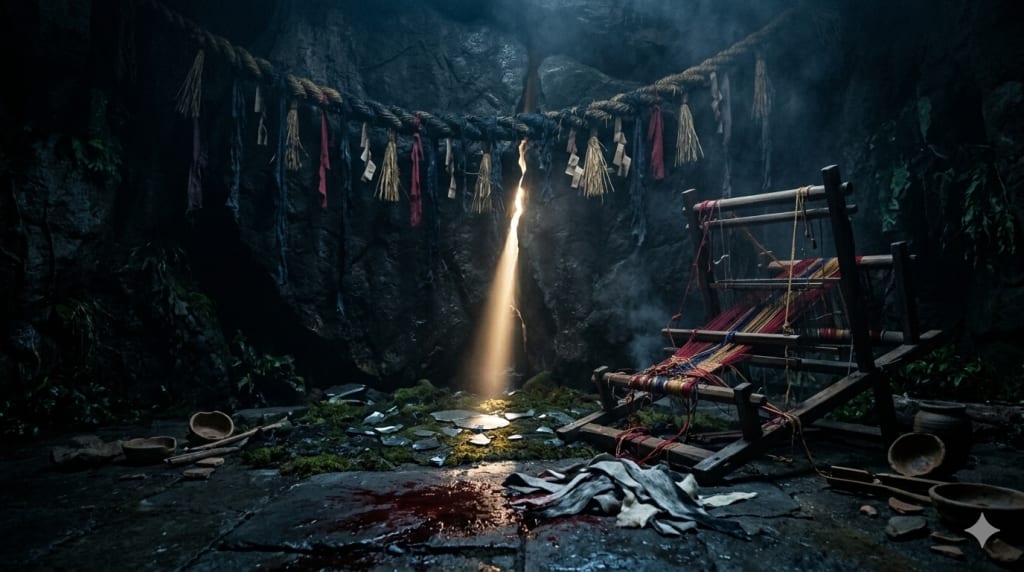
The myth-makers like to say that when Amaterasu Omikami entered the cave, the world simply went dark. They use the word "dark" as if it were a clean, binary switch—the absence of a lamp, a blanket thrown over a birdcage. They tell you that the gods gathered by the river to laugh her back out, as if a divine party could cure a cosmic trauma.
But they omit the smell. They omit the copper-tang of the flayed horse’s blood still wet on the weaving loom. They ignore the way the "darkness" felt less like night and more like a physical weight, a suffocating ink that tasted of cold iron and damp earth.
I was there, not as a protagonist, but as a minor spirit of the grass, pressed against the cold stones of the Ama-no-Iwato. And I tell you, the myth is a lie of simplification.
The Butcher’s Remnants
The tragedy began not with a divine tantrum, but with a mess. Susanoo, the brother of the sun, did not merely "misbehave." He committed an act of sensory desecration. He took the Heavenly Piebald Horse—a creature of pure, starlight-dappled hide—and he flayed it alive. He flung the wet, shivering skin through the roof of the sacred weaving hall.
The myth ignores the weavers. It focuses on Amaterasu’s retreat. But I saw the girls, their fingers stained with the indigo and gold threads, their eyes wide as the skin of the horse collapsed onto the loom like a heavy, sodden rug. One of them died not from a wound, but from the sheer, illogical horror of it. Amaterasu did not hide because she was offended; she hid because the logic of her world had been replaced by the gore of her brother’s chaos.
She crawled into the cave because the light had nowhere left to land that wasn't covered in filth.
The Gathering of the Desperate
The gathering at the Ama-no-Yasu River is described as a strategic meeting of the "eight million gods." In the scrolls, they look dignified, their brows furrowed in wisdom.
In reality, we were a mob of the terrified. The "god of wisdom," Omoikane, did not simply devise a plan with a calm smile. He was pacing until his sandals wore through to the bone of his feet, his hands trembling so violently he could barely hold his staff. There was a frantic, ugly quality to our gathering. Without the sun, the very concepts of "up" and "down" were dissolving. The river didn't flow; it stagnated in a lightless sludge.
We didn't bring the cocks to crow because it was a clever symbol of dawn. We brought them because we needed to drown out the sound of the silence—a silence that was beginning to scream.
The Dance of the Grotesque
Then came Ame-no-Uzume. The myth says she performed a "lively dance" that made the gods laugh. It sounds like a charming folk performance.
It was anything but charming. Uzume did not just dance; she stripped herself bare in the freezing, absolute blackness. She stomped on a wooden tub until it splintered, her heels bloody. She exposed herself to the crowd, not in a gesture of grace, but in a frantic, grotesque display of raw, animal vitality.
And we laughed. But it wasn't the laughter of joy. It was the hysterical, jagged laughter of creatures on the brink of madness. We laughed because if we didn't, we would have started eating each other in the dark. Our laughter was a weapon, a jagged shard of sound intended to pierce the stone. It was ugly. It was loud. It was the sound of the desperate trying to convince themselves they still existed.
The Distortion of the Mirror
The most sanitized part of the story is the mirror—the Yata-no-Kagami. The myth says Amaterasu, curious at the noise, peeked out, saw her own radiance, and was lured closer.
But consider the physics of the cave. Inside, Amaterasu was a goddess broken by the sight of a flayed horse. She had been sitting in the damp for what felt like aeons. When she looked into that mirror, held up by the straining arms of the gods, she didn't see "radiance."
She saw a stranger.
She saw a hollow-eyed woman covered in the dust of the cave, a deity who had learned that her light could be extinguished by a brother’s whim. She stepped forward not out of vanity, but out of a desperate, disoriented need to reclaim the person she saw in the glass—a version of herself that existed outside the cave.
She didn't come out because she was fooled. She came out because the mirror was the only thing that promised her she wasn't a ghost.
The Rope That Never Left
The final touch of the myth is the Shimenawa—the sacred rope Tajirao stretched across the entrance once she emerged, forbidding her from ever returning to the dark.
They call it a "sacred boundary." But I saw the way Amaterasu looked at that rope. It wasn't a protection; it was a tether. It was the gods telling the sun that she no longer had the right to her own grief. She was forced back into the sky, forced to shine upon the very world where her brother had committed his atrocities, bound by a rope that ensured she could never again seek the mercy of the shadows.
The world was bright again, yes. But the light was different now. It was a light that knew the darkness existed. It was a light that carried the memory of the flayed horse and the blood on the loom.
When you look at the sun today, don't think of it as a triumphant return. Think of the cracks in the stone. Think of the smell of iron in the dark. Think of the silence that we drowned out with our ugly, terrified laughter. The myth survived because it smoothed over the blood and the bile, but the stone remembers the truth.
About the Creator
Takashi Nagaya
I want everyone to know about Japanese culture, history, food, anime, manga, etc.
Keep reading
More stories from Takashi Nagaya and writers in Fiction and other communities.
The Hundred-Year Awakening: A Monologue from an Old Umbrella
Esteemed Reader, Have you ever looked at an old, forgotten object in your home—perhaps a chipped teacup, a faded kimono, or a dusty old fan—and wondered about its story? In Japan, we have a belief that after a hundred years of loyal service, an inanimate object can gain a soul, transforming into a Tsukumogami (付喪神). They aren't malicious spirits, but rather gentle, often melancholic entities, imbued with the memories and experiences of their owners.
By Takashi Nagaya2 months ago in Fiction
Imperishable
“Listen, I tell you a mystery: We will not all sleep, but we will all be changed— in a flash, in the twinkling of an eye, at the last trumpet. For the trumpet will sound, the dead will be raised imperishable, and we will be changed.” 1 Corinthians 15: 51-52
By Hannah Moore7 days ago in Fiction


Comments
There are no comments for this story
Be the first to respond and start the conversation.