
City of plague:A new Yorker’s pandemic chronicle Pt 7.
In the Subway Car
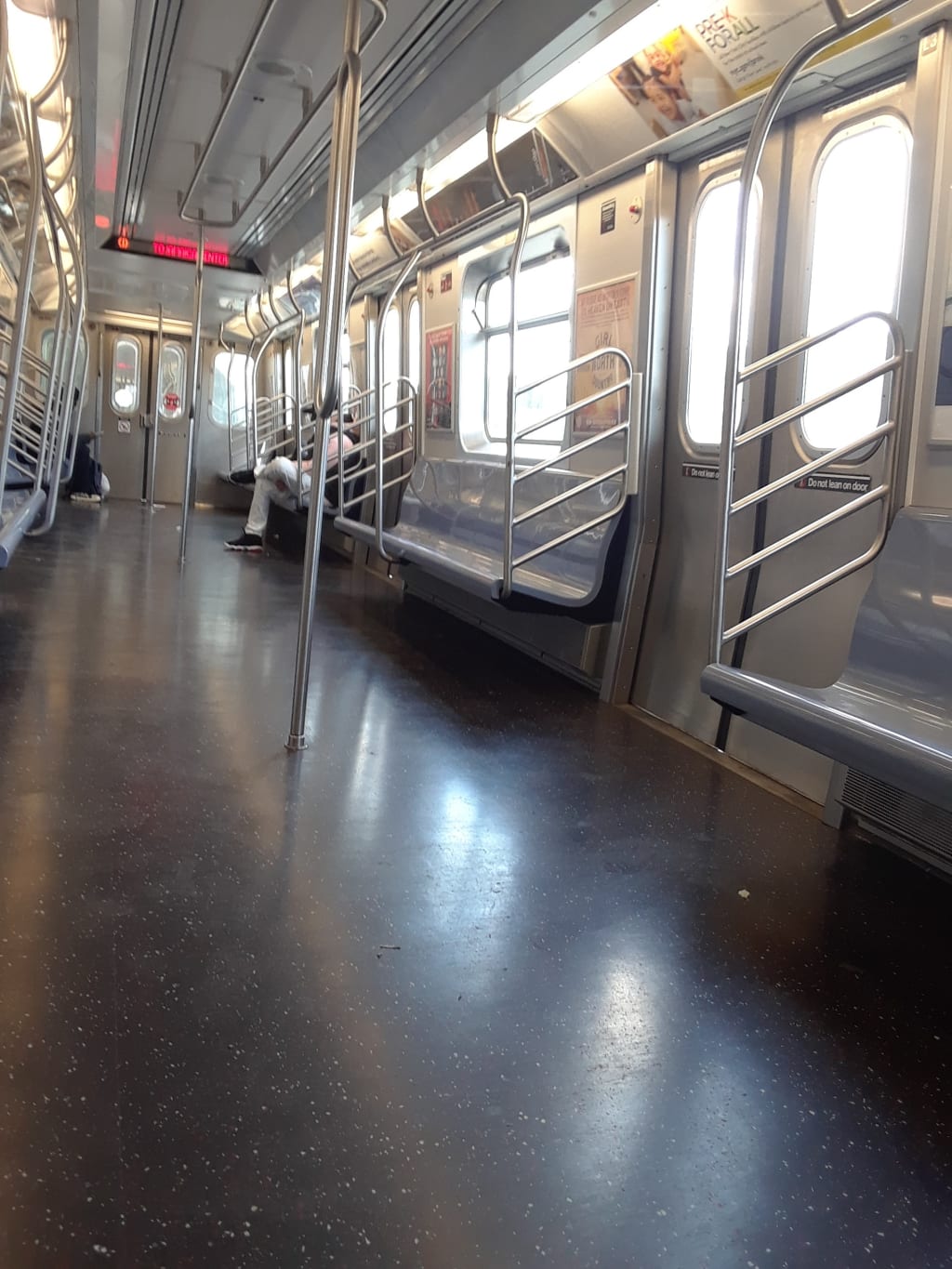
During the stay-at-home order, the subway never stopped running. It roared through tunnels with tireless persistence, as if driven by a quiet sense of duty—to keep the city alive while an invisible enemy stalked its people. In its motion, there was something almost sacrificial. The trains carried not only passengers, but also the fragile belief that New York would endure.
Systems differ, nations differ, and so do their responses. In Wuhan, China, the city sealed itself completely. Streets emptied. Life paused. It was as if someone had pressed a universal stop button. But New Yorkers were raised on freedom—sometimes recklessly so. A total shutdown was unimaginable. To many, the loss of freedom felt worse than death itself.
And there were still those who had no choice but to move: nurses, pharmacists, sanitation workers, bank employees, journalists—people whose labor formed the hidden skeleton of the city. Not everyone owned a car. Public transit was not convenience; it was survival.
I was one of them.
March 23 was the first official day of the stay-at-home order. Whether it marked the beginning of despair or hope, I could not tell. Perhaps it was both. I went to work as usual, stepping into the subway with a quiet resolve, as though entering a battlefield where the enemy could not be seen.
The car was almost empty.
Where there had once been bodies pressed shoulder to shoulder, now there were only scattered figures, sitting far apart like strangers in exile. The subway, usually full of restless energy, now felt hollow—like a living creature suffering from anxiety. In its more than one hundred years of history, it had likely never known such loneliness.
I estimated that ridership had fallen by at least ninety percent. The financial loss must have been enormous. Yet for those of us still riding, the emptiness offered something priceless: distance. Distance meant safety. Distance meant hope.
The train moved forward—not slowly, but without its former urgency. It was as if it, too, felt the weight of uncertainty. Even machines seemed capable of fear.
What frightened me most was not the silence, but the absence of masks.
Almost no one wore one.
Even transit workers stood exposed, their faces unprotected, as though masks carried a social stigma greater than the virus itself. It was early then. Many still believed masks were unnecessary, or worse, a sign of weakness. But I knew what others preferred not to acknowledge: infection did not always announce itself. A person could carry the virus and feel perfectly fine, all while becoming a silent threat to others.
The thought made my skin prickle.
I adjusted my hat and touched the homemade mask covering my face. I had stitched it myself and wrapped a scarf tightly around it for extra protection. It wasn’t perfect, but it gave me something essential: a sense of control.
I wasn’t afraid of getting sick.
I was afraid of becoming the reason someone else did.
Afraid that the virus might cling to my coat, my shoes, or my mask—and follow me home to the people I loved.
The subway continued forward, steady and faithful. It did not stop. It did not hesitate. It carried me, as it had carried millions before me, through darkness toward whatever future awaited.
Without it, I could not work. Without work, my income would vanish. Mortgage payments would become impossible. Yes, there was unemployment assistance, and for some it even exceeded their salaries. But assistance was temporary. Dignity was not.
In that moment, I felt unexpectedly grateful.
At the next major station, more passengers boarded. The car filled—not crowded, but no longer empty. People avoided eye contact. Everyone seemed wrapped inside their own private calculations of risk and survival.
Then he appeared.
A homeless man shuffled slowly toward me. His clothes were stained, his hair unkempt, and a sour odor surrounded him like a second skin. Instinctively, I recoiled. Fear rose first, then judgment.
Who could guarantee he wasn’t infected?
He wore no mask. No protection. He lived exposed to the elements, to hardship, to neglect. Statistically, he was more vulnerable than anyone else in the car.
But then another thought followed close behind:
He was not my enemy.
He was a victim of circumstances I could barely imagine.
Compared to him, I was fortunate. Compared to the wealthy, I was not. Weakness, I realized, was relative.
Without hesitation, I reached into my pocket and pulled out ten dollars. I placed it gently into his hand.
“Buy a mask,” I said.
He looked at me, confused.
I pointed to my face.
“Wear a mask.”
“Thank,” he said, smiling faintly before moving on.
As I watched him go, I understood something simple and profound: viruses do not care about status. They do not recognize wealth, power, or pride. They infect presidents and beggars alike.
Protecting the vulnerable was not charity.
It was survival—for all of us.
I did not know if he would actually buy a mask. But I hoped he would remember. Sometimes, change begins not with policies, but with small, human gestures.
Two weeks later, I saw him again.
He was wearing a mask.
He moved through the subway car just as before, asking for help—but now, he was protected.
By then, everything had changed. Transit workers wore masks. Passengers wore masks. The invisible threat had become undeniable.
But the cost was already unbearable.
More than 150 transit workers had died.
Over 100 homeless individuals had died.
Numbers that sounded abstract—until you realized each one had once stood breathing in a subway car like this one.
Not all of those deaths could have been prevented by masks. But the question lingered, heavy and unanswerable:
How many could have been?
I stepped off the train and onto the platform, returning to my ordinary life in an extraordinary time. Behind me, the subway doors closed, and the train disappeared into the tunnel, still running, still carrying the city forward.
It had not stopped.
And neither, somehow, had we.
About the Creator
Peter
Hello, these collection of articles and passages are about weight loss and dieting tips. Hope you will enjoy these collections of dieting and weight loss articles and tips! Have fun reading!!! Thank you.
Bomb Scare
It was 2027, and the world never thought it would happen. A missle hit the United States, but it wasn't where they had anticipated. A little town in the northeast was hit by a missile strike, they didn't know why, and they didn't know exactly where it hit, but they did know it was a coastal community, somewhere between Maine and Delaware.
By Gregory Payton7 days ago in Fiction
The Edge of Something
She kissed me. She kissed me, and I just stood there. I didn't understand what was happening until it was already over. Did I lean in? I don't know. She did — I know that much — because I would never have been the one to close the distance. I had only been thinking that I was having a nice time with a girl I met in class. A nice time. That's all.
By Eddamar González2 days ago in Fiction
A System That Isn’t Working Challenge Winners
Systems promise order. They organize behavior, distribute opportunity, and suggest that if everyone follows the rules, things will work. The entries in A System That Isn’t Working look closely at what happens when that promise begins to slip.
By Vocal Curation Teama day ago in Resources



Comments
There are no comments for this story
Be the first to respond and start the conversation.