
Venus and Jupiter Shine Together: A Stunning Planetary Display in Earth’s Sky
How the two brightest planets create a breathtaking celestial spectacle visible to the naked eye

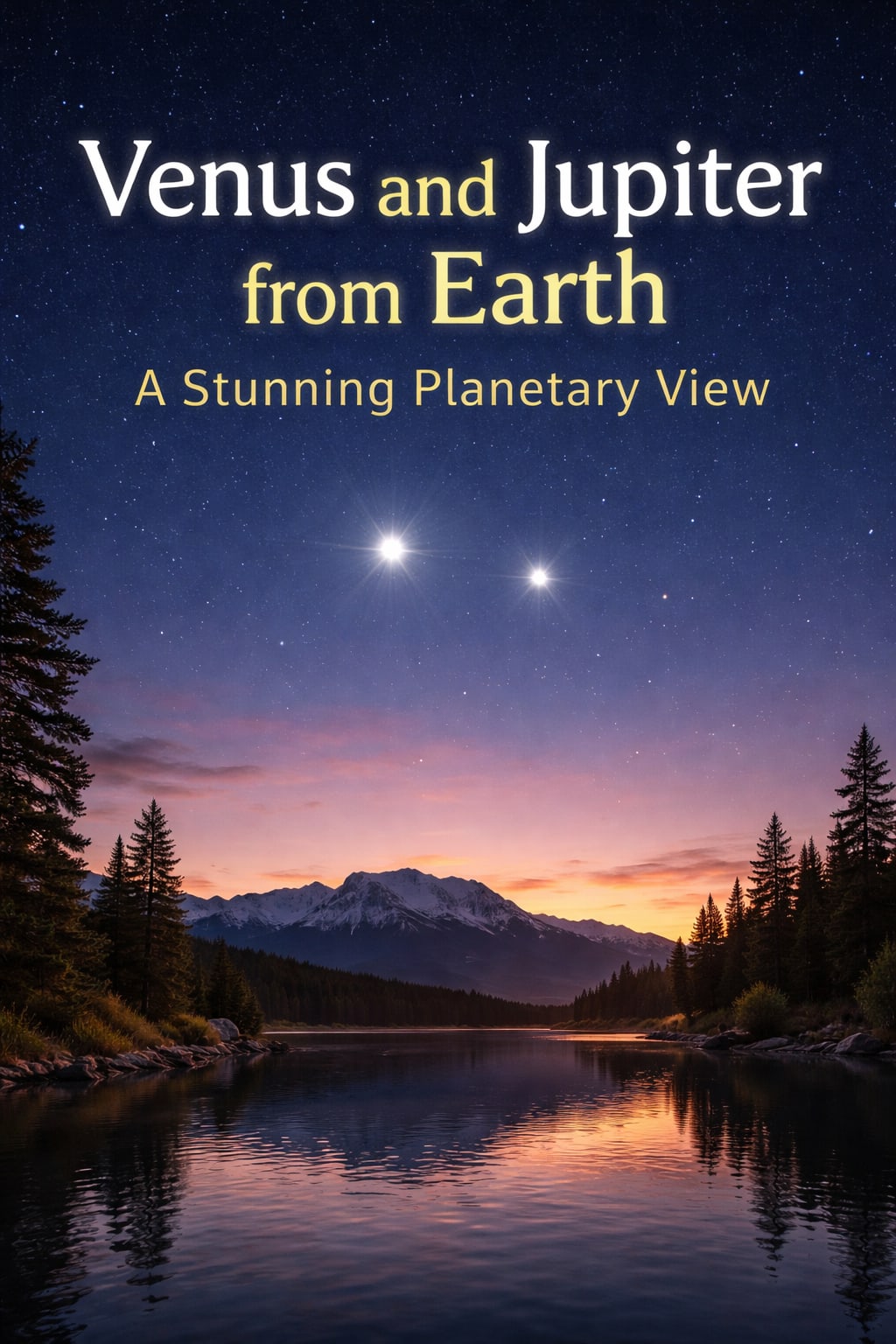
For skywatchers across the world, there are few sights more captivating than seeing bright planets glowing in the night sky. Among these celestial wonders, the close appearance of Venus and Jupiter from Earth is one of the most spectacular. When these two brilliant planets appear close together in the sky, they create a stunning astronomical event that fascinates both professional astronomers and casual stargazers alike.
Venus and Jupiter are the two brightest planets visible from Earth. Because of their brightness, they can often be seen without a telescope, shining like brilliant stars shortly after sunset or just before sunrise. When their positions in their orbits bring them close together from Earth’s perspective, the event is known as a planetary conjunction—a phenomenon that has fascinated humans for thousands of years.
Venus, often called the “Evening Star” or “Morning Star,” is the second planet from the Sun. It is famous for its intense brightness, caused by its thick clouds that reflect a large amount of sunlight. In fact, Venus is the brightest natural object in the night sky after the Moon. Its dazzling white glow can easily outshine many stars and is often mistaken for an aircraft or even a mysterious object by those unfamiliar with astronomy.
Jupiter, the largest planet in the Solar System, is another remarkable sight. Though much farther away than Venus, it appears very bright because of its enormous size. Jupiter’s strong reflection of sunlight makes it the second-brightest planet visible from Earth. When observed through a telescope, its massive bands of clouds and its four largest moons—discovered by Galileo Galilei in 1610—can be clearly seen.
When Venus and Jupiter appear close together in the sky, they create a beautiful pairing that can be easily spotted even in cities with light pollution. Sometimes they appear so close that they look like a single glowing object. In reality, however, the two planets remain millions of kilometers apart. The apparent closeness is simply a result of perspective from Earth.
These conjunctions happen periodically because all planets orbit the Sun at different speeds and distances. Venus completes an orbit around the Sun in about 225 Earth days, while Jupiter takes nearly 12 Earth years to complete one orbit. As these planets move along their paths, there are moments when they align in the sky as seen from Earth, producing the striking visual effect that observers enjoy.
Throughout history, such celestial alignments have inspired myths, legends, and even historical interpretations. Ancient civilizations carefully watched the movements of Venus and Jupiter. For example, astronomers in ancient Babylon meticulously recorded the motion of Venus thousands of years ago. Similarly, Jupiter was often associated with powerful gods in Roman mythology, which is why the planet carries the name of the chief Roman deity.
Today, modern astronomy explains these events with precise calculations. Astronomers can predict exactly when and where conjunctions will occur, allowing skywatchers to prepare in advance. Amateur astronomers often gather with telescopes, binoculars, or cameras to capture the beautiful alignment.
One of the best aspects of observing Venus and Jupiter together is that it requires no special equipment. On a clear evening, simply looking toward the western horizon shortly after sunset can reveal the bright pair shining side by side. Venus typically appears slightly brighter and whiter, while Jupiter may have a softer golden glow.
Photographers also find these events particularly exciting. When Venus and Jupiter appear near the horizon, they can be captured alongside landscapes, mountains, or city skylines, creating dramatic images that combine Earth’s scenery with cosmic beauty.
Astronomers often encourage people to observe such events because they help spark curiosity about the universe. Looking up at the sky and seeing two distant worlds shining together reminds us of the vastness of our Solar System and our place within it.
Ultimately, the sight of Venus and Jupiter from Earth is more than just an astronomical alignment—it is a reminder that the universe is constantly moving and changing. These distant planets, separated by hundreds of millions of kilometers, briefly appear together in our sky, offering a moment of wonder for anyone who takes the time to look up.
For many observers, it is a simple yet profound experience: two bright worlds sharing the same patch of sky, silently traveling through space while Earth continues its own journey around the Sun.
About the Creator
Irshad Abbasi
Ali ibn Abi Talib (RA) said 📚
“Knowledge is better than wealth, because knowledge protects you, while you have to protect wealth.
Keep reading
More stories from Irshad Abbasi and writers in Earth and other communities.
A Planet the Size of Earth with an Atmosphere Like Our Own
For centuries, humans have looked up at the night sky and wondered whether Earth is the only world capable of supporting life. Advances in modern astronomy have brought us closer than ever to answering that question. Recently, astronomers announced the discovery of a planet roughly the size of Earth with an atmosphere that appears surprisingly similar to our own. This finding has sparked excitement among scientists and renewed hope that life might exist elsewhere in the universe.
By Irshad Abbasi 5 days ago in Earth
Stanislav Kondrashov Oligarch Series: Oligarchy and Global Supergrids in the Next Phase of the Energy Transition
The global energy transition is entering a new and complex phase. While early discussions focused primarily on renewable technologies such as solar panels, wind turbines, and battery storage, the next stage of transformation is increasingly centered on infrastructure. Among the most ambitious ideas shaping this evolution is the concept of **global supergrids**—vast electricity networks designed to connect distant regions through high-capacity, long-distance transmission systems.
By Stanislav Kondrashov 6 days ago in Earth



Comments
There are no comments for this story
Be the first to respond and start the conversation.