
One of the World’s Ten Largest Ice Shelves on the Brink of Breaking Away
Scientists warn that a massive Antarctic ice shelf is nearing a critical fracture point, raising concerns about rising sea levels and accelerating climate change.

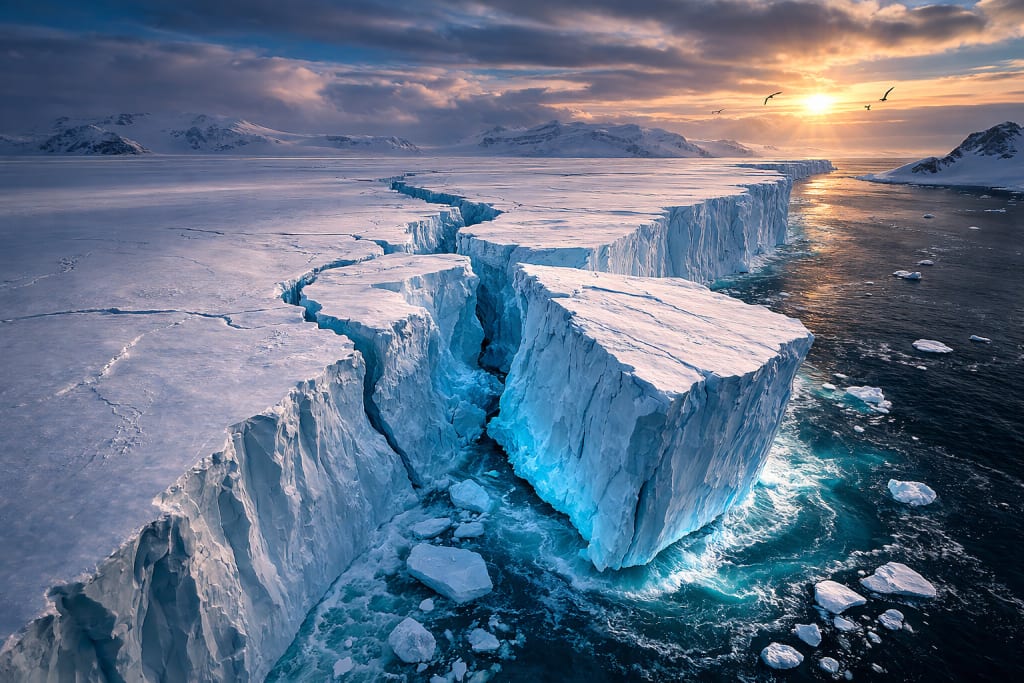
A massive ice formation in Antarctica—one of the ten largest ice shelves in the world—is reportedly close to breaking away from the continent, according to recent observations by climate scientists and satellite monitoring agencies. The development has drawn global attention, as experts warn that the detachment of such a huge ice mass could have significant implications for sea levels, ocean currents, and the stability of surrounding glaciers.
Ice shelves are thick floating platforms of ice that form where glaciers and ice sheets flow down to the coastline and extend over the ocean. They play a crucial role in stabilizing the Antarctic ice sheet by acting as natural barriers that slow the movement of land-based glaciers into the sea. When an ice shelf weakens or breaks apart, the glaciers behind it can accelerate, potentially contributing to rising global sea levels.
The ice shelf currently under scrutiny has been monitored for years through satellite imagery, radar mapping, and field research. Scientists have detected a growing network of cracks and fractures spreading across the ice surface. One particular rift has expanded rapidly in recent months, indicating that a large section of the ice shelf may soon calve off into the surrounding ocean.
Researchers estimate that the chunk of ice that could break away may be hundreds or even thousands of square kilometers in size—large enough to form one of the biggest icebergs seen in recent years. If the break occurs, the resulting iceberg could drift through the Southern Ocean for years before gradually melting.
While iceberg calving is a natural process in polar environments, scientists are increasingly concerned about the frequency and scale of these events in a warming climate. Rising air and ocean temperatures can weaken ice shelves from both above and below. Warmer ocean water can erode the underside of the ice, while surface melting can cause water to seep into cracks, expanding them and accelerating fractures.
Climate experts emphasize that the immediate breakup of the ice shelf itself may not directly raise sea levels because the ice is already floating. However, the long-term consequences could be far more significant. Once an ice shelf loses large sections of its structure, it may no longer effectively hold back inland glaciers. Those glaciers can then flow more rapidly into the ocean, adding new water to the global sea system.
“This is part of a broader pattern we’re seeing across Antarctica,” said one glaciologist involved in the monitoring effort. “Ice shelves are becoming more fragile as ocean temperatures rise. When they break apart, it can trigger a chain reaction affecting the entire glacier system behind them.”
Several dramatic ice shelf collapses in the past have illustrated this process. In some cases, glaciers that were once restrained by an ice shelf accelerated by several times their previous speed after the shelf disintegrated. Such changes can contribute to measurable increases in sea level over time.
Satellite technology has become one of the most powerful tools for tracking these changes. Modern Earth-observing satellites provide high-resolution images and data that allow scientists to monitor cracks, ice movement, and temperature changes across remote Antarctic regions that are otherwise difficult to study directly.
The potential breakup also highlights the growing urgency surrounding global climate discussions. Antarctica holds about 90 percent of the world’s ice and around 70 percent of its fresh water. Even small changes in the stability of its ice sheets can have long-term consequences for coastal communities worldwide.
Scientists are continuing to closely monitor the situation. If the fracture expands further, the separation could happen within weeks, months, or possibly longer, depending on environmental conditions such as ocean currents, wind patterns, and temperature fluctuations.
For now, researchers say the event serves as another reminder of how sensitive Earth’s polar regions are to climate shifts. As the planet continues to warm, understanding and tracking these massive ice systems will become increasingly important for predicting the future of global sea levels and environmental stability.
The coming months will reveal whether the looming fracture will result in a historic iceberg—or if the ice shelf will temporarily stabilize. Either way, scientists agree that Antarctica’s changing landscape remains one of the clearest indicators of the planet’s evolving climate.
About the Creator
Irshad Abbasi
Ali ibn Abi Talib (RA) said 📚
“Knowledge is better than wealth, because knowledge protects you, while you have to protect wealth.
Keep reading
More stories from Irshad Abbasi and writers in Earth and other communities.
Major Scientific Milestones of 2017
The year 2017 was an extraordinary period for scientific progress. Researchers across the world achieved remarkable breakthroughs in space exploration, medicine, technology, and environmental science. These discoveries not only expanded human knowledge but also opened new possibilities for the future. From observing gravitational waves to advances in gene editing and artificial intelligence, 2017 demonstrated the powerful role science plays in shaping modern society.
By Irshad Abbasi 5 days ago in Earth
Manaslu Circuit vs. Langtang Valley: Which Nepal Trek Is Right for You?
Nepal offers some of the most extraordinary trekking routes in the world. While many travelers focus on famous trails like Everest Base Camp or the Annapurna Circuit, other routes provide equally memorable experiences with fewer crowds.
By Alex Winslow45 minutes ago in Earth


Comments
There are no comments for this story
Be the first to respond and start the conversation.