Nonfiction
Kindness
I’ve noticed a common trait among the passive aggressive (aside from the glaringly obvious ones): when called out, they without exception refer to the failed sideways attack as evidence of their “kindness.” I can’t count on an abacus how many times I’ve experienced this, and, frankly, I’m fed up.
By Harper Lewisabout 13 hours ago in Critique
Movie Review: "I Heard the Bells"
"I Heard the Bells," produced by Sight & Sound Films (which shares the same parent company that operates the popular Broadway-style theaters in Lancaster, Pennsylvania and Branson, Missouri), is a treat to watch every Christmas. It depicts the true story behind the Christmas carol "I Heard the Bells on Christmas Day," written by poet Henry Wadsworth Longfellow.
By Heather Clarkabout 15 hours ago in Critique
The reason Hulk refused to fight Thanos
The Real Reason Hulk Refused to Fight Thanos 🚨 Most people think that in Avengers: Infinity War, Hulk refused to fight Thanos because he was scared. After all, this was the first time anyone had seen the Green Goliath genuinely overwhelmed in hand-to-hand combat. But the truth might be much deeper than simple fear.
By Literary fusion4 days ago in Critique
Do we really need AI videos?
By now, you’ve likely seen what the latest AI video model, Seedance 2.0, can do. If you haven’t, just look around. The videos flooding your feed—the ones with perfect lighting, cinematic depth, and hyper-realistic motion—they’re not real. They were all generated by AI.
By John Zhang10 days ago in Critique
Why Saying Less Makes Words Feel More Valuable
There is a widely held belief that words gain value through scarcity. When someone speaks rarely, their statements are treated as weightier, more deliberate, and more worth attending to. When someone speaks often, their words are assumed to be interchangeable, disposable, or less carefully considered. This intuition is not entirely wrong, but it is frequently misapplied. Scarcity does affect perception, but perception is not the same as truth, and rarity is not the same as meaning.
By Peter Thwing - Host of the FST Podcast15 days ago in Critique
Stassi Schroeder: The Gender Gap in Accountability
Stassi Schroeder. The #OOTD creator, the queen bee of SUR, the blueprint of the strong-willed woman. Many believe that Lisa Vanderpump's hit reality television show Vanderpump Rules would not have been nearly as successful without Nastassia Schroeder's strong opinions and intense personality.
By Autumn Henderson18 days ago in Critique
Protect the Children
At the time of writing this article, there is a lot of talk going on about Jeffrey Epstein, a new batch of files was released relating both to his victims and potential clients who abused said victims. I'm going to assume that if you're reading this, you are already at least somewhat familiar with the controversy surrounding Jeffrey Epstein and his private island, as well as the nature of those who were implicated in the released files. What I want to focus on for this article is how the conversation about Epstein started, how it shifted from Hilary to both Trump and right-wing politicians, why that shift happened, and what it means for people who actually care about protecting children.
By ChampionElCid24 days ago in Critique
On a Publisher’s Refusal
There was a day in my life, a kind of point of no return, when I lost everything: an apartment, a boyfriend, all my belongings, any clear vision of my future, and, icing on the cake, my bank account was in the red. By pure chance, a man I barely knew picked me up, and we set off on a road trip. We didn’t become a romantic couple by the end of the journey, as happens in movies: we just spent a month together, and then I was on my own again. That was when I decided to write about everything that had happened to me. Since I was no longer attached to anything in this world, my ability to write was the only thing still holding me up…
By Anastasia Tsarkova29 days ago in Critique
Speaking to Time Instead of the Room
Much of modern communication is oriented toward immediacy. Writing is framed as something meant to be consumed quickly, reacted to instantly, and replaced just as fast by whatever comes next. Under this model, the value of a piece is measured almost entirely by its initial reception. If it does not land immediately, it is treated as a failure. This assumption narrows the purpose of writing and misunderstands how meaning actually travels through time.
By Peter Thwing - Host of the FST Podcast30 days ago in Critique
Practice vs Performance
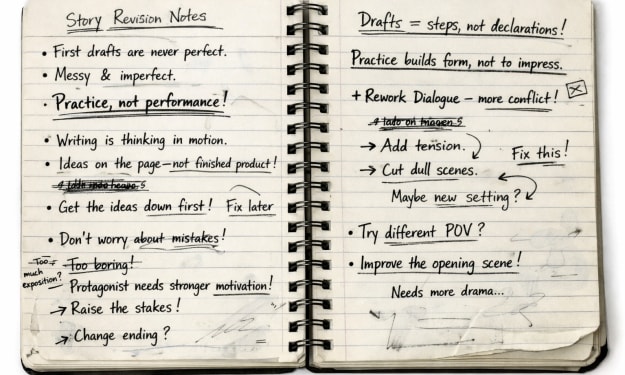
One of the quiet pressures shaping modern communication is the assumption that anything written should be immediately shareable. Drafts blur into declarations, and exploration is mistaken for conclusion. Under this pressure, writing becomes performative by default. The moment words are placed on a page, they are treated as finished statements rather than steps in a process. This expectation distorts both how writing is produced and how it is received, collapsing practice into performance and leaving little room for genuine development.
By Peter Thwing - Host of the FST Podcastabout a month ago in Critique