Childhood
Word of the Day: 冷戦
Yea, needless to say, from my previous story about Ghosts and Gods, the fact I live near a fucking airplane museum is actually very disturbing for me when... the Ether becomes turbulent.. I have been pinged by those graves before. Also I had a dream about an air raid recently so... I don't think that was me necessarily predicting anything, it might've been residual energy from those machines.
By Kayla McIntosh3 days ago in Confessions
Icons: Between Belief and Doubt-Part 9
God does not “create” the Ten Commandments in Exodus. He proclaims them solemnly so that the people recognise them, not hear them for the first time. They are not only a covenant with Israel but a calling for all humanity. There is profound truth in what the human conscience naturally senses — and the Decalogue comes to confirm, clarify, and consecrate what was already planted in humanity from the beginning.
By CA'DE LUCE3 days ago in Confessions
Icons: Between Belief and Doubt-Part 9
The apostles as saints… ‘Built on the foundation of the apostles and prophets…’ (Ephesians 2:20). Yes! In the Old Testament, holiness comes from God’s choice and ritual consecration. In the New Testament, holiness becomes accessible to all believers through grace and life in Christ. It shifts from an external status to an inner transformation.
By CA'DE LUCE3 days ago in Confessions
Icons: Between Belief and Doubt-Part 8
If someone sees Christ as the only point of contact, then any other form of mediation feels unnecessary or even wrong. If someone sees the Church as a single living body that includes both the living and the departed, then asking for intercession feels natural.
By CA'DE LUCE3 days ago in Confessions
Icons: Between Belief and Doubt-Part 7
So does the Liturgy and the Eucharist exist only among Catholics and Orthodox? Not only! 😊 The Liturgy and the Eucharist are central in Orthodoxy and Catholicism, but forms of celebrating the Lord’s Supper also exist in other branches of Christianity — only the way they are understood and practiced differs. ✝️ Where are the Liturgy and the Eucharist found? Christian branch: Orthodox — complete Liturgy with real Eucharist (Body and Blood). Catholic — complete Liturgy with sacramental transubstantiation.
By CA'DE LUCE3 days ago in Confessions
Icons: Between Belief and Doubt-Part 6
During the Liturgy, the bread and wine are consecrated and become, in the Orthodox and Catholic faith, the Body and Blood of Christ — not symbolically, but really, mystically. What does the Eucharist signify? It is the bloodless sacrifice of Christ, repeated liturgically but unique in essence. It is the nourishment of the soul, which unites us with Christ and with the other members of the Church — His mystical Body. It is the source and summit of spiritual life: all the other Mysteries lead toward the Eucharist.
By CA'DE LUCE3 days ago in Confessions
Icons: Between Belief and Doubt
The origin and theological justification is based on the idea that God became incarnate in Christ, therefore He can be represented visually. Saint Paul says in Colossians 1:15 that Christ is ‘the image of the invisible God.’ In the Old Testament, God Himself commands the making of sacred images, such as the cherubim on the Ark of the Covenant (Exodus 25:18).
By CA'DE LUCE3 days ago in Confessions
Icons: Between Belief and Doubt
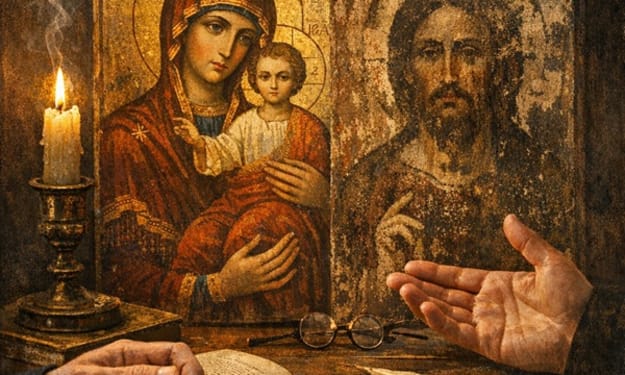
For example, in Orthodox icons the Mother of God is shown with a solemn, elongated face and three symbolic stars representing her virginity before, during, and after the birth of Christ. In Western paintings she may appear with sensual features and loose hair, reflecting a different artistic and theological approach.
By CA'DE LUCE3 days ago in Confessions